


















The sacred festival of Raksha Bandhan will be celebrated across the country on Friday, August 28, 2026. As the festival approaches each year, curiosity grows among people regarding the ancient traditions, legends, and historical origins associated with this auspicious day. One of the most prominent questions searched online is how the practice of tying Rakhi actually began and who tied the very first protective thread in history. According to ancient scriptures and mythological traditions, this sacred festival did not originate on Earth, but in the Netherworld, known as Patal Lok.
The Ancient Mythological Legend of Raksha Bandhan
According to sacred belief and details recorded in the Shrimad Bhagavat Purana, the festival of Raksha Bandhan was initiated by Mata Lakshmi herself. The Goddess tied the first protective thread on the wrist of King Bali due to a unique and extraordinary promise. As described in the Shrimad Bhagavat Purana, King Bali was a highly powerful, virtuous, and charitable demon king. Through his severe penance and formidable prowess, he established absolute control over all three worlds. Fearing the rising influence of King Bali and his dominion over the universe, Lord Indra and other deities became deeply alarmed. Seeking to protect heaven and their divine status, the gods approached Lord Vishnu for assistance.
The Vaman Incarnation, Three Paces of Land, and King Bali's Sacrifice
Responding to the prayers of the deities, Lord Vishnu took the Vaman avatar, assuming the form of a young Brahmin dwarf. He arrived at the grand sacrificial ceremony organized by King Bali. The generous King Bali welcomed young Vaman Dev with great honor and requested him to ask for any gift or donation he desired. Vaman Dev asked for merely three paces of land. Despite warnings from his guru Sukracharya, King Bali stood firm on his word and granted the request.
Upon receiving the pledge, Lord Vishnu expanded his form into a cosmic manifestation. In just two paces, he measured the entire Earth, sky, and heaven. When no space remained for the third step, King Bali offered his own head at the feet of Vaman Dev, asking him to place his third step there. Deeply impressed by King Bali's unyielding devotion, truthfulness, and supreme generosity, Lord Vishnu granted him rulership over Patal Lok. Furthermore, Lord Vishnu asked King Bali to request a boon of his choice.
Lord Vishnu Becomes the Gatekeeper of Patal Lok
In response to Lord Vishnu's offer, King Bali made an unusual request. He asked that whenever he woke up in the morning or went to sleep at night, he should always be able to behold Lord Vishnu. He requested the Lord to reside at the entrance of Patal Lok as his personal gatekeeper. Bound by his devotee's sincere request, Lord Vishnu left his divine abode of Vaikuntha Dham and moved to Patal Lok, taking up the role of King Bali's gatekeeper.
Mata Lakshmi's Strategy and the Sacred Thread Tied on Shravan Purnima
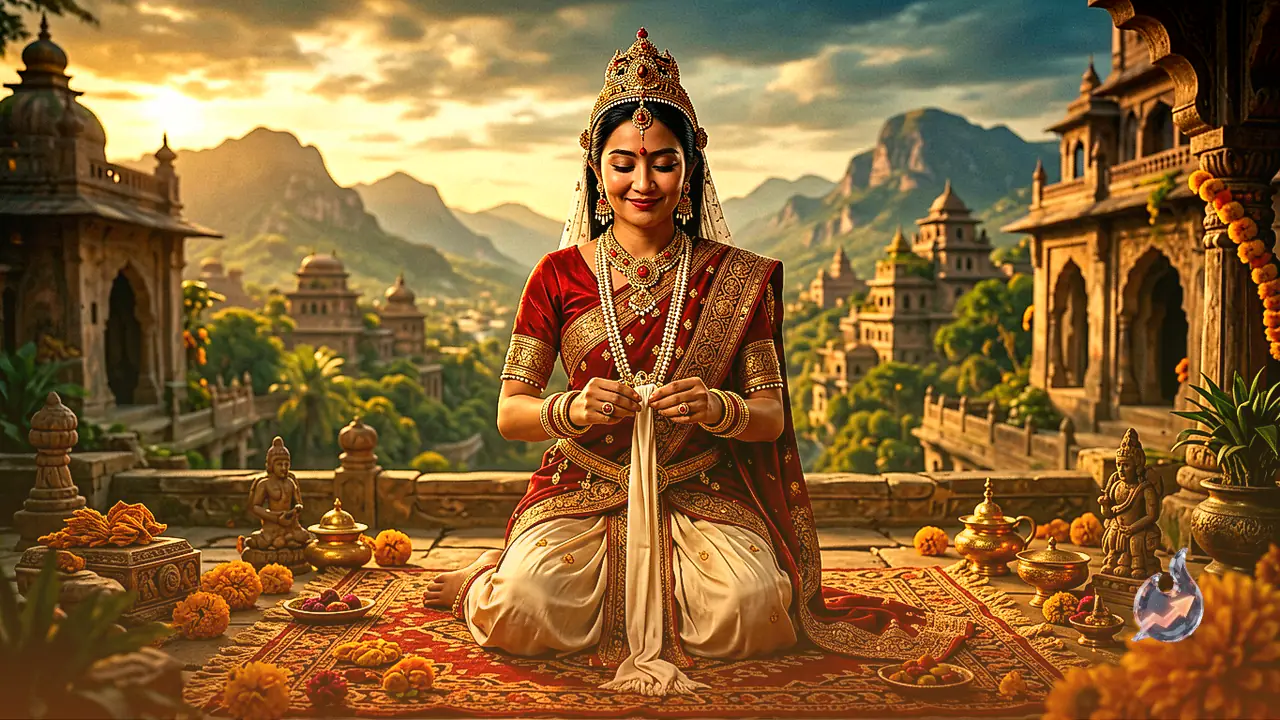
With Lord Vishnu absent from Vaikuntha Dham, the divine realm felt empty, leaving Mata Lakshmi in deep sorrow. To bring her husband back, Mata Lakshmi devised a clever plan. Disguising herself as an ordinary woman, she traveled to Patal Lok and accepted King Bali as her brother. On the auspicious day of Shravan Purnima, Mata Lakshmi tied a sacred protective thread around King Bali's wrist and prayed for his long, prosperous, and happy life.
Touched by the immense affection shown by an unknown woman, King Bali's heart filled with warmth and compassion. He asked his newly adopted sister to demand any gift she desired. At that moment, Mata Lakshmi revealed her true divine identity and requested the release of her husband, stating that she sought no worldly wealth but only the return of Lord Vishnu to Vaikuntha.
Fulfilling the Pledge and Establishing the Tradition of Rakhi
Honoring the sacred bond of the thread tied by Mata Lakshmi, King Bali immediately released Lord Vishnu from his promise that held him as a gatekeeper. Mata Lakshmi then returned to Vaikuntha Dham alongside Lord Vishnu. According to mythological tradition, this historic event on Shravan Purnima marked the origin of Raksha Bandhan, establishing the enduring tradition where sisters tie protective threads on their brothers' wrists.