























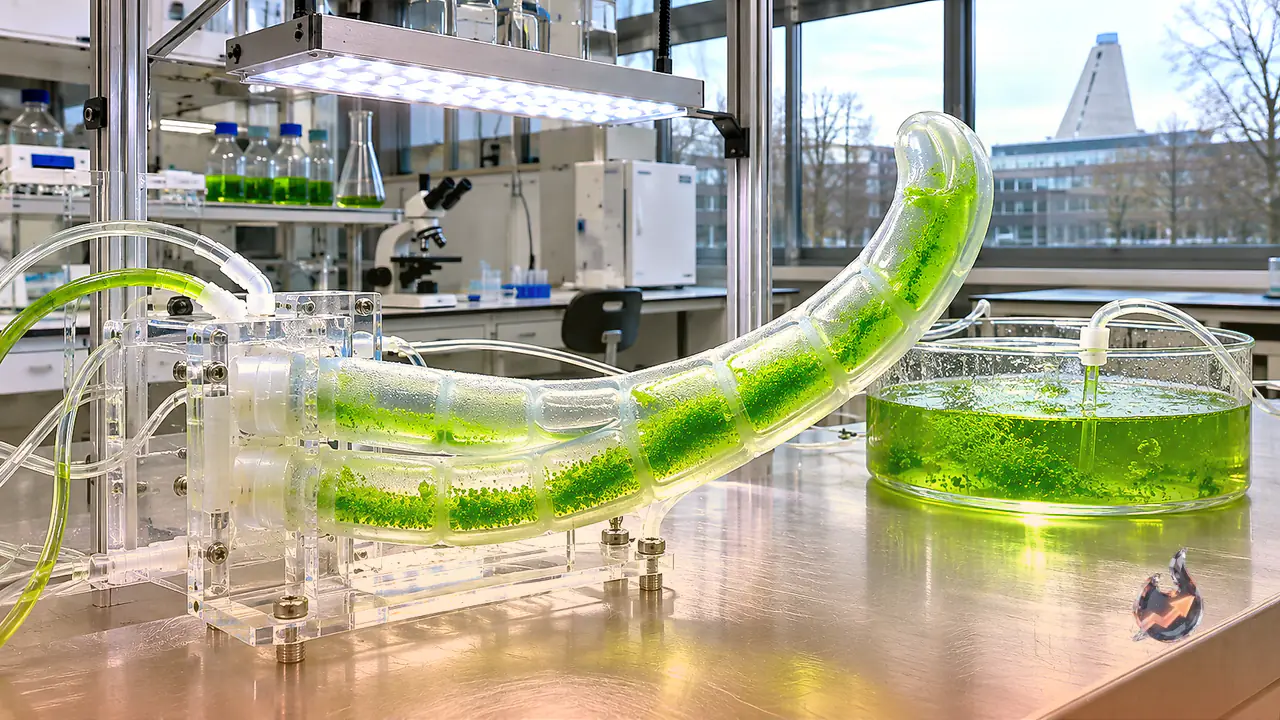

Moving away from the traditional metal and wire constructs of stereotypical machines, researchers have developed flexible instruments known as soft actuators. These devices convert energy such as electricity, heat, or light into mechanical motion while lacking any rigid framework. Much like a human bicep, they can flex and possess a fine-tuned sense of touch comparable to a human hand. Among these innovations, a category called bioactuators utilizes living cells to generate motion, drawing significant research attention in recent years.
Addressing this frontier, a research team at Delft University of Technology in the Netherlands has constructed a soft robotic arm with its surface colonized by algae. When these microbes undergo photosynthesis, the mechanical arm bends in response. The primary objective has been advancing living materials research to new tiers. Marie-Eve Aubin-Tam, who led the research, explained that the team did not start with a specific application in mind, but rather wanted to explore the possibilities that emerge when living cells are integrated directly into functional materials.
Constructed from two layers of hydrogel that support algal colonies, these diminutive robot arms measure roughly three-quarters of an inch long and match the thickness of a credit card. One of the hydrogel layers reacts to pH fluctuations mediated by algal metabolism. When light strikes the algae, photosynthesis initiates. By absorbing carbon dioxide and fixing nitrogen during this biological cycle, the algae shift the local pH to a more basic state, causing the responsive hydrogel layer to swell. Conversely, when darkness falls, respiration releases carbon dioxide, returning the pH to acidic levels and shrinking the hydrogel.
Bending is controlled entirely by the volume differential between the two hydrogel layers. According to the research team, the pH-responsive layer changed significantly alongside algal activity. Under acidic conditions, specifically between pH 3 and 7, the layer measured approximately 37 percent of its original weight, but swelled to quadruple its original weight at pH 11. While other scientists have engineered pH-responsive soft robots, those designs typically require altering the chemistry of all surrounding liquid. The algal bots bypass this limitation.
The photosynthetic activity exerts a highly localized effect, rendering the technology well-suited for applications where minimal environmental disruption is critical. However, these robots do not operate at high speeds. While the chemical shift begins promptly—roughly 20 seconds after light exposure and about 10 seconds after darkness sets in—the actual bending of the hydrogel takes several hours to complete.
Following their initial proof of concept, the team built additional algal devices. One notable prototype was a four-fingered gripper that closes when exposed to light, successfully grasping and lifting a hollow metal sphere before releasing it when the light was deactivated. Another hook-shaped gripper demonstrated the ability to pick up and place a rubber ring. Although these objects were extremely lightweight and weighed far less than a small paperclip, the robotic arms handled them with remarkable dexterity.
These soft robots demand no external energy sources beyond light and operate without complex mechanical components. Aubin-Tam noted that microalgae are plantlike organisms that remain largely self-sustaining, granting the actuator potential for long-term operation with minimal external input. Theoretically, running a system based on this technology requires very little energy.
Looking ahead, the research team hopes to contribute to the creation of autonomous, environment-responsive soft robots suitable for automated agricultural equipment, fluid control inside lab-on-a-chip devices, or general underwater robotics. Because the algae do not require genetic modification, the technology avoids the biosafety concerns often linked to microbe-based systems. These machines offer an exceptionally eco-friendly profile, simultaneously absorbing atmospheric carbon dioxide while deriving energy from sunlight.