



















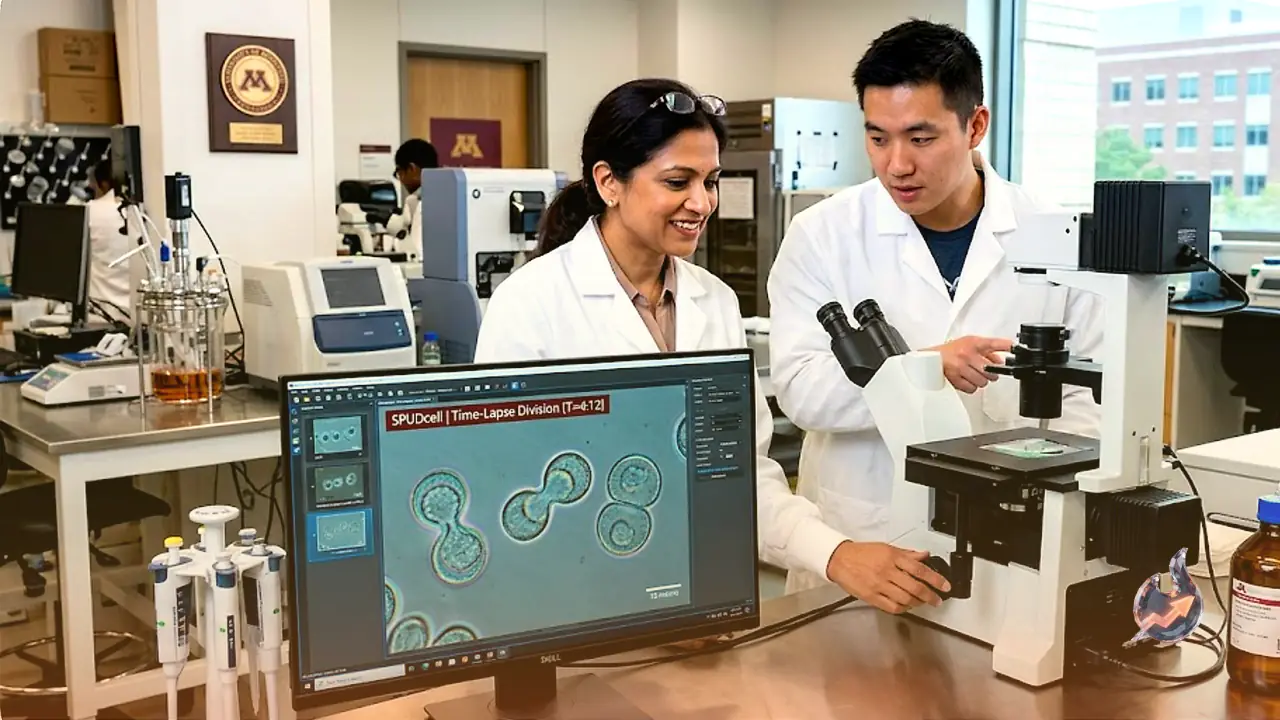

Can humans ever build a living cell entirely inside a laboratory? Scientists have chased that question for decades, and researchers at the University of Minnesota in the United States now say they have taken a major step forward. Their team has built an artificial cell that can take in food to grow and can divide itself into two to increase its own numbers. The creation has been named SPUDcell. The scientists are careful to say it is not yet a fully living cell in the strict sense, but it displays several important life like traits, which is why the work is being seen as a major milestone in biological engineering.
If the technology matures further in the coming years, it could eventually make it possible to build living cells on demand, develop new kinds of medicines, improve treatment of diseases and design purpose built living micromachines. Scientists believe this achievement could, over time, reshape the direction of medicine, biotechnology and scientific research more broadly.
What exactly is SPUDcell
SPUDcell is a synthetic, meaning artificial, cell that scientists assembled in the lab by joining together different biological components. The goal behind building it was to create a system that behaves like a natural cell and can carry out the basic processes of life. The cell grows by taking in food and later splits itself into two parts, producing new cells in the process.
Why it is not being called fully alive yet
According to the scientists, SPUDcell cannot currently be described as a complete living cell. It needs a constant external supply of nutrients and ribosomes. Ribosomes are the tiny structures inside a cell responsible for building proteins. Beyond that, SPUDcell still lacks a strong system for removing waste and does not yet have the ability to protect itself from threats. In short, it cannot survive on its own for long stretches of time at this stage.
Why this discovery is being called so significant
Until now, the widely held view in the scientific community was that all the processes of life could only occur inside natural cells. This research shows that many of life's basic functions can be replicated at a purely chemical level as well. Scientists say this proves that processes like a cell growing and multiplying do not require some mysterious life force, and can be achieved through the rules of chemistry itself.
How its division differs from ordinary cells
Normal cells contain a specific internal framework called the cytoskeleton, which helps the cell divide. SPUDcell has no such framework at all. In its place, scientists used proteins that accumulate on the outer layer of the cell and generate pressure. That pressure eventually splits the cell into two parts, giving rise to a new cell.
A single gene change produced faster growth
During the research, scientists altered a gene inside the cell, which caused a particular fusion protein to be produced in greater amounts. As a result, the cells began growing faster than before and produced a larger number of new cells. After five generations, this modified version turned out to be far more successful than the original cells.
How different SPUDcell is from a natural cell
A human cell's genome runs to roughly 30 lakh kilobase pairs, while SPUDcell's genome is only around 90 thousand base pairs. Another key difference is that its DNA is not held in a single chromosome but is spread across seven separate plasmids. This separation allows scientists to program different biological functions independently, based on what is needed.
What benefits could this bring in the future
If the technology is refined further, it could eventually allow scientists to build specialised cells tailored to a patient's specific needs. This could help with testing new drugs, treating rare diseases, repairing damaged tissue and even environmental cleanup. Scientists also believe that, in time, living micromachines could be developed that travel inside the body and work directly at the exact site of a disease.
A long road still lies ahead
As significant as this achievement is, scientists are equally clear that a long journey remains. SPUDcell still cannot survive entirely on its own. It still needs to develop the ability to generate its own energy, protect itself, and expel waste. Reaching that point will require sustained, collaborative work from scientists around the world over an extended period.