























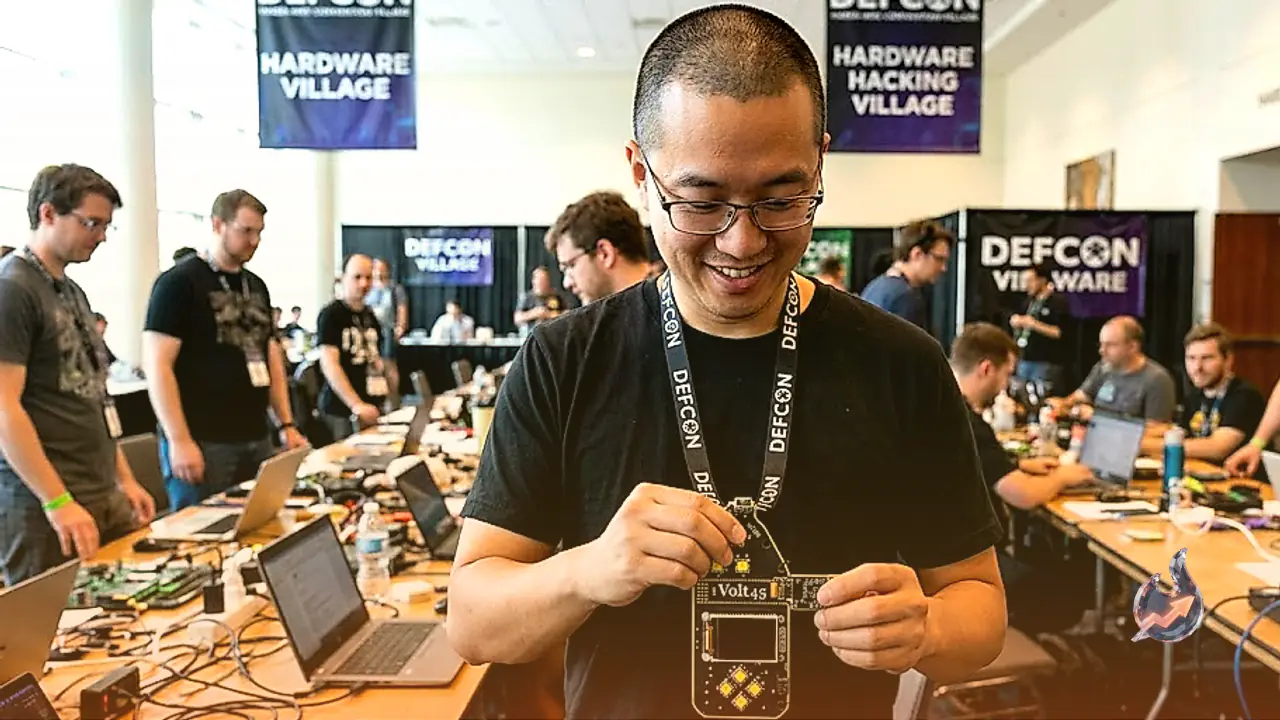

It has long been an iconic tradition of the annual Defcon hacker conference that attendees depart not only with insights into software vulnerabilities and cybersecurity techniques, but also with an elaborately engineered electronic conference badge. These custom hardware badges frequently feature complex cryptographic puzzles, hidden Easter eggs, interactive logic challenges, and even mechanical gear assemblies. Each year, badge designers attempt to outdo prior iterations to captivate the hacker community. However, this year's badge implementation adopts a fundamentally different philosophy. Rather than focusing solely on artistic exterior aesthetics, the highlight of the design resides deep within the silicon architecture itself.
A Paradigm Shift in Hacker Conference Hardware
For the current conference, Defcon organizers invited renowned hardware engineer Andrew "bunnie" Huang to architect the official badges. Revealed for the first time, these credentials integrate a novel open-source microcontroller designed to advance transparency, hardware security, and verifiable trust in computing. Beyond serving as an event credential, the badge features a removable core module. Once the conference concludes, attendees can detach this module and utilize it as a standalone, inspectable hardware security token, extending its operational lifecycle well beyond the event.
The Architecture of Total Transparency: Inside the Baochip-1x
Designated as the Baochip-1x, the microcontroller represents the culmination of a three-year engineering effort to realize Huang's vision of physically verifiable silicon security. Huang has published the complete source code for the chip's operating system, firmware, processor cores, cryptographic engines, and input-output systems on GitHub, allowing researchers globally to audit and build upon the design.
Conventional integrated circuits function as opaque black boxes encased in impermeable plastic, concealing their internal physical logic. Even previous open-source chips wrapped in standard plastic packages required users to trust that manufacturing facilities did not introduce supply-chain modifications or hardware backdoors. To solve this supply-chain verification bottleneck, the Baochip-1x is packaged to allow infrared light to penetrate the rear of the silicon die. Researchers can illuminate the silicon under infrared light to visually inspect memory arrays and logic gates, comparing physical structures directly against published architectural schematics.
Overcoming the Multimillion-Dollar Silicon Fabrication Barrier
Manufacturing a custom integrated circuit typically requires millions of dollars in fabrication setup expenses. Huang bypassed this financial hurdle three years ago when technology firm Crossbar sought his expertise to develop a secure open-source processor. Huang agreed to collaborate on the condition that he could piggyback on Crossbar's manufacturing run by placing his own CPU core onto their silicon wafer. This shared wafer execution enabled both processor designs to be fabricated simultaneously within a single production run without requiring separate capital funding.
The joint production produced a composite die containing both Crossbar's processor and Huang's design. The Baochip-1x distributed at the conference utilizes this combined die with the proprietary Crossbar processor permanently disabled. While the Crossbar variant relies on a proprietary ARM architecture, Huang's implementation utilizes an open-source RISC-V instruction set architecture (ISA). Both versions leverage shared underlying power and peripheral buses while executing on distinct CPU cores. Although low-level physical design files tied to TSMC's 22-nanometer fabrication process remain proprietary, the chip achieves an unprecedented level of openness compared to commercial security silicon.
From Development Prototype to 27,000 Defcon Badges
Historically, conference badges relied on commercial off-the-shelf microcontrollers rather than custom silicon. The decision to adopt the Baochip-1x emerged following discussions late last year between Huang and Defcon founder Jeff Moss regarding the upcoming commercial release of the chip through Huang's venture, Baochip.
Moss recognized that the chip aligned with the conference theme of agency, defined by Defcon as technologies and choices that foster self-determination. The conference provided an ideal platform to bootstrap adoption. Previously limited to small developer runs, the deployment of 27,000 badges at Defcon marks the first wide-scale distribution of the Baochip-1x platform. Moss required that the badges retain utility after the event rather than accumulating in landfills. Having long expressed skepticism regarding vulnerable hardware tokens and crypto wallets, Moss envisioned the inspectable chip as a robust alternative for hardware authentication.
Post-Conference Utility: A Verifiable FIDO Security Key
The detachable badge module functions post-event as a FIDO hardware authentication token. Its software stack supports time-based one-time password (TOTP) generation and password management features. Huang describes the device as the world's first open-source security token capable of full physical and logical inspection down to the bootloader and physical transistors.
To facilitate authentication registration, the module includes an integrated camera designed for scanning QR codes. However, in compliance with Defcon privacy guidelines and anti-surveillance policies, the camera features low-resolution, fixed-focus optics. The firmware restricts data processing strictly to black-and-white pixel information and omits image storage capabilities entirely, rendering the camera effective for QR code capture while preventing unintended photography.
For conference interaction, the badges incorporate customizable LED lighting arrays. Different color schemes and flashing sequences distinguish general attendees, speakers, volunteers, and VIP Uber badge holders. Badges communicating via proximity protocols can exchange data to unlock expanded color palettes and dynamic flashing sequences.
Silicon Hardening, RRAM Memory, and Realistic Defense Boundaries
The Baochip-1x runs an operating system implemented in Rust, featuring secure boot mechanisms, a true random number generator (TRNG), and hardware countermeasures against non-physical remote exploitation. For non-volatile storage, the chip incorporates resistive RAM (RRAM) instead of traditional flash memory. Unlike flash memory, where physical delayering allows data states to be visually read under microscopy, RRAM alters physical resistance states, making physical data extraction significantly more difficult.
Huang maintains a pragmatic assessment regarding the chip's security boundary, estimating that it can withstand physical attack attempts costing tens of thousands of dollars in analysis equipment. While well-funded adversaries with multimillion-dollar laboratories could potentially defeat its protections, Huang emphasizes that launching at Defcon subjects the hardware to immediate stress-testing, allowing community-discovered zero-day vulnerabilities to inform future security hardening.
Technical Specifications and the Roadmap to Linux
The hardware architecture centers on a 350 MHz RISC-V main processor paired with 2 megabytes of static RAM (SRAM) and 4 megabytes of resistive RAM (RRAM). Four auxiliary 700 MHz PicoRV32 cores manage input-output operations. The platform supports MicroPython alongside C and Rust development kits. While currently serving as a YubiKey-equivalent security token, the processing headroom positions the hardware near the threshold required to execute Linux or operate as a Hardware Security Module (HSM) in future firmware revisions.