





















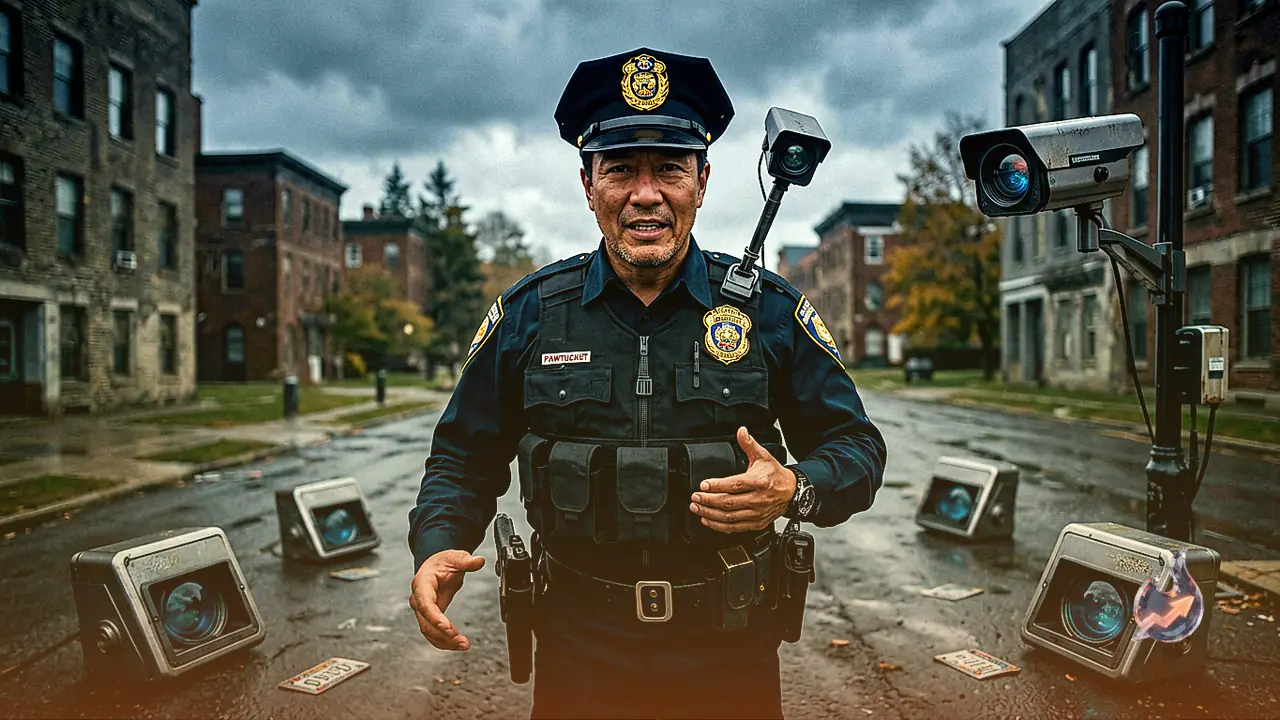

On an autumn afternoon in 2023, while patrolling his district in Pawtucket, Rhode Island police officer Noel Pichardo spotted an unfamiliar camera mounted on a utility pole above West Avenue. At 28 years old and five years into his career, he was alone in his cruiser during a routine lull in radio calls. Curious about the compact, solar-powered device angled toward the road, he made a U-turn and drove past it again at a slower speed. Soon afterward, he began noticing identical cameras deployed near highway access points, busy intersections, and major thoroughfares throughout the city.
These cameras formed a component of a massive vehicle-surveillance network managed by Flock. The company promotes its platform as the largest fixed license-plate-reader network in the United States, logging billions of vehicle sightings every month and allowing law enforcement agencies across different jurisdictions to share and search recorded data. In 2021, Pawtucket police participated in a sixty-day pilot program that installed seventeen cameras across the city alongside neighboring municipalities. The rollout faced immediate criticism from the American Civil Liberties Union of Rhode Island because it proceeded without prior public notice or city council approval, prompting an apology from police chief Tina Goncalves regarding communication gaps.
Although local news reports indicated that the city would not pursue the project after the initial test concluded, public records later showed that Pawtucket advanced a two-year deployment worth $128,000 in September 2023. The plan involved placing twenty cameras along high-traffic routes such as Newport Avenue, Main Street, and West Avenue. Discovering that the surveillance system had returned without public debate prompted Pichardo to question how the decision was made.
Pichardo brought a unique background to his role as a police officer. After studying criminal justice at Salve Regina University, he joined the Pawtucket department in 2018. When he inquired with local representatives about how the camera deployment was authorized, he learned that officials considered the installation an administrative prerogative that did not require a public vote. Uncomfortable with the idea that ordinary citizens' daily movements were being systematically recorded without public scrutiny, he ultimately decided to contact a reporter at the local newspaper, the Valley Breeze.
The article published in October 2023 featured Pichardo openly criticizing the surveillance system as a grave threat to privacy that lacked sufficient oversight. While many fellow officers privately congratulated him for taking a stand, department leadership reacted with immediate displeasure. Within weeks, the Pawtucket police department initiated internal investigations into his conduct, citing unauthorized communication with the media and potential damage to the agency's reputation.
Following union consultations, Pichardo accepted a thirty-day unpaid suspension to resolve the initial disciplinary matter and avoid prolonged conflict. However, the department initiated subsequent inquiries into unrelated matters, including a missed court appearance and an unproven complaint regarding a mental health call. Despite the mounting pressure, Pichardo testified before the Rhode Island House Judiciary Committee in April 2024, arguing that automated license plate readers raised serious constitutional concerns and lacked adequate guardrails against misuse.
The Rhode Island Police Chiefs Association strongly condemned his testimony in an official letter, characterizing his statements as inaccurate and misleading. Tensions within the department continued to escalate when a delivery driver filed a complaint following a minor dispute in May 2024. Reviewing recordings of the interaction, internal investigators sustained multiple allegations against Pichardo, resulting in a forty-day unpaid suspension and his removal from the detective eligibility list, a penalty that coincided with the birth of his second child.
By early 2025, Pichardo felt heavily isolated within the department as additional disciplinary actions accumulated. Following a dispute over a stranded vehicle and another call involving a family dispute, investigators conducted a detailed review of his daily activities using GPS data and body-camera logs, ultimately recommending his termination in July 2025. Rather than pursue a prolonged administrative battle, Pichardo chose to resign after seven years of service, turning in his badge and equipment.
Following his departure, Pichardo faced employment difficulties within law enforcement and eventually secured work as a caregiver. Seeking to share his perspective on automated surveillance, he recorded a video with a friend that unexpectedly attracted widespread attention online. His public stance propelled him into national media appearances and interviews, placing him at the center of a growing nationwide debate over automated license plate readers and individual privacy rights.