



















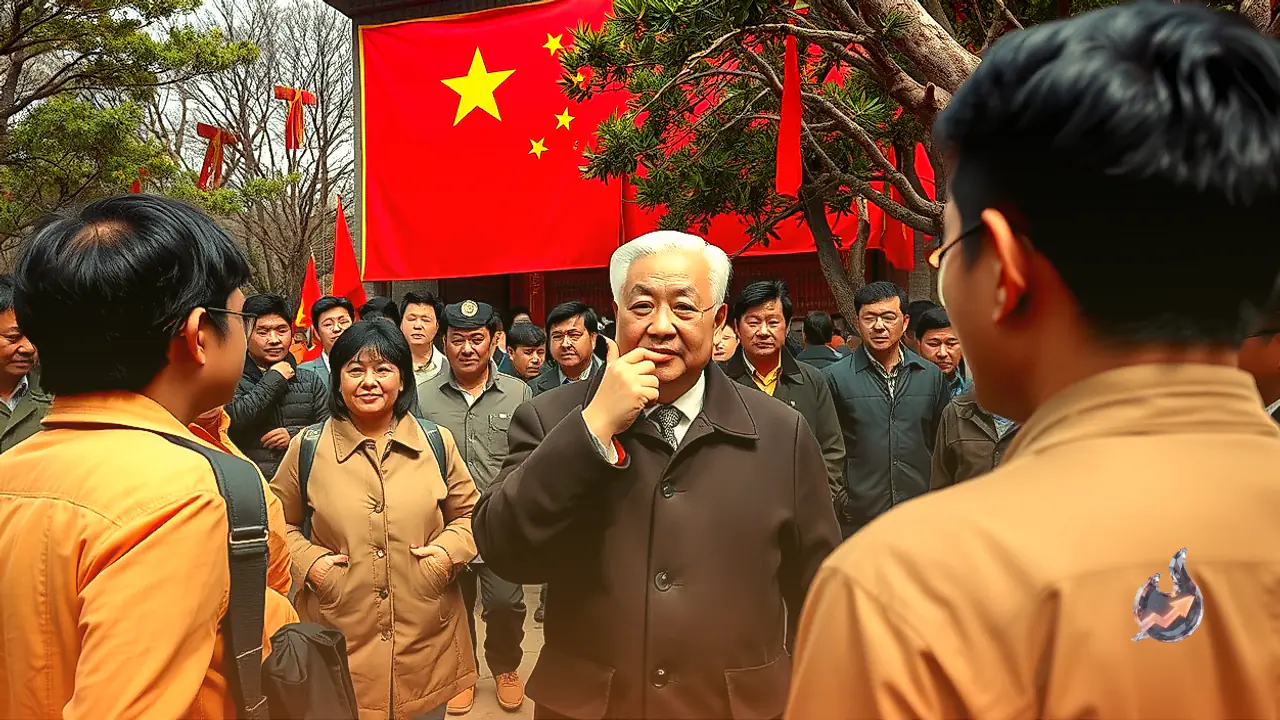

Chinese President Xi Jinping has delivered an uncompromising warning to cadres and ranking figures within the ruling Communist Party, declaring that individuals entangled in corrupt practices will face decisive expulsion from the political architecture. Newly disclosed excerpts of his address, published in the party's authoritative theoretical journal Qiushi, underscore an uncompromising governance posture. Xi indicated that whenever institutional integrity demands it, the party will not hesitate to pull out compromised figures by their roots. This forceful declaration surfaces just as the party's highest echelons prepare for a high-stakes strategic summit scheduled for the end of the month in Beijing.
Metaphor of Stricken Trees for Institutional Renewal
Framing the anti-graft campaign as an existential confrontation, Xi asserted that this institutional contest leaves absolutely no room for failure. In his remarks, he described the anti-corruption drive as a monumental struggle that the leadership cannot afford to lose and must never lose. He cautioned against complacency, stating that the oversight machinery cannot pause even for a fleeting moment or retreat by so much as half a step. The leadership must remain resolute in chopping down and uprooting diseased and decayed growth whenever necessary.
Xi drew upon a classical Chinese poetic allusion to explain the philosophical rationale behind this sweeping administrative purge. The metaphor suggests that only by eliminating rotting and ailing timber can healthy forestry flourish and room be cleared for vibrant, sustainable growth. Through this vivid imagery, Xi reinforced his commitment to sustaining aggressive corrective actions across all strata of the party apparatus. He characterized corruption as the most perilous risk, the gravest threat, and the most pressing operational challenge confronting the Communist Party, warning that unchecked malfeasance undermines national stability and hinders economic momentum.
Targeting Senior Leaders and Emerging Cadres
Reflecting on the domestic landscape, Xi acknowledged that illicit practices remain pervasive across multiple layers of the bureaucracy and display a persistent tendency to resurface. He characterized the anti-corruption terrain as profoundly grave and intricate, requiring relentless vigilance. Consequently, he instructed disciplinary inspectors to intensify inquiries directed at primary regional leaders, emerging younger officials, and administrative appointees occupying sensitive bureaucratic nodes.
This heightened focus aligns with extensive personnel reorganizations occurring across numerous provinces. China has accelerated its bureaucratic transition cycles, with Beijing appointing fresh top-ranked party chiefs and secondary governors across six distinct provinces since September alone. During such critical transitional junctures, the political loyalty, ethical record, and future prospects of both senior officials and rising cadres are subjected to intense screening by internal party auditors.
Crucial Central Committee Conclave on the Horizon
The newly published excerpts originate from a speech delivered by Xi during the fifth plenary gathering of the Central Commission for Discipline Inspection (CCDI), held earlier in January. The CCDI serves as the party's highest and most feared disciplinary and anti-graft supervisory authority. The decision to release these specific passages less than a fortnight prior to the fifth plenary session of the 20th Central Committee, set to convene in Beijing from October 26 to October 29, points toward imminent structural maneuvers.
Political observers anticipate that the upcoming four-day Central Committee session could introduce groundbreaking regulatory revisions. A comprehensive policy instrument aimed at reinforcing inner-party governance, structural integrity, and ideological discipline is anticipated to be submitted and formally ratified. Deliberations are expected to prioritize dismantling the structural roots of corruption, fortifying political oversight over administrative machinery, and sealing institutional loopholes within state-run departments.
Intensifying Focus on Central Committee Figures
The sweeping scope of the anti-corruption crackdown has already left a profound imprint on China's ruling elite. Out of the 205 full members serving on the prestigious 20th Central Committee, as many as 34 individuals are currently entangled in formal disciplinary investigations or have already been stripped of their seats within the National People's Congress, the nation's top legislative body. This tally highlights that senior standing offers little insulation from scrutiny.
Further emphasizing this far-reaching net, the CCDI recently announced an official corruption investigation into Huang Qifan, the former mayor of Chongqing. Although Huang concluded his tenure in office eight years ago, he remained an influential figure across Chinese macroeconomic policy debates and administrative circles. His formal investigation signals that the disciplinary apparatus is not confining its investigations solely to incumbent post-holders, but is actively examining historic financial and political dealings of long-retired regional powerbrokers.
Reprimand Against Bureaucratic Slacking and Recklessness
Beyond active malfeasance, Xi voiced deep frustration regarding bureaucratic behavior during transitional phases. He observed a recurring tendency where certain officials approaching departure neglect their official obligations, succumbing to administrative lethargy. Conversely, newly appointed figures frequently rush into hasty initiatives in an ill-advised bid to generate immediate visible achievements without adhering to rigorous planning.
Xi stressed the vital need to curb both behavioral extremes, demanding stringent performance accountability throughout the administrative pipeline. The directive emphasized that coasting toward the end of a political assignment is just as unacceptable as impulsively pushing unvetted ventures upon entering office. Disciplinary supervisors have been instructed to monitor operational consistency, ensuring governance remains steady regardless of personnel adjustments.
Leveraging Big Data and Artificial Intelligence in Oversight
To modernize the disciplinary toolkit against sophisticated misconduct, Xi championed the deeper integration of cutting-edge technological infrastructure into supervision. He advocated deploying big data analytics, automated data tracking, and artificial intelligence frameworks across investigative, disciplinary, and regulatory procedures. Integrating these advanced mechanisms is intended to elevate transparency, detect irregular financial trails, and boost enforcement precision.
Nevertheless, Xi introduced an explicit cautionary caveat regarding the deployment of digital surveillance tools. He stressed that technological adoption must be governed by strict ethical guidelines and statutory data security protocols. Every deployment of advanced algorithmic surveillance must operate strictly within the boundaries of party discipline and sovereign legal statutes, ensuring that modern investigative practices do not outpace institutional oversight and procedural safeguards.