























Commercial navigation is on the verge of a historic leap as aerospace startup Xona Space Systems prepares to launch six specialized satellites into orbit later this month. Designed to operate as a high-precision alternative to legacy GPS infrastructure, the deployment marks the beginning of the first commercial constellation focused on resolving structural weaknesses that have plagued government-run satellite positioning networks for decades. While conventional GPS offers positioning accurate within several meters, Xona aims to narrow that margin down to individual centimeters.
From Stanford Graduate Discussions To A Massive Hardware Market
The venture originated in 2019 when five aerospace engineering graduate students crossed paths at Stanford University. Among them was Tyler Reid, who later completed his PhD after authoring an academic thesis on utilizing low-Earth orbit satellites to dramatically upgrade navigation accuracy. Over casual chats with pizza and beer, the group of engineers began debating whether addressing the vulnerabilities and precision gaps of modern satellite positioning could form the foundation of a viable commercial business.
The concept was initially met with internal skepticism. Brian Manning, Chief Executive Officer of Xona, recalled his immediate reaction as feeling the proposition sounded unwise, given that GPS is universally perceived as a free public utility. However, a deeper examination of the ecosystem revealed a fundamentally different commercial reality. The true market does not lie in broadcasting a signal; rather, it revolves around the hardware itself. Billions of tracking and navigation devices are manufactured and purchased annually across the globe, none of which are given away without cost. Across industries, a vast market exists that is urgently seeking enhanced performance and reliability.
Overcoming Technical Bottlenecks And Infrastructure Challenges
Although the United States GPS along with comparable networks operated by Europe, China, and Russia deliver immense global utility, they remain prone to signal jamming and spoofing interference. Furthermore, their resolution lacks the pinpoint accuracy required for independent deployment in fully autonomous farming robotics or driverless passenger vehicles.
Engineering a dependable, high-power signal capable of delivering ultra-precise location and timing data posed major design hurdles. Standard navigation satellites rely on costly, specialized atomic clocks installed onboard to keep synchronized time. To bypass this requirement, Xona engineered a proprietary architecture that removes the need for bulky spaceborne atomic clocks altogether. Instead, its satellites capitalize on their close proximity to Earth and continuous communication links with authoritative ground-based reference points to maintain precise synchronization.
Seamless Hardware Compatibility And The Pulsar Constellation
In addition to time synchronization, the engineering team tackled another pivotal barrier: backward compatibility. The company ensured that conventional GPS receivers can capture Xona transmissions through a straightforward software patch. This software-driven approach grants the startup direct access to the existing receiver market while drastically simplifying regulatory hurdles associated with broadcasting positioning frequencies.
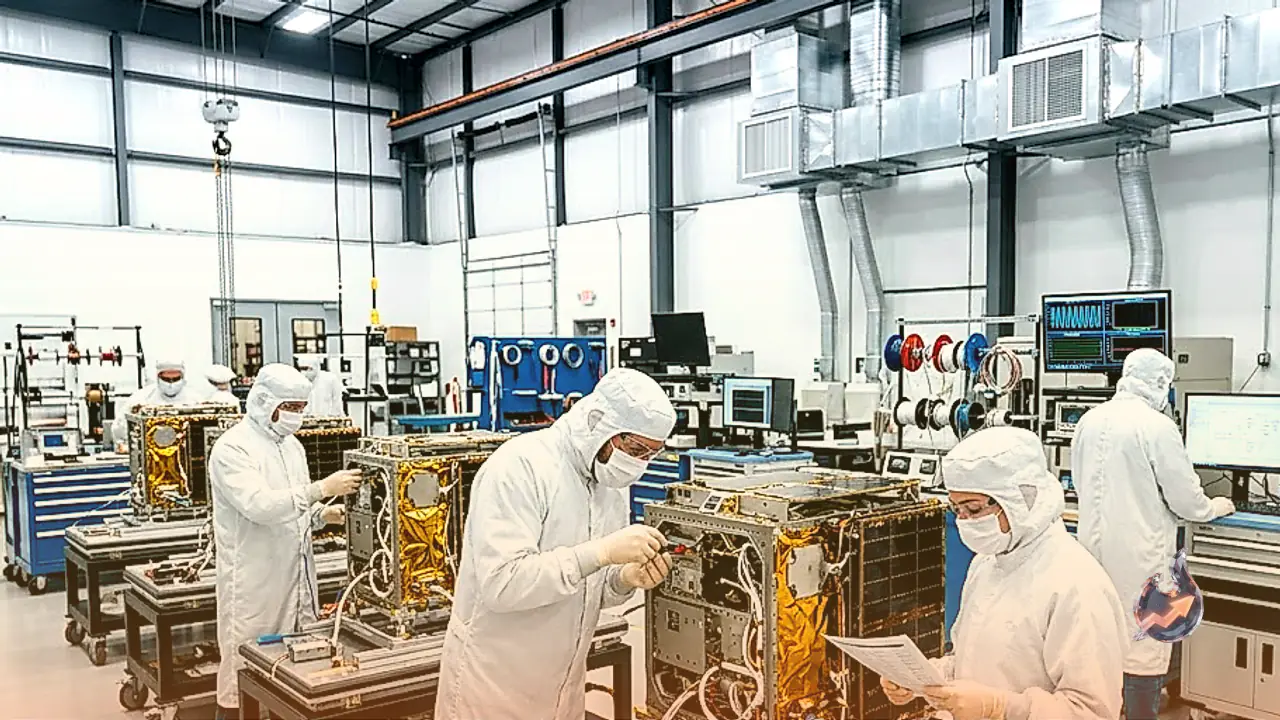
A SpaceX rocket is slated to carry the initial batch of six spacecraft into orbit later this month. Four units rely on a satellite bus supplied by Aerospace Labs, mirroring a successful prototype launched last year that validated the startup's underlying technology. The remaining two spacecraft were manufactured entirely in-house at the company's Burlingame, California headquarters. These spacecraft will establish the initial footprint of Pulsar, an operational network designed to eventually encompass 258 satellites.
Centimeter Precision, Anti-Jamming Signals, And Beta Pilots
The Pulsar network is engineered to provide centimeter-level geolocation precision, vastly outperforming the meter-level accuracy provided by traditional GPS. Because the signals are transmitted with significantly higher power, they can easily penetrate dense urban landscapes and reach deep within interior building spaces. Manning also noted that this increased broadcast power provides substantial resilience against malicious signal disruption and spoofing attempts.
Once the six satellites reach orbit and begin completing roughly eight passes over mid-latitude regions each day, Xona plans to commence beta trials with commercial partners. Ian Gough, Chief Executive Officer of electronic timing specialist TimeBeat, indicated that this initial phase will allow their technical teams to calibrate and correct synchronization across devices deployed globally. By 2028, Xona intends to deliver complete, uninterrupted coverage across the United States, Europe, Japan, and South Korea.
Venture Backing And The Autonomous Future
Since inception, Xona has secured over $300 million in private venture funding, a total that includes a $20 million contract from the U.S. Space Force. While the venture remains dedicated to commercial enterprise, government and defense authorities have shown keen interest in the technology as deliberate satellite navigation disruption becomes more frequent in global conflict zones.
Alongside billions of potential consumer and industrial timing receivers, the startup is positioning itself at the center of the autonomous revolution. Tyler Reid, who currently serves as Chief Technology Officer and previously developed automated vehicle systems at Ford, recognized early on that an infrastructure like Pulsar is critical to unlocking the true potential of self-driving machines across every category. Looking out at passenger airliners landing at San Francisco International Airport from the company headquarters, Manning emphasized that civil aviation represents the pinnacle of mass transit safety. For Xona, the overarching mission is to extend that exact level of safety to road vehicles, allowing drivers to remove their hands from the steering wheel with the same confidence passengers feel inside a commercial airliner.