























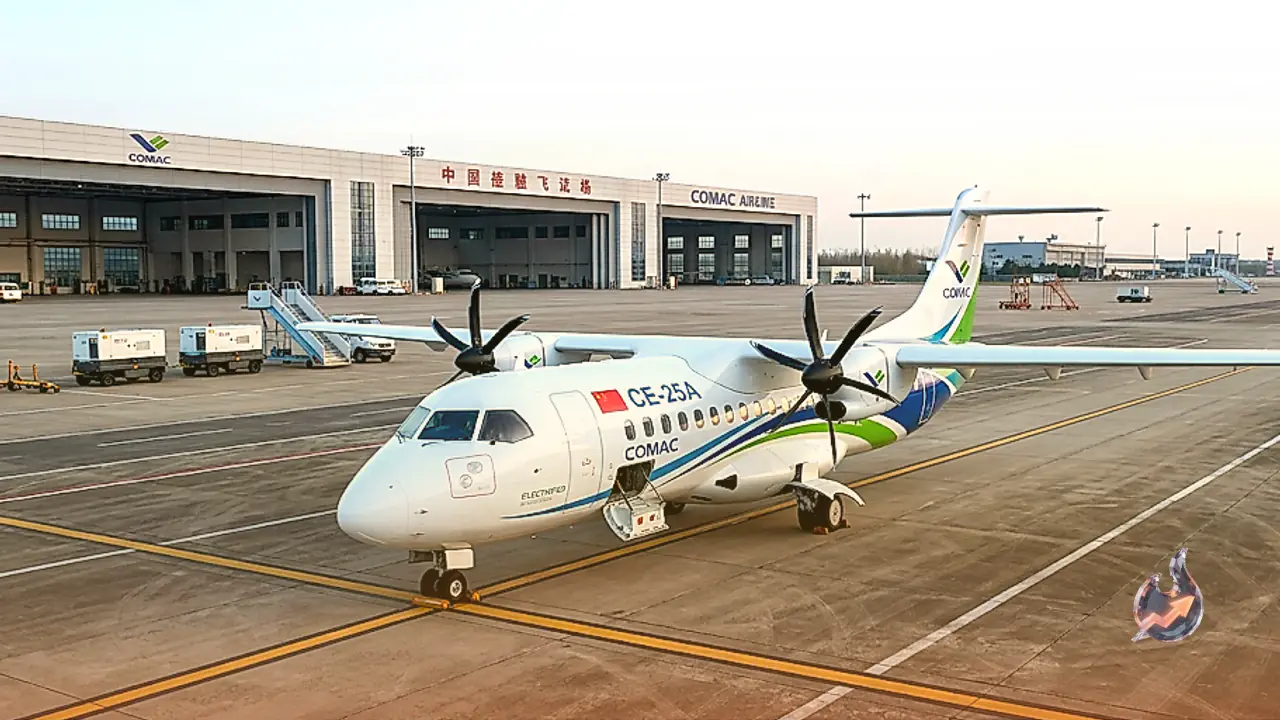

A major milestone has been achieved in the pursuit of sustainable zero-emission aviation as a fully battery-powered commercial aircraft successfully completed its maiden crewed flight in Binzhou, China. Developed to transform regional travel without relying on traditional jet fuel, the 19-passenger plane demonstrated stable flight characteristics and efficient energy usage during its airborne trial. This successful demonstration signals a significant step forward in bringing quiet, clean, and lower-cost aerial transportation closer to reality.
Flight Test Dynamics and Operational Performance
The test flight was managed by a three-member crew comprising two experienced pilots and one flight test engineer. Technical metrics logged during the mission show that the entire testing procedure lasted for 57 minutes and 46 seconds, with the aircraft remaining airborne for 16 minutes and 38 seconds. During its time in the air, the aircraft covered a total distance of 60.4 kilometers while conducting essential maneuvering tests. Engineering assessments confirmed that all flight control systems, structural dynamics, and electrical power management networks operated within target parameters.
Designated as the CE-25A model, the aircraft is engineered to reach a maximum cruising speed of 300 kilometers per hour and delivers an operational range of 400 kilometers on a single charge. Built with a maximum takeoff weight of 10 tonnes, the plane can operate at service altitudes reaching up to 2,400 meters. Tailored specifically for short-haul intercity routes, the aircraft's type certification application has been formally accepted by the Civil Aviation Administration of China (CAAC), moving the vehicle closer to commercial launch approval.
Manufacturing Partnership and Environmental Impact
The electric airliner was built by state-owned manufacturer Commercial Aircraft Corporation of China (COMAC) in collaboration with several specialized research institutes and industrial partners. By completely eliminating jet fuel combustion in favor of high-capacity battery packs and electric propulsors, the platform drastically cuts carbon output and lowers operating costs associated with routine maintenance and fuel procurement. Details regarding the flight trial were also shared on social media, highlighting the rapid pace of developments in clean aviation architecture.
The introduction of electric aircraft on regional routes is expected to dramatically reduce noise pollution around suburban airports compared to traditional turboprops or jet-engine aircraft. With a seating capacity of 19 passengers, the CE-25A provides an ideal solution for connecting smaller regional hubs with major urban centers, making short-distance flights cleaner and quieter.
Global Competition in Electric and Hybrid Aviation
While China has achieved a key milestone with the CE-25A flight, aerospace innovators in the United States and Europe are also aggressively pursuing next-generation electric and hybrid propulsion technologies. In September 2026, American firm Heart Aerospace revealed an updated design for its ES-36 hybrid-electric aircraft. Capable of accommodating 36 passengers, the ES-36 is designed to travel up to 201 kilometers purely on battery power, while expanding its range to nearly 1,199 kilometers when utilizing its hybrid gas-turbine generator system.
Concurrently, Virginia-based startup Electra is developing a 9-seat hybrid-electric aircraft known as the EL9 Ultra Short. Electra aims to conduct the inaugural test flight of the EL9 Ultra Short platform by early 2028. Meanwhile, aerospace engineering entities across Germany are working on distinct hybrid and fully electric aircraft designs. These parallel international efforts underscore a global shift toward decarbonizing commercial air transit over the next decade.