


















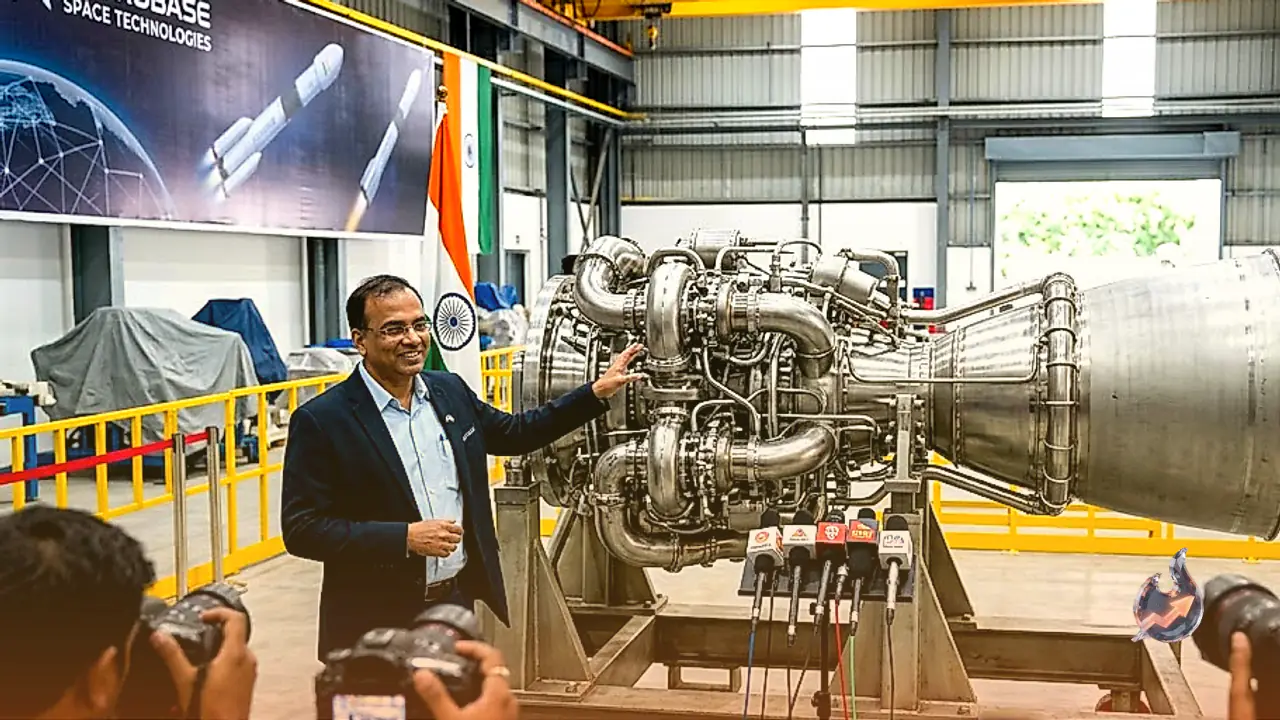

India's commercial space sector has achieved a crucial engineering benchmark as private enterprise expands beyond traditional satellite assembly into heavy rocket propulsion systems. Bengaluru-based Astrobase Space Technologies has formally presented its new 800 kN class rocket engine named 'Everest'. The system marks the first private development of a high-thrust Full-Flow Staged Combustion (FFSC) engine within the Indian commercial space industry.
Understanding the FFSC Architecture Behind Everest
Full-Flow Staged Combustion is widely regarded as one of the most complex mechanical engineering challenges in aerospace propulsion. Unlike conventional engine cycles, an FFSC architecture fully gasifies both the fuel and the oxidizer in separate preburners before injecting them into the main combustion chamber. This complete pre-vaporization significantly raises combustion efficiency and optimizes thermal control across the turbomachinery.
The Everest power plant utilizes a liquid oxygen and liquid methane (methalox) propellant combination. According to design parameters, the engine produces an estimated 800 kN of thrust while targeting a specific impulse of approximately 340 seconds. A defining feature of the architecture is its dynamic throttling capacity, which ranges from 50 percent to 110 percent of rated power.
Engine Throttling and Reusable Rocket Mechanics
Broad throttling capabilities are essential for landing reusable launch vehicles safely. During the descent and soft-landing phases, a rocket booster must precisely modulate thrust to offset decreasing vehicle mass and counteract aerodynamic forces. The 50-to-110 percent control range engineered into Everest provides the fine power adjustment necessary for controlled propulsive recovery.
Astrobase plans to integrate the Everest engine into its proprietary reusable medium-lift launch vehicle. The enterprise has set a target date of December 2028 to execute its maiden orbital mission using this vehicle setup.
Domestic Manufacturing and Supply Chain Integration
Over 70 percent of the Everest engine's components have been designed and manufactured inside India. While complete architecture layout and integration occur at the company's facilities in Bengaluru, certain high-precision sensors and specialized hardware items are currently sourced internationally due to limited local vendor availability. Astrobase intends to progressively replace these imported sub-assemblies as domestic supply networks expand.
Reflecting on the competitive landscape, Astrobase Chief Executive Officer Neeraj Khandelwal noted that commercial space launch infrastructure remains concentrated among very few global entities. He stated that India's established engineering expertise offers an opportunity to build an alternative commercial launch hub capable of serving global satellite operators. The startup is developing an end-to-end architecture encompassing propulsion, airframe manufacturing, static testing, and ground launch management.
Next Steps: Static Firings and Payload Capacity Targets
The unveiling represents an initial hardware milestone, with static hot-fire tests scheduled as the next operational objective. Ground tests will evaluate structural integrity, turbopump stability, and thermal management under simulated ignition pressures before the engine advances to full qualification firings and stage integration.
Looking further ahead, Astrobase aims to establish an initial orbital delivery capability of roughly 100 metric tons of payload annually. The firm intends to scale this capacity beyond 1,000 metric tons per year over time, seeking to capture demand in the global commercial launch market by delivering reliable and cost-effective payload transport services.