






















Renowned across the globe for its turquoise lagoons, sun-drenched beaches, and secluded luxury resorts, the Maldives is an archipelago of 1,200 coral islands scattered across the Indian Ocean. Only a handful of these islands accommodate human settlement, home to a modest population of approximately 400,000 residents. Highly vulnerable to global environmental shifts, the low-lying nation faces severe existential threats if ocean levels rise even slightly. The nation is currently observing the 900th anniversary of its Islamic heritage, having emerged from British colonial rule in 1965 after spending much of its documented history under India's protective geopolitical sphere. While contemporary Maldives is recognized as an exclusively Muslim country, its historical foundation rests firmly upon ancient Sanatan Hindu and Buddhist traditions, with early lineages tracing back to the Indus Valley Civilization.
The Etymological Evolution from Mahiladwipa to Maldives
The name Maldives is deeply rooted in classical Sanskrit linguistics. Ancient historical records and local oral lore suggest that the chain of islands was originally designated as 'Mahiladwipa', a name derived from governance by female monarchs. Certain ancient texts also refer to the territory as 'Malashikhar'. In subsequent eras, Arab seafarers and traders documented the islands under the names Divi or Dibat. When South Indian cultural and naval power expanded under Tamil and Chola rulers, the archipelago came to be referred to as Male Dweep. In both Sanskrit and Tamil, this compound signifies a garland of islands clustered together. An aerial or cartographic view of the 1,200 atolls reveals an arrangement resembling a necklace resting on the sea, an image that eventually evolved into the modern designation of Maldives.
The Indus Valley Connection and the First Settlers
Documented historical analysis establishes that long before the introduction of Islam in the twelfth century, the Maldives was predominated by Buddhism, preceded by Vedic Hindu traditions and maritime interactions linked to the Indus Valley Civilization. In his seventeenth-century Arabic treatise titled 'Fi Aathaar Meedhoo Al-Qadeemah', the Islamic scholar Allama Ahmad Shihabuddine wrote that the earliest settlers of these islands were the Dheyvis people. According to his account, this founding population migrated directly from Kalibangan, an ancient urban center of the Indus Valley civilization located in modern-day Hanumangarh district of Rajasthan, India. Although the precise chronological timeline of their maritime voyage remains unrecorded, historical consensus places it well before the reign of Emperor Ashoka, which lasted from 269 to 232 BCE.
Vedic Sun Worship and the Chola Expedition
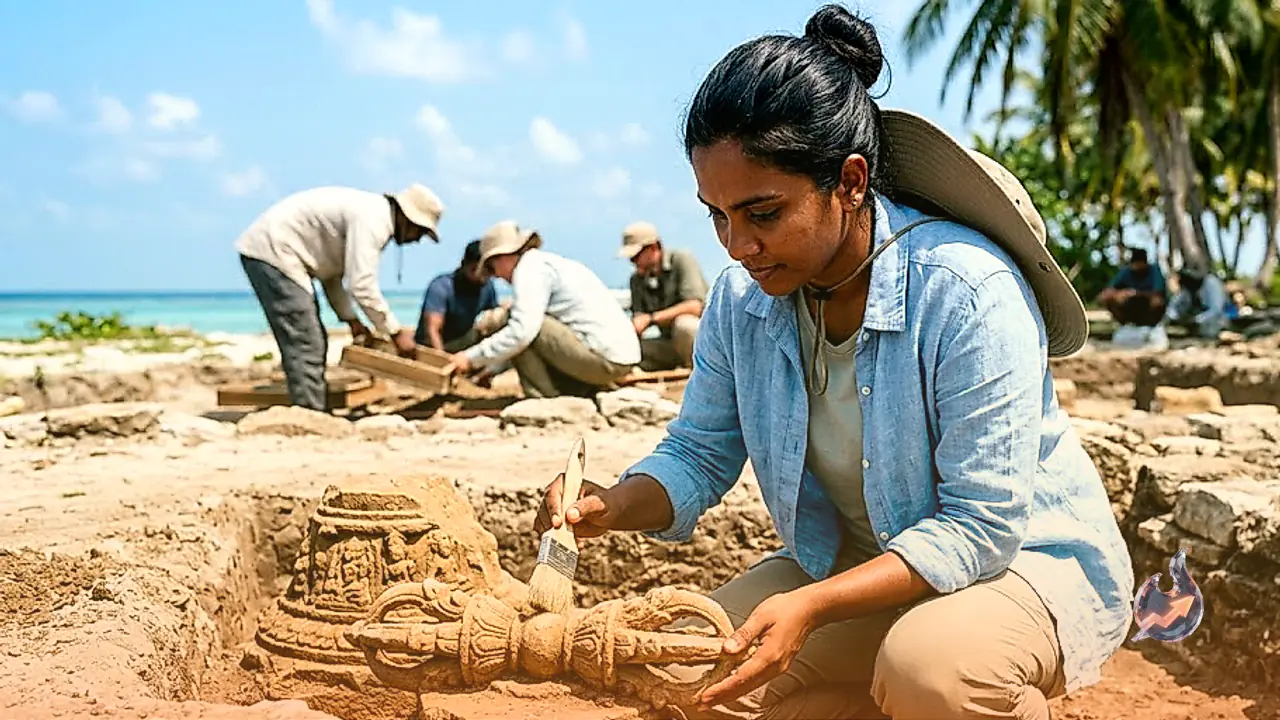
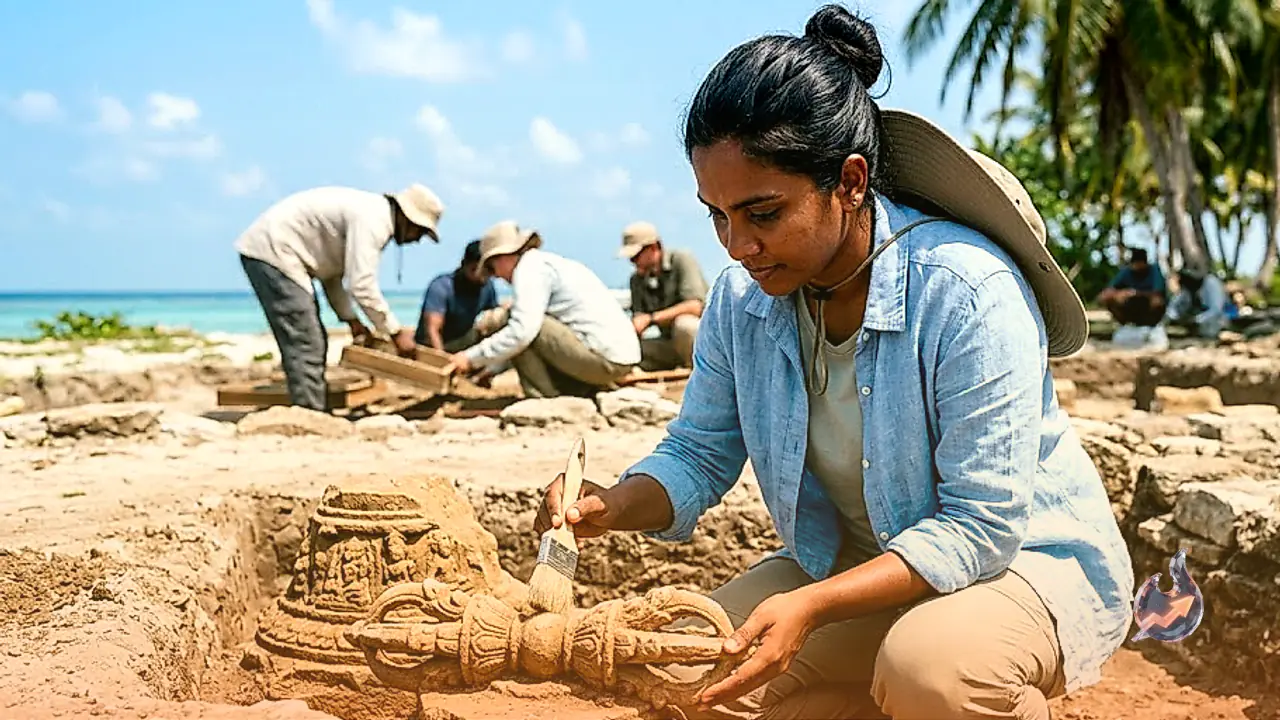
Following the decline of the Indus Valley Civilization, Vedic cultural and spiritual practices spread throughout the Indian subcontinent, eventually reaching peripheral sea routes. Multiple archaeological excavations and ancient epigraphs indicate that seafaring groups from coastal India and Sri Lanka gradually established settlements across the atolls. Before the third century BCE, the original inhabitants practiced nature-centric rituals, prominently solar worship and Vedic traditions. Archaeological expeditions led by Norwegian explorer Thor Heyerdahl uncovered coral stone carvings bearing ancient Hindu iconography, including solar discs, tridents, and lingams. By the eleventh century, the South Indian monarch Rajaraja Chola I conquered the archipelago, further reinforcing Tamil cultural influence, classical Hinduism, and Buddhist monastic institutions across the territory.
Linguistic Heritage Rooted in Sanskrit and Pali
The national tongue of the Maldives, Dhivehi, provides unmistakable evidence of South Asian linguistic ancestry. The language originates from ancient Prakrit, Pali, and classical Sanskrit structures. Its grammatical syntax and foundational script exhibit profound affinities with Sri Lanka's ancient Elu dialect and early Indian Brahmi scripts. Even today, the names of various islands, local kinship terms, navigational coordinates, and geographical features in Dhivehi trace their roots directly to Sanskrit and Pali etymology. For instance, the name of the capital island, Male, is widely regarded by linguists as an offshoot of the Sanskrit terms 'Maha-laya' or 'Mala'.
Monastic Settlements, Stupas, and Sacred Relics
Beginning in the third century BCE, Buddhist teachings steadily expanded across the archipelago, eventually becoming the dominant faith across nearly every atoll. Remnants of massive mounds crafted from coral stones and soil remain visible across locations such as Laamu, Fuvahmulah, and Thoddoo. These structures are the eroded remains of Buddhist chaityas and stupas, locally designated as 'havitta' and 'ustubu'. Comprehensive surveys conducted in the nineteenth and twentieth centuries by British archaeologist H. C. P. Bell and explorer Thor Heyerdahl unearthed stone statues of the Buddha, meditative bas-reliefs, and extensive monastic layouts. The Kuruhin Taraagandu site on the islands of Gan and Kaashidhoo preserves an extensive Buddhist monastic complex dating back to the seventh and eighth centuries. Historical accounts left by Chinese pilgrims as well as Roman and Persian maritime chroniclers similarly described the archipelago as a realm governed by queens and populated by Buddhist monks.
Royal Conversion of King Dhovemi and the Islamic Transition
Historical copper-plate charters, known locally as Loamaafaanu and dating to the late twelfth century, document the definitive turning point in the nation's spiritual history. The inscriptions detail that King Dhovemi formally renounced Buddhism to adopt Islam, initiating an era of state-directed religious transition. Over the subsequent years, persistent pressures were applied to convert the remaining Buddhist population. Historical records inscribed on these plates indicate that several Buddhist stupas were systematically dismantled, while monks who refused conversion faced severe punishment or exile. Today, the Maldives is a constitutionally homogeneous Islamic state where non-Muslims cannot obtain citizenship, yet the buried stone artifacts and linguistic footprints continue to testify to its extensive Hindu and Buddhist past.