



















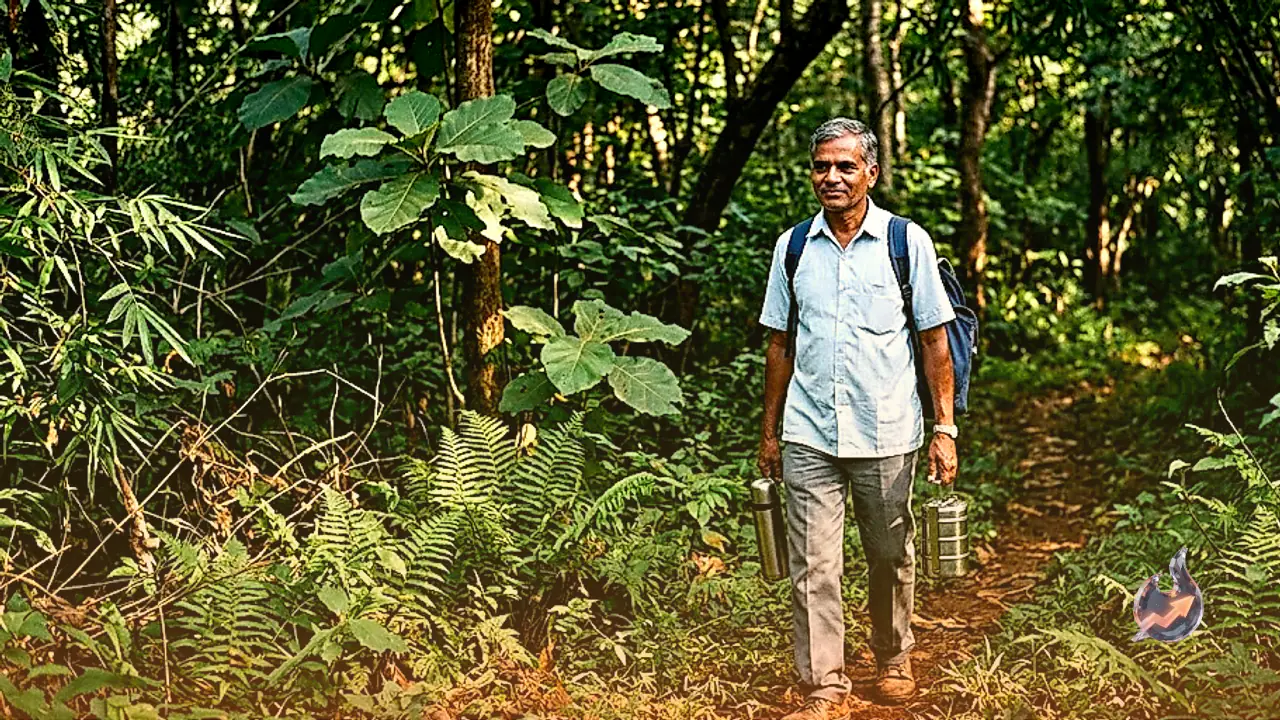

Imagine a daily commute where death lurks around every corner, where a leopard could spring from the dense undergrowth at any moment, or a massive wild gaur could block your path. In conditions where most people would hesitate to venture even once, a 55-year-old teacher has been walking five kilometers every single day for the past 13 years. In the Kolhapur district of Maharashtra, this story, which sounds like the plot of an inspiring movie, is a daily reality. Jeevan Mithari, a primary school teacher, treks through thick forest canopies every morning to ensure that his sole young student receives her education. While modern educators often demand comfortable transfers and urban connectivity, Mithari treats every morning's arduous journey as a fresh test of his commitment.
The Geography of Absolute Isolation
This extraordinary tale of perseverance unfolds in Kavaltek Dhangarwada, a tiny and remote settlement in the Gaganbawda taluka, located near the border of Maharashtra and Sindhudurg. This region is nestled deep within the rugged terrain of the Western Ghats. The hamlet's isolation is so severe that even in the twenty-first century, electricity has not yet reached its homes. Furthermore, there is no motorable road connecting the settlement to the outside world. The nearest point accessible by any vehicle is about two and a half kilometers away from the school. From there, the only way forward is a treacherous, unpaved trail winding through dense, predator-populated forests.
Trading Influence for the Hardest Post
What makes Jeevan Mithari's story truly remarkable is that his placement at this school was entirely voluntary. On July 26, 2013, he chose to be transferred to this remote outpost. At the time, he was serving as the chairman of the Kolhapur District Primary Teachers Cooperative Bank, a highly influential and prestigious administrative position. In educational circles, senior and influential teachers were often accused of pulling strings to secure comfortable urban postings while avoiding difficult terrains. Deeply moved by this stereotype, Mithari decided to lead by example. He relinquished his comfortable position and chose the most inaccessible school in the district to prove that dedicated educators do not run away from challenges.
Depopulation and the Struggle of Kavaltek Dhangarwada
Over the years, the demographics of the village have shifted drastically due to migration. Kavaltek Dhangarwada once bustled with 70 to 100 families, and the school was lively with the chatter of many children. However, the complete lack of basic infrastructure, electricity, and roads eventually forced a massive migration. Families moved to urban centers in search of employment and a survival, leaving the hamlet nearly deserted. Currently, the school has only one officially enrolled student, Swara Bodke, who is in the third grade. Interestingly, her younger sister also accompanies her to the class daily. Since the settlement lacks an Anganwadi or pre-school center, she sits alongside her sister, absorbing whatever lessons she can.
Coexisting with Predators and Local Hardships
The daily life of the villagers in Kavaltek Dhangarwada is defined by extreme hardship. The local population belongs primarily to the Dhangar community, relying on small-scale subsistence farming, collecting firewood from the forest, and gathering wild fruits like jamun and karvanda to sell in distant markets. Farming in this wilderness is a constant battle against nature; farmers must erect strong double fencing around their plots to protect their crops from being destroyed by wild animals. The educational prospects for children here are equally bleak. If this Zilla Parishad school were to close down, the only alternative is in Dhundavade village, which is about 5.5 kilometers away. A round trip of 11 kilometers through forest trails is practically impossible and highly dangerous for young children.
Unshaken Resolve and Hope for the Future
Despite the single enrollment and hazardous conditions, Jeevan Mithari has never faltered in his duty. He is scheduled to retire in May 2029, yet his enthusiasm remains as vibrant as ever. He jokingly remarks that the grueling five-kilometer walk has become part of his daily exercise routine, keeping him physically fit. However, he remains deeply concerned about the safety of his students. He strongly advocates for the construction of a sturdy boundary wall around the school premises to keep wild animals at bay. Jeevan Mithari’s decade-long journey stands as a shining testament to the fact that true dedication to education needs no lavish infrastructure, only an unwavering spirit.


