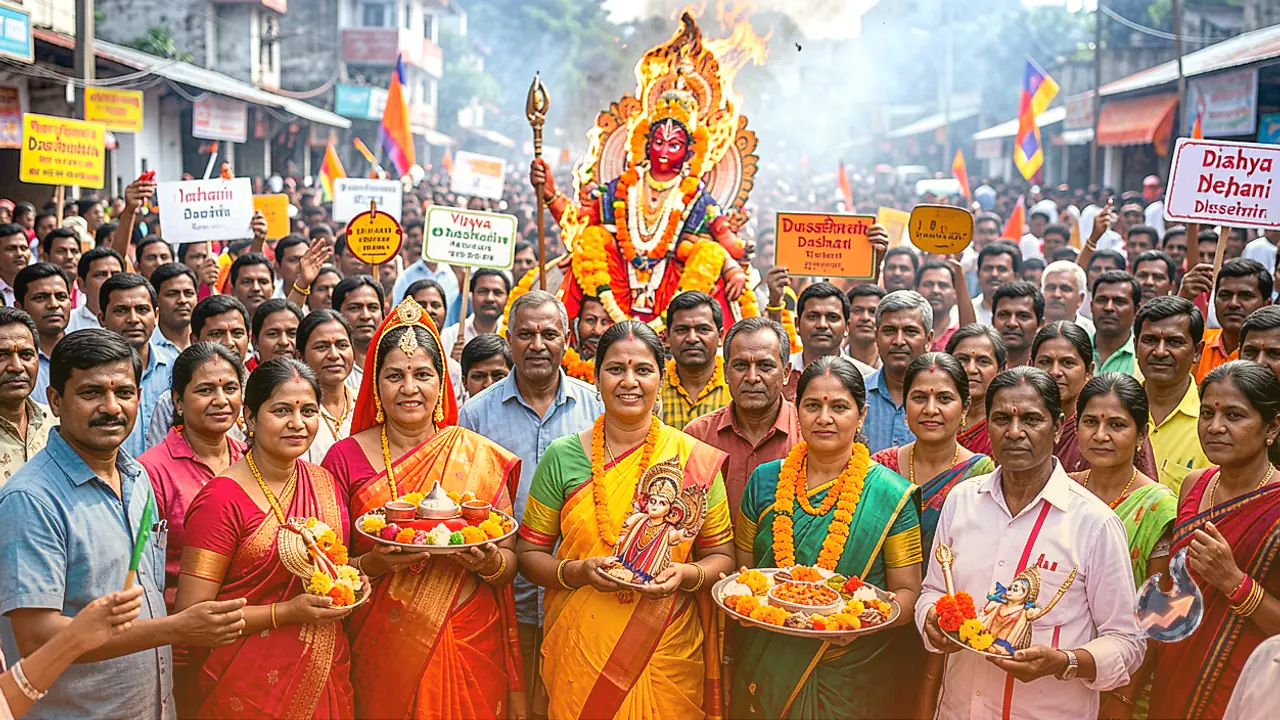
















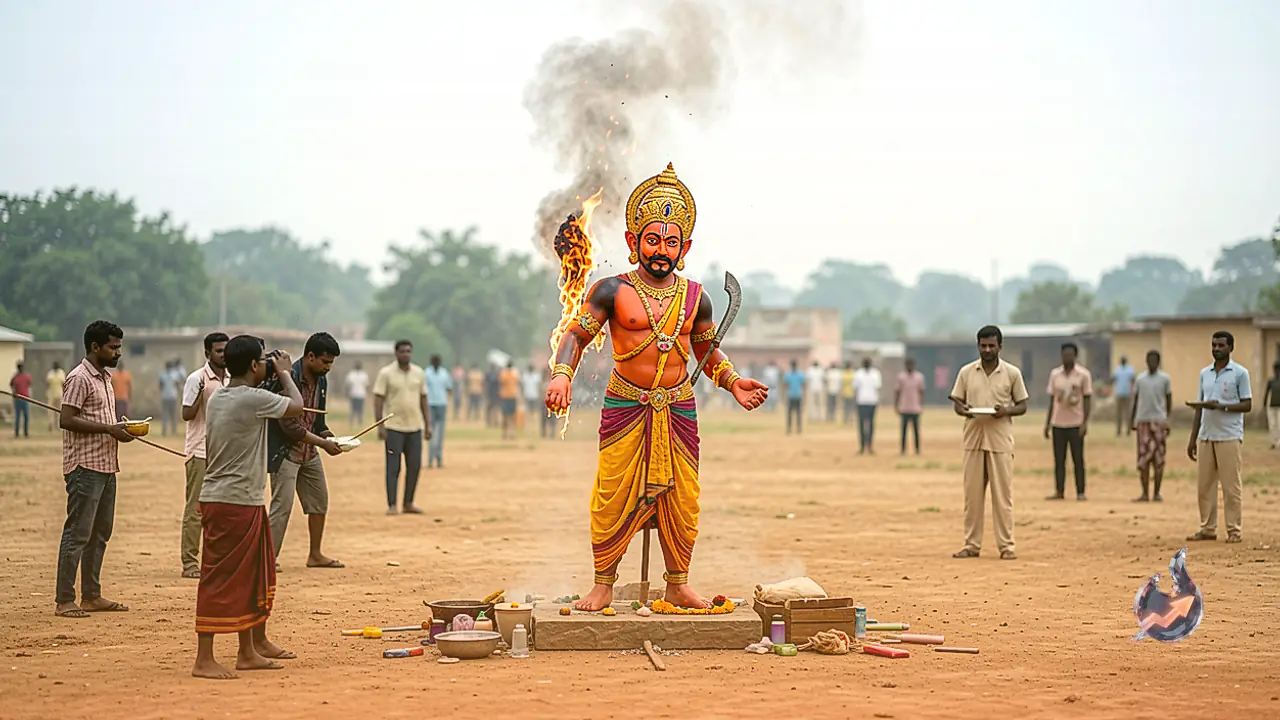

In the contemporary era, social media heavily dictates public perception and beliefs. When sensitive topics and historical facts are distorted online without proper verification, it becomes a matter of deep concern. The internet is flooded with unregulated content where casual remarks often masquerade as established facts without any rigorous research. A similar misleading narrative has been circulating widely online, claiming that the tradition of burning the effigy of Ravan began only after the year 1947. However, historical evidence completely debunks this notion.
Historical Documents and British-Era Records
The exact date when the tradition of burning Ravan effigies first began is not explicitly mentioned in any ancient religious text, but that does not mean later literature lacks references to it. Several medieval books, British library archives, and Indian government gazettes contain photographs and accounts of Ravan effigy burning during Dussehra festivals. Historical records show a photograph of Ravan Dahan in Quetta in 1920. Furthermore, there are documented photographs and records of Ravan effigy burnings in Lahore during 1923 and 1940, Abbottabad in 1943, and Karachi in 1940.
Evolution of Ramlila and Effigy Burning
The Ramcharitmanas, written by Tulsidas, gained immense popularity across the Indian subcontinent. Tulsidas lived between 1532 and 1623, composing his epic around 1574 AD. Within decades, his disciples initiated theatrical Ramlila performances to connect the masses with the epic. This folk tradition spread rapidly across the Indian subcontinent and reached neighboring countries like Thailand, Cambodia, and Indonesia. The practice of burning Ravan effigies emerged alongside these dramatic stage performances, although pinning down the exact calendar date of its inception remains a subject for ongoing historical research.
British Rule and Written Proof in Delhi
There are still many elderly citizens alive today who were born before 1947, and none of them ever recalled the Dussehra tradition starting in that specific year. In Delhi, near the historic Red Fort, the Sri Dharmik Ramlila Committee has been organizing grand Ramlila and Ravan Dahan events since around 1800. Numerous British administrative books, official gazetteers, travelogues, and contemporary newspapers carry detailed records of public Ravan effigy burnings. Thomas Twining's 1790 book 'Travels in India a Hundred Years Ago' explicitly mentions the practice, while the 1883-84 Imperial Gazetteer of Delhi notes that giant paper-and-bamboo effigies of Ravan, Kumbhakaran, and Meghnad were ceremoniously burned with fireworks near the Yamuna riverbank in Shahjahanabad during Ashwin.
The 1947 Independence Celebration Confusion
When India gained independence in August 1947, massive celebrations erupted nationwide with drums, music, and widespread fireworks that continued for months. When Dussehra arrived that year, organizers fitted Ravan, Kumbhakaran, and Meghnad effigies with advanced commercial firecrackers to match the festive nationwide mood. This likely marked the first time heavy fireworks were integrated into the effigies on such a grand scale, leading some observers to mistakenly assume that the ritual itself originated that year.
Valmiki Ramayana and the Final Rites
Several versions of the Ramayana exist in India, with the Valmiki Ramayana considered the most authoritative. The 109th sarga of the Yuddha Kanda contains verses where Lord Rama tells Vibhishana that enmity ends with death and their objective of establishing righteousness has been met. Rama instructs Vibhishana to perform the final funeral rites for Ravan, noting that Ravan was as much a brother to him as to Vibhishana. Following Rama's command, Vibhishana performed the traditional cremation. Additionally, the Valmiki Ramayana documents the immense jubilation of the Vanara army and celestial beings following Ravan's defeat.