
















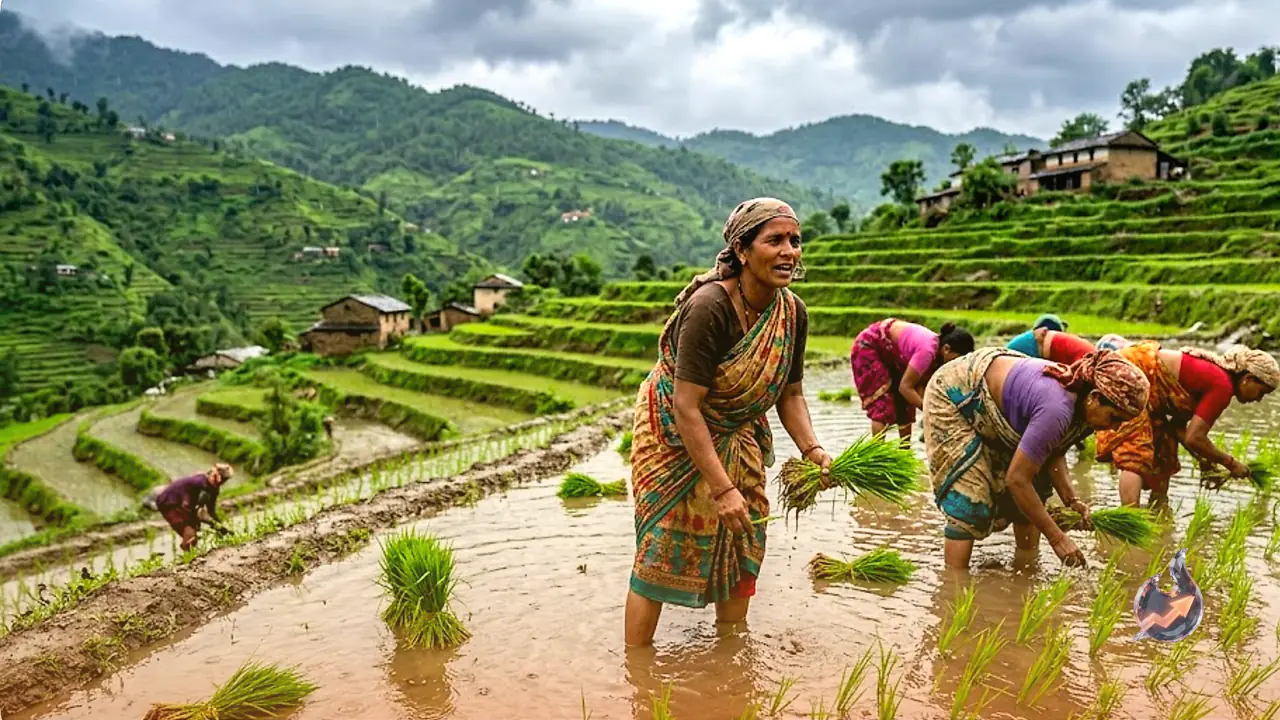

Once good rainfall arrives in the hills in early July, paddy transplantation picks up pace across Kumaon's villages. Farmers first plough their fields and complete puddling, the process of preparing the mud, before uprooting seedlings raised in nurseries and planting them in the main fields. The water-filled terraced fields make for a striking sight from a distance, and the combination of greenery, clouds and mountains during transplantation draws tourists and photographers alike. This period is considered the most crucial in the farming calendar, since timely planting raises the chances of a good paddy harvest.
Women carry the load in the fields
In most villages of Kumaon, the primary responsibility for paddy transplantation falls on women. From morning to evening, they bend continuously in water-filled fields, planting one seedling at a time by hand. Completing a single field can sometimes take an entire day. Standing in mud for long hours and bending repeatedly puts heavy strain on the back, knees and legs, yet women carry out this work with full enthusiasm. This is why the practice is still regarded as the backbone of rural life in the hills, with women's contribution to a family's food security remaining vital.
The 'Parma' tradition of collective labour
Many hill villages still follow the tradition of 'Parma', or collective labour. Under this system, women and families from the village take turns working in each other's fields. On one day, everyone gathers to work on a particular farmer's land, and the next day they move to another farmer's field. This spreads the workload and allows more fields to be transplanted in less time. The tradition is not limited to farming alone; it is also seen as a strong example of social unity and mutual cooperation within the villages.
Fields that echo with folk songs
Paddy transplantation in the hills is not merely agricultural work, it is also part of the region's folk culture. In several villages, women sing traditional Kumaoni folk songs and jhode while planting. These songs ease the fatigue of the work and keep the atmosphere lively. Local woman Narayani Devi says that earlier, almost every village used to resound with these songs during the planting season. However, with changing times, the tradition has now become limited to a few places, though many villages still keep this cultural heritage alive.
Hands remain more practical than machines
The use of machines for paddy transplantation has increased significantly in the plains, but machines cannot easily reach most of Kumaon's terraced fields. The fields here are broken into small plots with narrow paths running between them. This is why hand transplantation is still considered the most practical method, and why this traditional farming practice continues to survive in the hills. The development of lighter, smaller agricultural machines suited to mountain terrain could offer farmers relief in the future.
Challenges from seeds to migration
Paddy farming in the hills is not considered easy. Farmers face a range of challenges, including seeds, fertiliser, irrigation, labour costs and protecting crops from wild animals. The migration of young people has also reduced the number of hands available to work in the fields. Despite this, many families continue to preserve their traditional farming practices with limited resources. Farmers say that better markets, fair prices and government support could go a long way in strengthening paddy cultivation.
A scenic backdrop with tourism potential
During the planting season, Kumaon's villages present a remarkable display of natural beauty. Water-filled terraced fields, greenery spread all around and cloud-covered mountains resemble a painting. This is why many nature lovers and photographers head to these villages during this season. If agri-tourism is promoted at the local level, visitors could witness the traditional transplantation process up close, which could also open up an additional source of income for villagers.
A tradition tied to cultural identity
Traditional paddy transplantation is not just farming, it is also part of Uttarakhand's cultural identity. Changing lifestyles, migration and declining interest in farming are gradually affecting this tradition. It has become important to connect the younger generation with traditional agriculture and local food systems. A balanced use of modern technology, government schemes and local knowledge could make farming more profitable. This would not only strengthen the rural economy but also help preserve Kumaon's centuries-old farming culture for future generations.