





















A single football match can throw up more possible scenarios than there are atoms in the universe. It sounds like hyperbole, but Patrick Lucey is happy to push the point even harder. The number of permutations inside one game, he says, simply dwarfs anything you can imagine.
Lucey is chief scientist at Stats Perform, a data and AI company that has quietly become the backbone of the global football ecosystem. There is barely a corner of the modern game its statistics do not touch. The data underpins player scouting and the multimillion-dollar fees behind transfers, helps coaching staff settle on tactics and lineups, and even designs corner and free kick routines. Players lean on it to negotiate contracts, while broadcasters use it to entertain audiences.
Numbers that behave like self-driving cars
The data, Lucey explains, is fine-grained, multi-agent and adversarial. What happens in sport, he argues, is most similar to autonomous vehicles, because in both cases you are studying trajectories. Take a single team, he says, and you already have 10 factorial permutations just from the order in which you list the players. Add the opposition into the mix, and the whole thing simply explodes.
Smaller nations finding clever workarounds
Technology is not the preserve of the big nations alone. Curaçao, a Dutch Caribbean island with a population of roughly 159,000, became the smallest nation ever to qualify for a World Cup at this tournament. It got there by using its own data and technology for what it called diaspora tracking: mapping parentage, identifying eligible players, and drawing on geospatial data to plan scouting trips and organise trials.
Alex Stewart, chief executive of the data-driven sports consultancy Analytics FC, points out just how striking the result was. Only one player in the Curaçao squad of 26 was actually born on the island of Curaçao, he says. The rest were born in the Netherlands.
From choosing coaches to building squads
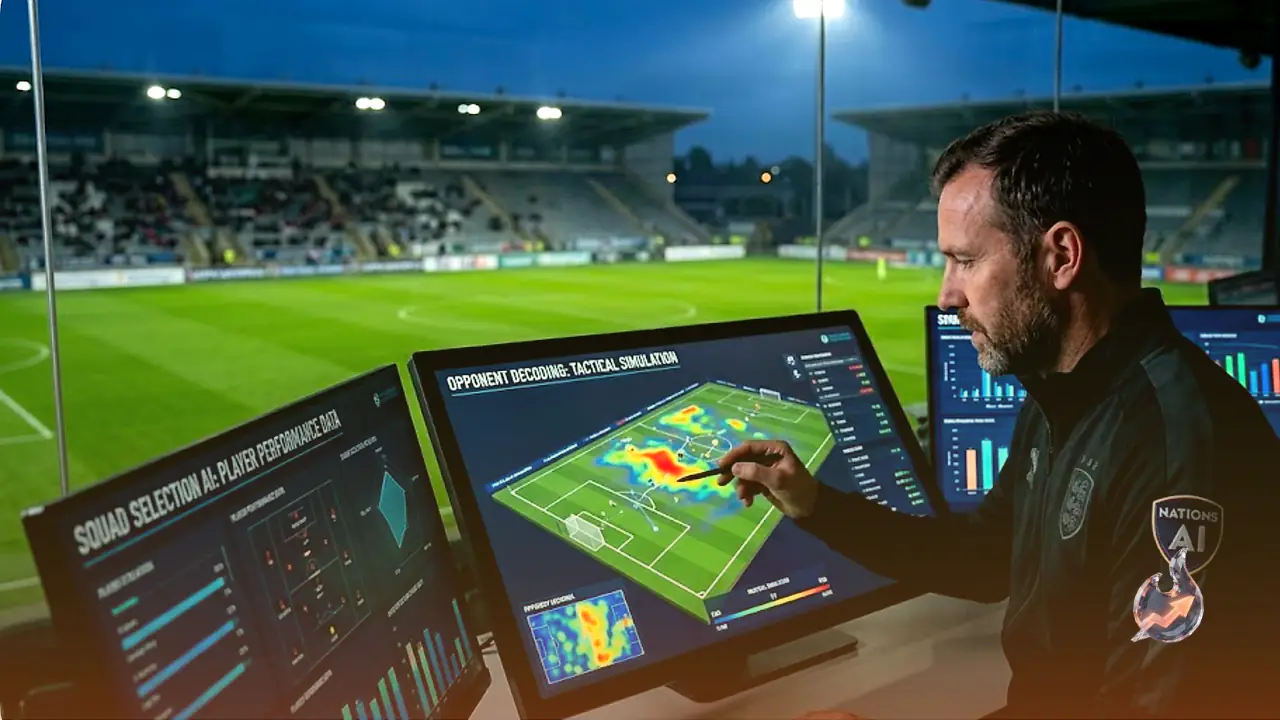
Another fast-growing use of data and AI inside national federations is manager selection. The tools can analyse the realistic pool of squad options and pinpoint the managers whose tactical strengths best fit them. Teams can go a step further and use AI to help shape the make-up of a squad ahead of a tournament, based on the opponents waiting in the group stage.
Marcelo Bielsa, the Uruguay manager, once said during his time in charge of Premier League side Leeds United that his staff would spend around 300 hours analysing an upcoming opponent. That, Lucey says, is something that can now be done automatically. He plays a video of red and blue dots darting around a pitch in pursuit of a yellow ball. Analysts can interrogate it directly, asking how often a particular move led to shots or goals, and every other time it occurred, with each answer peeling back a fresh layer of insight.
A moment like the early internet
Jan Wendt, cofounder and CEO of PLAIER, an AI platform working with clubs and national teams, compares the current moment to the arrival of the web. In the early days of the internet, he notes, both British Airways and Amazon built websites. One ended up as an information and airline ticketing platform, while the other transformed commerce across the world. AI, Wendt argues, has a similar spread, reshaping both routine tasks and entire industries, and in football's case, whole sports franchises.
Not every country can afford it
But AI tools, and the staff needed to build and run them, are expensive, and not every country has the resources. Wendt believes that for smaller nations, partnering with established outside companies, like his own, should be seen as the more efficient route.
There is another catch. More data can actually make an analyst's job harder, because their role is to distil a vast amount of information into a handful of genuinely useful insights for a coach or player.
You do not want to be the person who says, now that we have all this clever technology, here is a 47-page dossier on the opposition fullback, Stewart says. In one sense the analyst's job is easier because there is more information, he adds, but it is also harder for exactly the same reason, and there is a real skill in boiling it all down.
A widening gap between rich and poor
Technology can sharpen match analysis and preparation for teams that previously could not compete with nations running large scouting and analytics departments. But that raises an awkward question: will the new problem simply be that they cannot match the big squads of computer scientists and analysts instead? Could the data gap between wealthier and poorer nations grow so wide that it distorts competition in a tournament where the odds are already stacked against smaller countries?
FIFA is concerned enough that it has built its own bespoke AI agent, Football AI Pro, and is making it available to every nation at the World Cup for the first time during this tournament.
FIFA's ChatGPT-style assistant
The agent looks like a ChatGPT-style interface, where coaches can type questions and pull up information about their next opponents. Matches are recreated in 3D, opening up analysis from angles that were previously impossible. Everything is quantifiable, from where players pass and run to how they attack and defend, right down to the shots they take and the goals they score.
Johannes Holzmüller, FIFA's director of innovation, says the goal, and even the duty, is to give every team access to the technology so they can use it simply, without needing extra experts on staff, because not everyone can afford that.
Whether this closes the gulf between a nation with a bare-bones data department and, say, the England national team, which employs in-house software developers, data scientists and analysts backed by external AI tools, is open to debate. That is the minimum we can do, Holzmüller says, adding that the gap is clear to see, with some teams using technology and data far more than others.
The next step is forecasting the future
The future of data, AI and football is, quite literally, about predicting what comes next. The next step is long-term forecasting, Lucey says, believing they will eventually reach a point where counterfactual analysis lets them recommend which players to rest in order to maximise the probability of success.
So will FIFA eventually have to step in and restrict nations to using only FIFA-approved AI tools? That is a big question, Holzmüller says. Whether it ends up being regulated in some way is not something for today, he adds, but AI will certainly play a big role in the future.