






















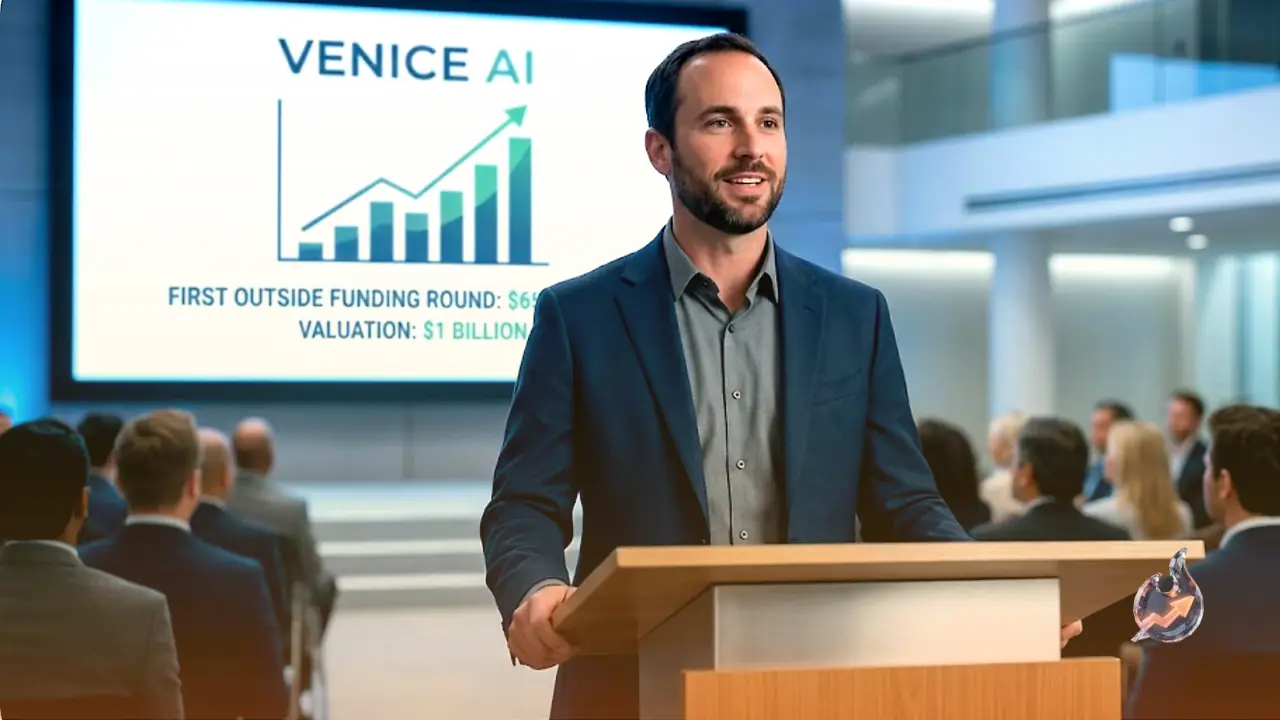

Venice AI, the privacy-first artificial intelligence platform, is now a billion-dollar company. Founder Erik Voorhees said Wednesday that the firm had pulled in $65 million in its first outside funding round, a raise that pegged its valuation at $1 billion.
Voorhees is a longtime figure in the cryptocurrency industry, best known as the founder of the ShapeShift exchange. In a post on X, he said the fresh capital confirms Venice's mission to build a private, uncensored alternative to widely used AI tools such as ChatGPT.
A Bet Against Surveillance
Voorhees laid out his thinking bluntly. “This aversion to ubiquitous centralized surveillance and control is our philosophical foundation, and upon it Venice is growing rapidly,” he wrote. “In April, we hit 3 million users, and as of Q1, in an environment where AI firms were losing money while spying on you, Venice became profitable while choosing not to.”
Venice AI launched in May 2024. Unlike mainstream chatbots, it is built to avoid storing users' conversations on centralized company servers. The round was led by Dragonfly, with participation from North Island Ventures, Coinbase Ventures, Archetype, Liquid2 Ventures, and Morgan Creek.
Token Jumps After the News
The Venice AI native token, VVV, climbed after the funding announcement. According to CoinGecko, it is currently trading at $13.74, up 11% over the last 24 hours. VVV emissions were also trimmed Wednesday to 3 million per year, which go to holders who stake their VVV to support the network. In practice, that means fewer tokens are added to the supply each year.
Where He Sees the Real Threat
AI developers including Anthropic's Dario Amodei and OpenAI's Sam Altman have warned about the dangers of frontier models. Voorhees, however, argued that the industry's fixation on job losses and cybersecurity misses a deeper danger: the erosion of privacy as AI reshapes how people relate to their own thoughts.
“Perhaps it is not job losses or cybersecurity incidents that should most frighten us, but rather that our flow of consciousness is increasingly under examination,” he wrote. “Our thoughts are now constructed in tandem with and at the permission of this dystopian apparatus.”
How the Money Will Be Used
Voorhees said the new funding will help expand Venice's platform, which offers access to leading open-source and proprietary AI models through a single interface and API. He added that the goal is to advance what he called First and Fourth Amendment protections for how humans interact with AI.
“We will construct the platform dedicated to private and unrestricted machine intelligence; an open, permissive port city that respects the sovereignty of its inhabitants, both human and agentic,” he said.
The move lands as AI privacy draws growing attention in Washington. Earlier this year, lawmakers introduced legislation to require warrants for AI-assisted government surveillance, while the FBI has expanded its use of AI for investigations, threat analysis, and facial recognition.