






















Expanding its footprint into automated security for both residential and commercial spaces, Amazon-owned home security company Ring is launching a dedicated robotics division. The company announced the formation of Ring Robotics, unveiling two distinct hardware devices that are bound to generate significant discussion regarding privacy and surveillance. These machines are engineered to automate routine patrols and bring proactive monitoring to homes and offices alike.
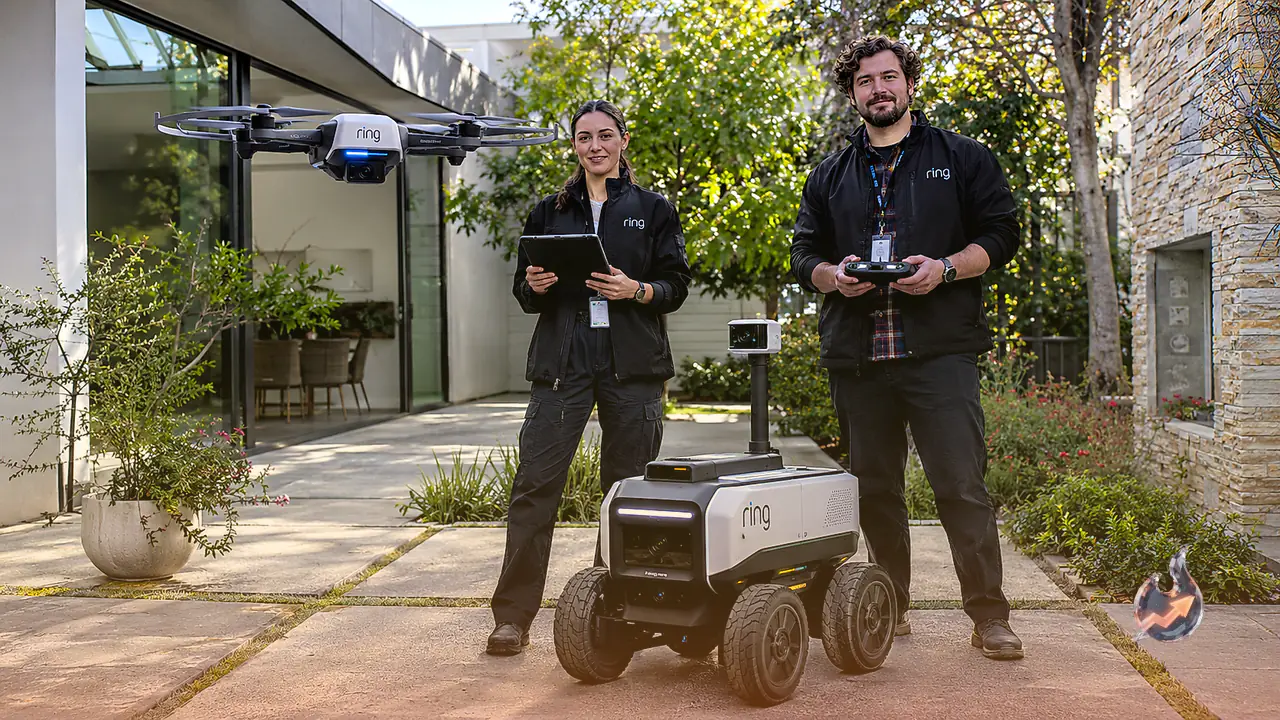
The first hardware introduction is an autonomous home security drone intended for residential monitoring while residents are away. The second device is a roving enterprise security robot built specifically to patrol business environments and commercial spaces after hours.
Starting with the aerial device, Ring describes the product as a flying indoor security camera designed to execute specific surveillance tasks. The Ring Drone Cam navigates autonomously from room to room, inspecting indoor conditions and sending alerts if an anomaly is detected. It integrates directly with other ecosystem hardware, meaning that if a Ring alarm trips near a specific entry point like a back door, the drone can fly directly to that zone to investigate. When not in active patrol mode, the hardware rests inside a dedicated charging and docking bay.
The flying camera records video in 2K resolution and incorporates built-in LED illumination to capture clear footage during nighttime or low-light situations. Users can pilot and coordinate the device using Amazon’s Alexa Home Map. Furthermore, owners can establish automated patrol schedules for overnight absences or vacations, ensuring continuous remote oversight.
The second device, the Ring Rover Cam, serves commercial and enterprise environments. Similar to the aerial counterpart, this ground robot can be programmed to execute scheduled patrols along predetermined routes within business facilities. The unit streams continuous 4K video viewable through the Ring mobile app and features automated recording triggers activated by human detection. It also incorporates an adjustable periscope camera designed to peer over physical obstacles, alongside two-way audio capabilities that allow remote operators to converse with anyone present on the premises.
Both new hardware items run on a proprietary artificial intelligence platform called AI Pilot. According to the company, this software suite utilizes specialized vision models, onboard sensors, and cloud processing infrastructure to navigate spaces autonomously. The system builds a detailed structural schematic of a home or office purely through initial environmental exploration.
The company promotes the pairing as an active guard that never rests, capable of sweeping retail floors after closing or investigating late-night sensor alerts while streaming live video directly to a user's mobile device.
Automated security robotics has historically proven challenging for the technology sector. In 2021, Amazon introduced a domestic security robot named Astro, which shares a visual resemblance to the new Ring Rover. Astro originated as a general household assistant before pivoting toward small-business security applications. However, adoption lagged, and Amazon discontinued the enterprise version of Astro just seven months after its repositioning.
Privacy advocates have consistently scrutinized Ring over concerns that its camera ecosystem creates unofficial surveillance networks accessible by law enforcement agencies. Given the invasive nature of roaming cameras and indoor drones, similar scrutiny is expected for these latest releases.
In response, Ring maintains that privacy and data security are integrated into the architecture of both devices. Recorded video streams utilize TAKE, which stands for Throw Away the Key Encryption, described by the company as its most robust default encryption standard to date. It remains unconfirmed whether local onboard video storage will be supported, as traditional Ring hardware relies predominantly on cloud storage infrastructure.
The Ring Rover is scheduled to launch on December 16 with a retail price of $1,000. Meanwhile, the Ring Drone Cam will debut next year on January 27, priced at $270.