























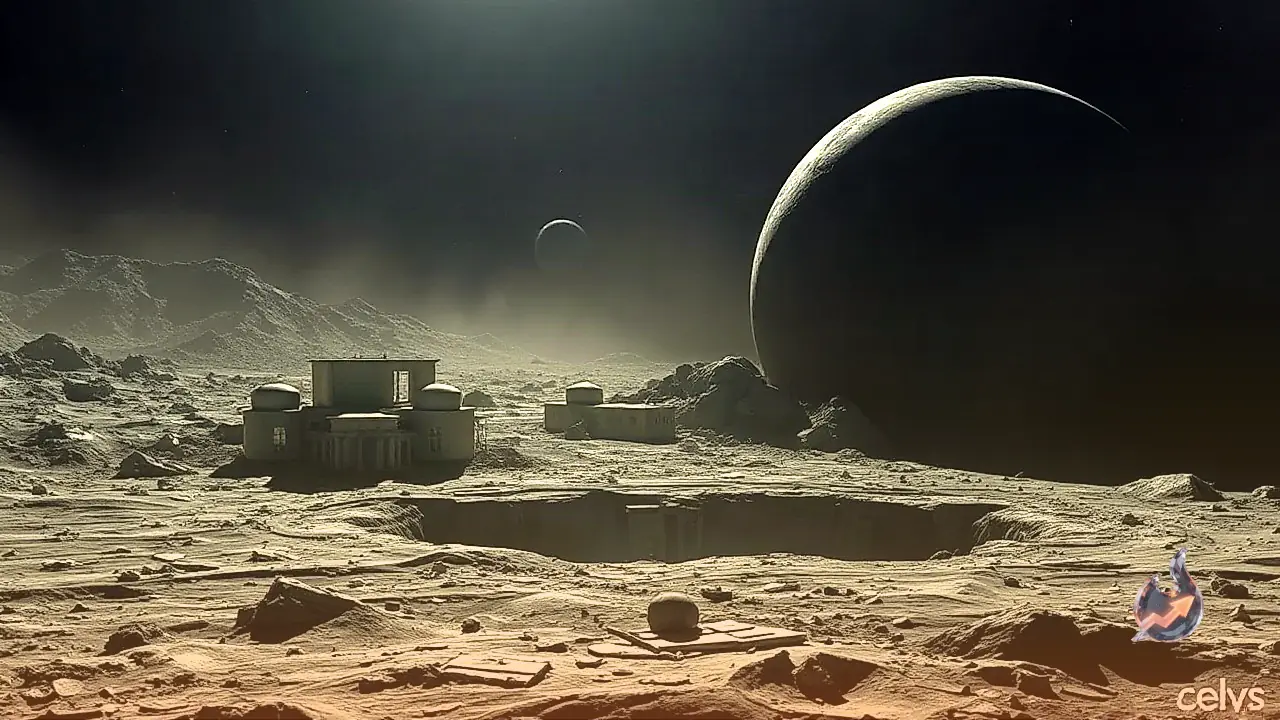

A high-velocity collision by an extraterrestrial object has gouged a massive scar across the lunar surface, carving out an impact basin measuring roughly 728 feet across and 141 feet deep. The freshly formed crater exceeds the footprint of Rome's historic Colosseum, marking the largest impact structure documented in the solar system across recent decades. Planetary scientists state that an impact of this immense violent magnitude is an extraordinarily rare spectacle, occurring approximately once in 132 years. This landmark discovery emerges just as long-term engineering preparations gather pace to establish permanent human habitats on the Moon.
The May 2024 Event and Its Subsequent Confirmation
The violent collision occurred on the lunar near side, the hemisphere that continuously faces Earth, during May 2024. At the precise instant of impact, powerful optical ground observatories and orbital platforms missed tracking the flash live. Because of the vast backlog of downlink data generated by the Lunar Reconnaissance Orbiter (LRO), the initial anomalous signatures went unnoticed until August 2025. Following that detection, the spacecraft executed closer passes over the impact zone, collecting high-resolution frames that enabled definitive visual confirmation.
A formal analysis documented in the journal Science Advances confirmed the findings and designated the feature in honour of the late scientist Thomas McGetchin. In comparative terms, this excavation is roughly three times larger than the previous record-holding contemporary crater. Scientists determined that the projectile was a comet or asteroid fragment equivalent in volume to a three to six-storey building. Utilizing data captured by the orbiter, researcher Robert Wagner traced the exact coordinates and physical footprint of the newly formed depression.
Debris Ejection Beyond 100 Kilometres
The energy liberated by the incoming projectile violently shook the Moon's crust across an expansive radius exceeding 100 kilometres. Chunks of bedrock and pulverised regolith were ejected at steep launch trajectories, showering the surrounding landscape across vast distances. Mark Robinson, chief scientist for the LRO camera team, observed that the shattered materials dispersed at velocities and elevations far exceeding earlier theoretical models.
Surrounding the immediate rim of the crater, investigators detected a sprawling thermal cold spot spanning approximately 7 kilometres. The presence of this thermal anomaly demonstrates that the shockwave completely fractured and loosened the uppermost crustal mantle. David Paige, a planetary scientist at the University of California, analogised the kinetic disturbance to the tilling of garden soil, explaining that the strike excavated deep subsurface rubble and redistributed it outward across the lunar plain.
Implications for Apollo Heritage and Lunar Base Engineering
The findings dismantle longstanding assumptions regarding the geological preservation of historical artifacts on the Moon. Popular consensus held that the iconic bootprints left by Apollo astronauts would remain frozen in time across millions of years. However, new calculations show that continuous kinetic bombardment turns over the topmost two centimetres of lunar regolith roughly every 80,000 years. Mark Robinson noted that these legendary pioneer imprints will inevitably be wiped away into oblivion as the regolith churns over astronomical timescales.
Beyond historical implications, the empirical measurements provide critical baseline metrics for safeguarding future crewed lunar installations. Aerospace engineers are currently evaluating the statistical vulnerability that permanent surface infrastructure faces from such impacts. By integrating the shockwave dimensions and ballistic debris distributions into their structural models, planners aim to engineer reinforced shelters capable of withstanding incoming micrometeorite and fragment hazards without endangering astronaut crews.