




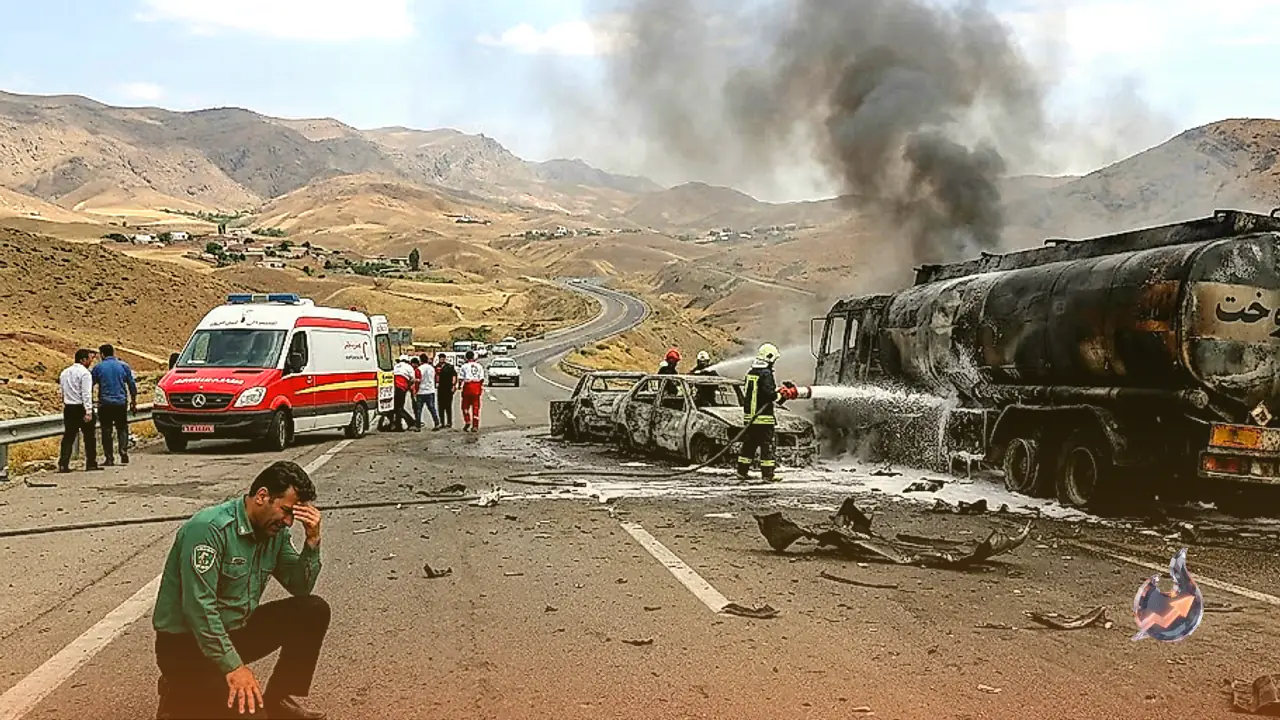
















A catastrophic explosion involving a fully loaded fuel tanker on a major highway in western Iran has claimed at least 11 lives and left 7 others severely injured. The deadly incident occurred on an inter-city transit corridor linking Sanandaj county in Kurdistan province with Hamedan county in Hamedan province. The blast triggered a massive fireball that swiftly engulfed several nearby passenger vehicles traveling along the busy thoroughfare. Emergency rescue units rushed to the scene shortly after the explosion to initiate rescue operations and contain the spreading flames.
Explosion Engulfs Multiple Vehicles Near Sanandaj Transit Route
According to Babak Hodayi, head of Emergency Medical Services at Kurdistan University of Medical Sciences, the sudden detonation of the fuel tanker immediately spread fire to adjacent passenger cars on the road. The intense inferno resulted in 11 casualties on the spot, while 7 survivors sustained serious burn injuries and trauma. Emergency responders transferred the injured individuals to specialized medical centers in Sanandaj for intensive treatment. Local authorities are currently carrying out procedures to formalize the identification of the deceased and provide updated health assessments of the injured victims.
Mechanical Malfunction Suspected in Initial Probe
Initial reports from local news agencies indicated that the fuel tanker struck multiple civilian vehicles before catching fire and exploding near a traffic police station close to Sanandaj. Preliminary technical findings suggested a catastrophic failure in the truck's braking mechanism as the primary trigger that caused the driver to lose control. Later official state communications clarified the precise location of the tragedy along the inter-provincial arterial route between Kurdistan and Hamedan. A comprehensive investigation remains underway to determine the exact sequence of events leading up to the collision.
Persistent Highway Safety Concerns and Past Tragedies
The tragedy evoked memories of a similar devastation in 2018 near Sanandaj, where a collision between a fuel tanker and an inter-city passenger bus resulted in 15 deaths and 4 injuries. Road traffic fatalities remain a persistent national issue across Iran's extensive highway network. Transport safety experts frequently point to poorly maintained commercial fleets, insufficient safety standards, widespread non-compliance with traffic regulations, and delays in emergency medical response as major factors driving high fatality rates on regional roads.
Heightened Regional Tensions Surrounding Energy Transport
This domestic road accident coincides with broader vulnerabilities surrounding Iranian energy transport infrastructure and maritime fuel routes. In July, local media recorded an oil tanker explosion in the Strait of Hormuz after the vessel reportedly drifted from designated safe lanes into a restricted area and struck a naval mine. The Strait of Hormuz connects the Persian Gulf to the Gulf of Oman and serves as a vital global transit bottleneck for crude oil and liquefied natural gas shipments. Furthermore, United States Central Command stated that on September 5, US forces engaged three Iranian crude oil vessels following an incident in which Iran's Islamic Revolutionary Guard Corps launched ballistic missiles toward two patrolling American naval warships in the region.