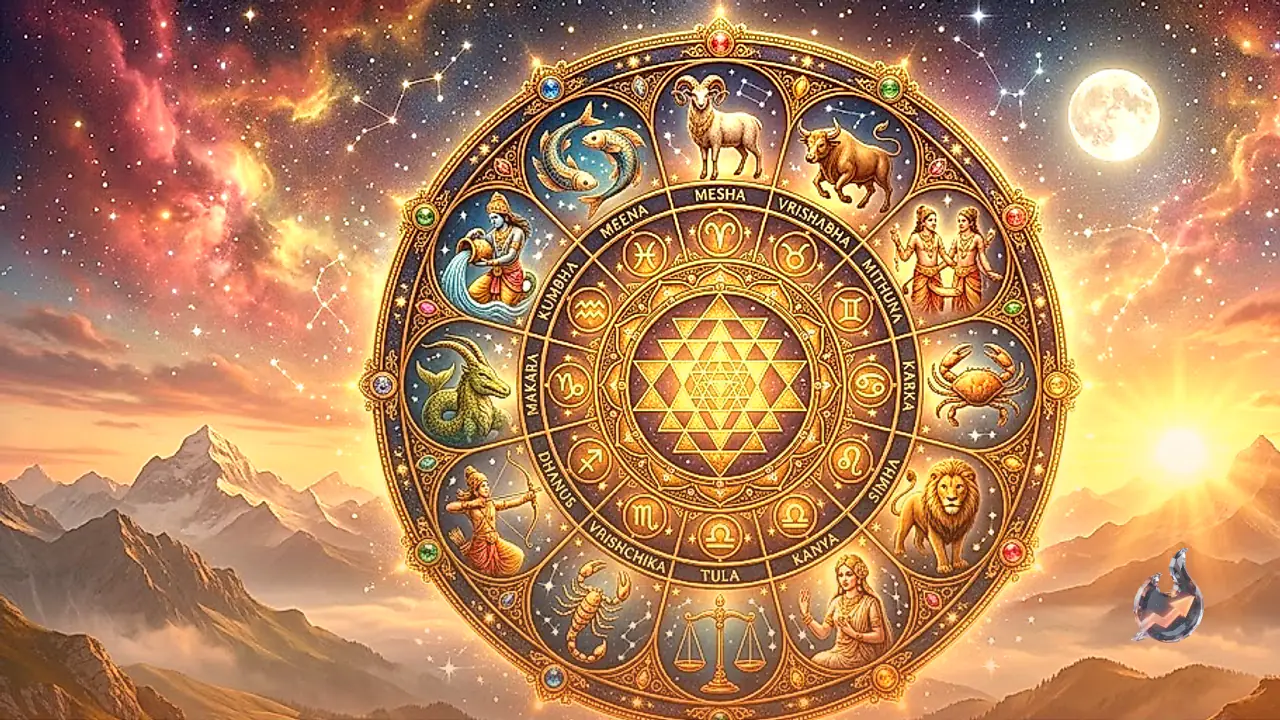






















The final lunar eclipse of the year 2026 is scheduled to occur on 28 August, a date that extraordinarily coincides with the sacred festival of Raksha Bandhan. From a purely astronomical perspective, this phenomenon will be registered as a deep partial lunar eclipse, wherein the Earth's shadow obscures a substantial portion of the lunar surface. However, within the domain of Vedic astrology, scholars and practitioners attribute immense spiritual, psychological, and social significance to this alignment. The heightened interest surrounding this celestial event stems from the fact that at the precise moment of the eclipse, the Moon will be positioned in the constellation of Aquarius (Kumbh Rashi) and traversing the Shatabhisha nakshatra. According to classical Vedic astrology, Shatabhisha nakshatra is governed by the shadow planet Rahu. Simultaneously, the Sun will be seated directly opposite in the sign of Leo (Singh Rashi). This alignment creates a direct opposition between the Sun and Moon while subjecting the Moon to the intense energetic influence of Rahu's nakshatra, an arrangement traditionally associated with emotional turbulence and mental recalibration.
Astrological Mechanics and Rahu's Influence
In the foundational structure of Vedic astrological thought, the Moon serves as the primary significator of the human mind, internal consciousness, emotional responses, thought patterns, psychological stability, and maternal connections. The position and aspects of the Moon dictate how individuals perceive their immediate environment, process inner feelings, and execute spontaneous reactions. Conversely, the air sign Aquarius governs intellectual exploration, social structures, networking channels, long-term strategic vision, and collective mass dynamics. When the Moon resides in Aquarius while being filtered through Rahu's nakshatra Shatabhisha, astrologers note that it can generate inner restlessness, persistent overthinking, unwarranted anxiety, and cognitive hesitation.
Rahu is characterized in astrological lore as the agent of mystery, unexpected shifts, intense desires, illusions, and unconventional pursuits. Meanwhile, Shatabhisha nakshatra, which is symbolized by a cluster of a hundred stars or an open circle, is intrinsically linked with healing, deep research, secret knowledge, and profound inward introspection. Because the Sun and Moon stand in direct opposition during this full moon period while Rahu exercises dominance over the lunar nakshatra, traditional astrological guidelines explicitly advise against taking hasty, impulse-driven decisions. Evaluating all dimensions of a situation with composure, clarity, and patience is considered essential before committing to any major life transition.
Five Zodiac Signs Advised to Exercise Caution
According to detailed astrological charts, the lunar eclipse on 28 August will exert distinct subtle influences across all twelve signs of the zodiac. Nevertheless, individuals belonging to five specific signs are strongly recommended to navigate this transitional period with heightened mindfulness, restraint, and tactical care
1. Aquarius
Because this lunar eclipse takes place directly within the sign of Aquarius, natives belonging to this sign will experience its psychological and personal effects most acutely. During this timeframe, you may experience an inexplicable sense of restlessness, heightened mental stress, or emotional confusion. Rumination over unresolved past issues could temporarily cloud your focus and impair daily productivity. Astrological advisors suggest avoiding impulsive choices regarding personal relationships or professional moves until you have achieved total mental clarity and evaluated all underlying factors.
2. Leo
Counting from Leo, Aquarius occupies the seventh house in the astrological chart, a domain that governs marital bonds, intimate partnerships, public interactions, and business collaborations. As a result, Leo natives must handle their personal and professional relationships with utmost care and diplomacy. Minor misunderstandings or petty arguments could escalate quickly if left unchecked. Maintaining a calm tone in conversations, avoiding autocratic behavior, and genuinely listening to your partner's viewpoint will be vital to preserving harmony.
3. Capricorn
For Capricorn natives, the lunar alignment sheds light on financial matters, material assets, and family dynamics. Unexpected expenditures could surface abruptly, disrupting your established financial planning. It is highly advisable to refrain from lending significant sums of money, entering speculative investments, or signing financial contracts without conducting thorough risk assessments. Exercising restraint in family discussions and resisting pressure-driven financial decisions will safeguard your financial stability.
4. Taurus
Taurus individuals may encounter heightened workload pressure, increased accountability, and professional stress in their workplace environment. Coordinating with colleagues, business partners, or corporate superiors might demand additional patience and diplomatic effort. Rather than making swift moves regarding career transitions, job resignations, or new business launches, take the time to verify hard facts, contractual terms, and operational realities. Reactive choices made in moments of frustration could trigger long-term career setbacks.
5. Pisces
Pisces natives are cautioned to monitor unnecessary expenses and manage rising anxiety levels during this eclipse period. Unforeseen financial drains could emerge, requiring strict budget discipline. Amidst professional duties and personal concerns, do not sacrifice your physical health, proper nutrition, or sleep routine. Refrain from making life-altering financial or emotional decisions driven purely by mood swings; maintaining a grounded, pragmatic outlook will help you navigate this phase smoothly.
Visibility in India and Sutak Period Traditions
A critical consideration regarding this lunar eclipse concerns its geographic visibility and the corresponding religious traditions. On 28 August 2026, the lunar eclipse will not be visible from anywhere within the territorial boundaries of India. Astronomical calculations confirm that the peak or maximum phase of the eclipse will occur at approximately 9:43 AM Indian Standard Time (IST). At that time, full daylight will prevail across the subcontinent, and the Moon will remain positioned below the horizon.
Because the Moon is below the horizon during the maximum phase, the eclipse cannot be observed with the naked eye from India. According to sacred scriptures and orthodox Vedic traditions, the ritualistic restrictions associated with the Sutak period, such as the closure of temple doors and prohibition of religious ceremonies, are applicable exclusively in regions where the eclipse is physically visible. Since the eclipse remains invisible in India, traditional Sutak rules do not apply. Consequently, devotees and citizens across the country can celebrate Raksha Bandhan rituals and perform their daily religious practices without hesitation or spiritual concern.