






















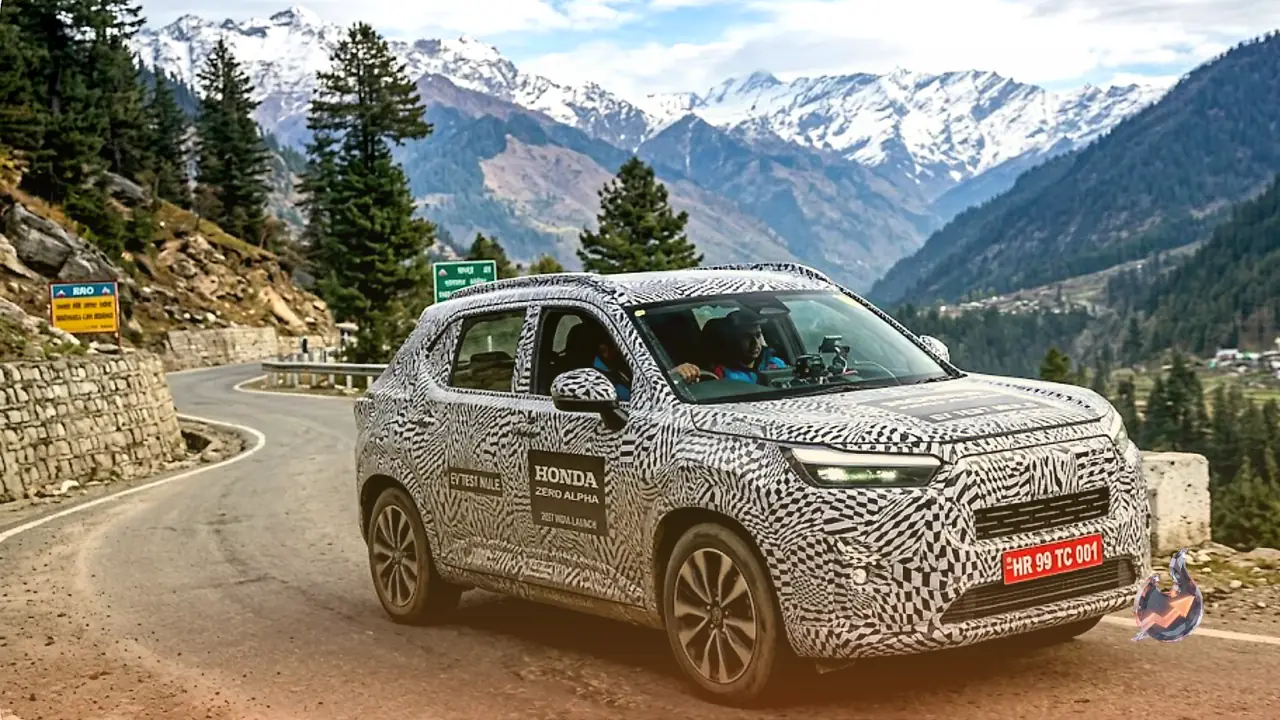

Honda's first-ever electric SUV for India, the Honda Zero Alpha, has been spotted undergoing testing on public roads, with the Manali region providing the most revealing prototype sighting yet. The test mule offered a clear view of the interior, revealing a large landscape-oriented touchscreen dominating the dashboard alongside a fully digital instrument cluster. Slated for a 2027 launch, this vehicle is built on Honda's new 'Thin, Light, and Wise' design philosophy, which places a premium on cabin space, energy efficiency, and intelligent features.
Bold Design with a Purpose
Drawing inspiration from the Zero Alpha concept car, the production prototype sports a boxy, upright silhouette that makes it instantly distinguishable. Up front, rectangular LED lights flank an illuminated Honda logo, with a slim black panel running across the face. At the rear, vertically stacked taillights and a clean tailgate complete the look. The tall roofline and generous glass area contribute to a spacious, airy cabin feel, while the aerodynamic body shape helps maximize range. The production model is expected to ride on 19-inch alloy wheels.
A Cabin Built Around Technology
Inside, the minimalist layout keeps clutter to a minimum while packing in the latest technology. A large free-standing touchscreen sits at the center of the dashboard, noticeably bigger than anything Honda currently offers in its lineup. Alongside it is a fully digital instrument cluster and a new Helix-style steering wheel fitted with multi-function controls. Paddle shifters manage regenerative braking, physical buttons handle climate control, and an auto-dimming IRVM combined with premium cabin materials deliver a genuinely upmarket feel.
Connectivity and Infotainment
The Zero Alpha is expected to support wireless Android Auto and Apple CarPlay, connected car technology, built-in navigation, and EV-specific functions such as battery monitoring and a charging station locator. Honda's new user interface is designed to make these features intuitive and straightforward to access.
Safety Equipment
Official safety specifications have not yet been confirmed, but the Zero Alpha is widely expected to include multiple airbags, ESC, hill hold assist, TPMS, and a comprehensive ADAS suite covering automatic emergency braking and lane keep assist. The purpose-built EV platform itself is designed to deliver a strong structural safety foundation.
Battery, Range, and Charging
The Zero Alpha will be a front-wheel drive, single-motor electric vehicle. The battery pack is expected to fall between 50 and 75 kWh, with 60 to 70 kWh being the most likely configuration. That should translate to a real-world driving range of 400 to over 500 km. DC fast charging is projected to take the battery from 10 to 80 percent in just 15 to 30 minutes. The PMSM motor will deliver a solid balance of performance and efficiency.
Made in India, Sold Globally
Honda plans to manufacture the Zero Alpha locally in India, with the car targeted at both the domestic market and export destinations. In the premium mid-size EV segment, it will go head-to-head with the Creta EV and the eVitara. India is central to Honda's global EV strategy, and the company has set an ambitious target of launching 10 new cars in the country by 2030.
Price and Launch Timeline
Testing will continue ahead of the planned 2027 launch. The Zero Alpha is expected to be priced between Rs 20 lakh and Rs 30 lakh (ex-showroom), placing it competitively within its segment. The model is a clear signal of Honda's serious commitment to electric mobility in one of the world's fastest-growing automotive markets.