






















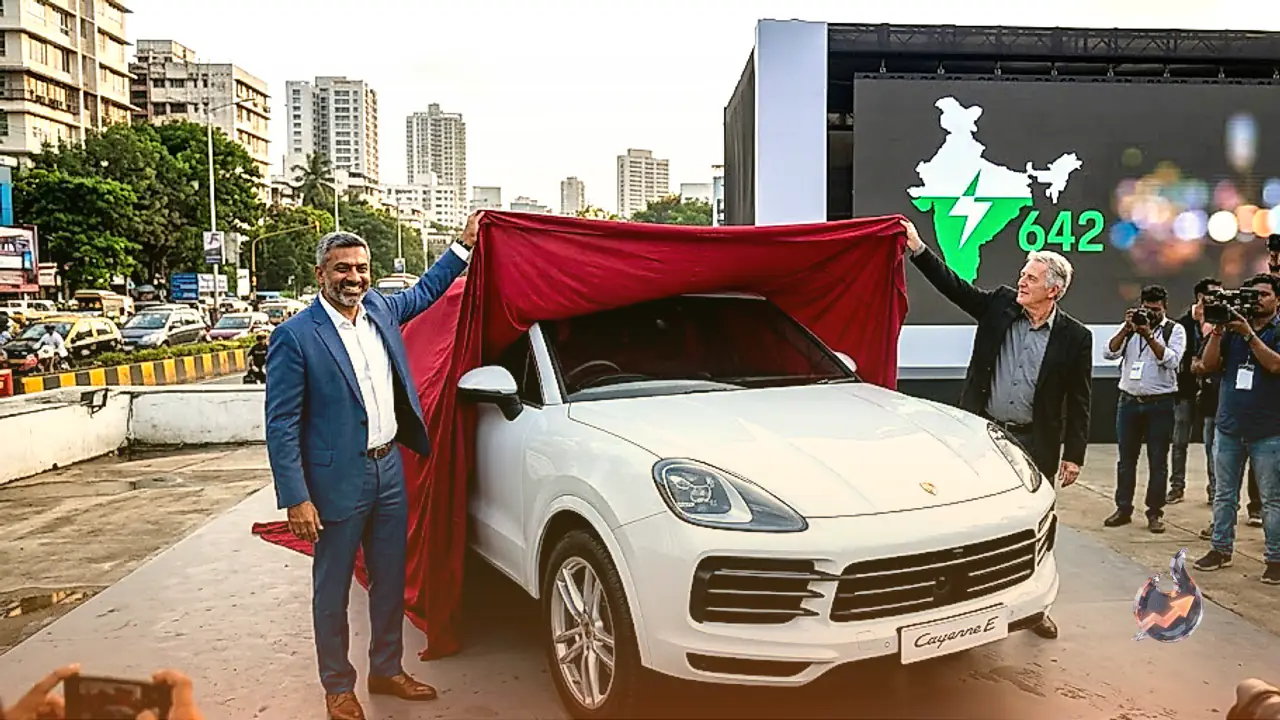

German sports car manufacturer Porsche has officially expanded its electrification journey in India with the rollout of the battery-powered Cayenne. Prospective buyers can pick between two distinct versions: the Cayenne Electric and the high-output Cayenne Turbo Electric. The standard iteration carries an ex-showroom tag of Rs 1.77 crore, whereas the performance-focused Turbo edition tops out at Rs 2.27 crore. Customer handovers have already commenced from September 30. Furthermore, petrol-powered versions of the SUV will continue to be retailed concurrently over the next decade, ensuring that buyers who still favour combustion engines have plenty of choices.
Powertrain Specifications and Acceleration Figures
Both models draw their energy from an expansive 113 KWH battery pack, engineered to deliver a driving range of up to 642 kilometres on a full charge. In terms of propulsion, the entry-level variant generates 408 horsepower under standard operation, which climbs to 442 horsepower whenever launch control is engaged. This enables the base SUV to sprint from a standstill to 100 km/h in 4.8 seconds. Moving up to the Turbo trim raises the output significantly to a staggering 1,156 horsepower alongside 1,150 Newton-metres of torque. As a result, the flagship Turbo completes the zero to 100 km/h dash in a supercar-rivalling 2.5 seconds. Porsche has equipped the vehicle with adaptive air suspension across the board, with rear-axle steering listed as an optional enhancement for sharper manoeuvrability.
Rapid Charging Capabilities and Exterior Styling
Replenishing the onboard energy reserves is streamlined through DC fast-charging support of up to 390 kW. Utilizing an outlet of adequate wattage allows the battery level to jump from 10 percent to 80 percent in approximately 16 minutes. Visually, the electric iteration carries forward the familiar silhouette of the lineage while integrating modern aero enhancements. Up front, it features a blanked-off grille paired with active aerodynamic louvres, flanked by matrix LED headlamps featuring the marque's distinct four-point daytime running light signatures.
Chassis Proportions and Luggage Capacity
In terms of physical footprint, the vehicle spans 4,985 mm in length, 1,980 mm in width, and 1,674 mm in height, riding on an extended wheelbase measuring 3,023 mm. Storage practicality is divided between a 90-litre front trunk and a 781-litre rear boot. Dropping the rear bench flat expands cargo carrying room to a cavernous 1,588 litres. Beyond carrying luggage within the cabin, the SUV is rated to tow heavy loads ranging between 3,000 kg and 3,500 kg.
Interior Appointments and Driver Assistance
Inside the cabin, the dashboard layout is centered around a curved 14.5-inch infotainment panel accompanied by an all-digital driver display cluster. Customers can optionally specify an independent 14.9-inch screen dedicated to the front passenger, as well as an augmented reality head-up display system projected directly onto the windscreen. Standard cabin amenities include 8-way powered front seats that can be optioned up to 18-way sports seats, ventilated upholstery, four-zone automatic climate control, a panoramic sunroof with sliding mechanism, and a 25W wireless charging dock. Advanced driver aids include ParkAssist featuring 2D surround-view cameras, Intersection Assist, Lane Change Assist, and Warn and Brake Assist. Hands-free tailgate operation via gestures and Comfort Access keyless entry round out the package. In the Indian luxury EV space, this new entrant goes up against established competitors such as the Lotus Eletre, BMW iX, and Audi Q8 e-tron.