

















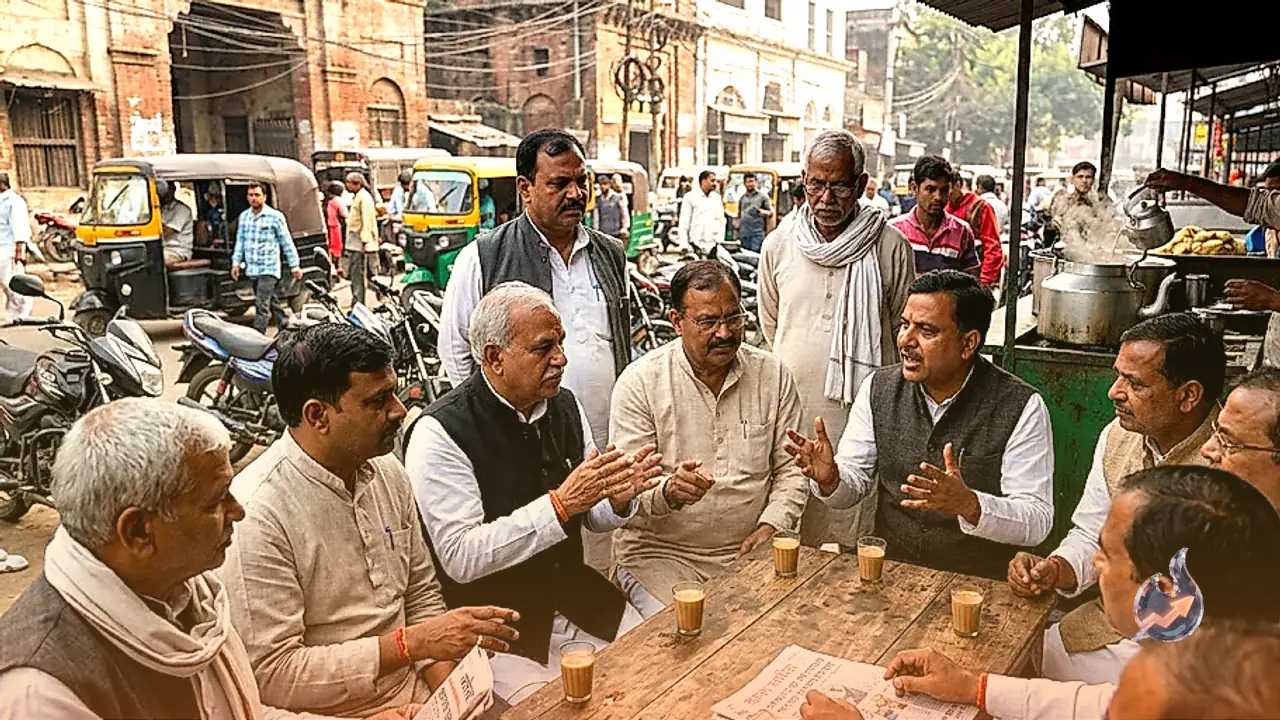

Political conversations in Patna have gained noticeable momentum, spilling out from tea stalls to the corridors around the Bihar Legislative Assembly. Citizens and political observers are actively debating the internal dynamics of the Janata Dal (United) as the legislative council graduate constituency election draws near. The central focus of these public discussions revolves around the candidacy of Neeraj Kumar, the party's choice of nominee, and the broader question of succession once Chief Minister Nitish Kumar steps back. While a section of the public expresses unwavering confidence in the party's strength, others point toward factional friction and the looming threat of internal fragmentation.
Confidence in Neeraj Kumar's Candidacy for Legislative Council Polls
Near the Bihar Legislative Assembly, discussions among local residents revealed strong support for Neeraj Kumar's electoral bid. Lalan Singh asserted that Neeraj Kumar is comfortably positioned to secure a decisive victory with a substantial vote margin. He highlighted that Neeraj Kumar is an educated and seasoned social figure, emphasizing that voters should naturally prefer qualified leadership in such contests. Singh dismissed public statements and counter-arguments appearing on the streets, maintaining that routine political rhetoric should not be misconstrued as severe internal division within the party.
Sharing the same space, Ashok Kumar pointed to the structural advantages enjoyed by the National Democratic Alliance. He observed that the NDA government is in power and the Bharatiya Janata Party possesses a solid cadre vote that provides dependable electoral support. Given that the graduate constituency represents an educated and intellectual electorate rather than uninformed voters, Ashok Kumar noted that Neeraj Kumar's long-standing role as an integral component of the administration makes him a seasoned and capable candidate. He maintained that there is no visible deficit in Neeraj Kumar's standing, and minor differences of opinion are standard during internal reconciliation processes within any political organization.
Nishant Kumar as Political Heir: Continuity or Discord
Addressing the broader question of leadership succession in the JDU, Avinash Chandra offered a perspective grounded in generational transition. He noted that Nishant Kumar has stepped forward following Nitish Kumar and carries the profile of a balanced and composed personality. Drawing a direct parallel with the Rashtriya Janata Dal, where Tejashwi Yadav took charge of Lalu Prasad Yadav's political mantle, Chandra argued that Nishant Kumar will similarly inherit and guide Nitish Kumar's legacy. In his assessment, Nishant Kumar is well-equipped to steer the party smoothly without triggering a split, adding that any departures by disgruntled leaders would merely clear the path for consolidated leadership.
Offering a contrasting viewpoint, Bhola Ji argued that the possibility of internal fractures within the JDU cannot be dismissed so lightly. Emphasizing the intellectual nature of the electorate in this election, he questioned the party's insistence on nominating the same familiar figure repeatedly. Bhola Ji noted that while holding power in the state government, the leadership ought to have provided opportunities to fresh faces. He asked whether the JDU lacked other capable and intellectual members, pointing out that several talented leaders within the ranks were overlooked. He contended that repeating a candidate despite visible internal dissent dampens enthusiasm across the cadre, whereas promoting new talent would have united the organization.
Factional Rivalries, High-Level Silence, and the Lifespan of Regional Parties
Arvind Sinha brought attention to the optics of the ongoing friction, addressing the controversy between Neeraj Kumar and Anant Singh. While Sinha considered the rift to be fundamentally a personal dispute rather than an existential party matter, he acknowledged that the public inevitably interprets it through a political lens. Crucially, Sinha noted that prolonged silence from the party high command breeds public skepticism, fostering the impression that an intense battle for supremacy is underway beneath the surface.
Expanding on the political trajectory of regional formations across India, Sinha outlined an observed historical trend. Citing political developments in states such as Tamil Nadu, he explained that regional entities frequently encounter severe survival challenges after completing 20 to 25 years of existence. Over time, many such organizations experience gradual erosion and eventually merge into larger political forces. In Sinha's view, the JDU has entered precisely this cyclical phase, where unresolved leadership succession and escalating internal strains pose critical questions about its long-term endurance.