


















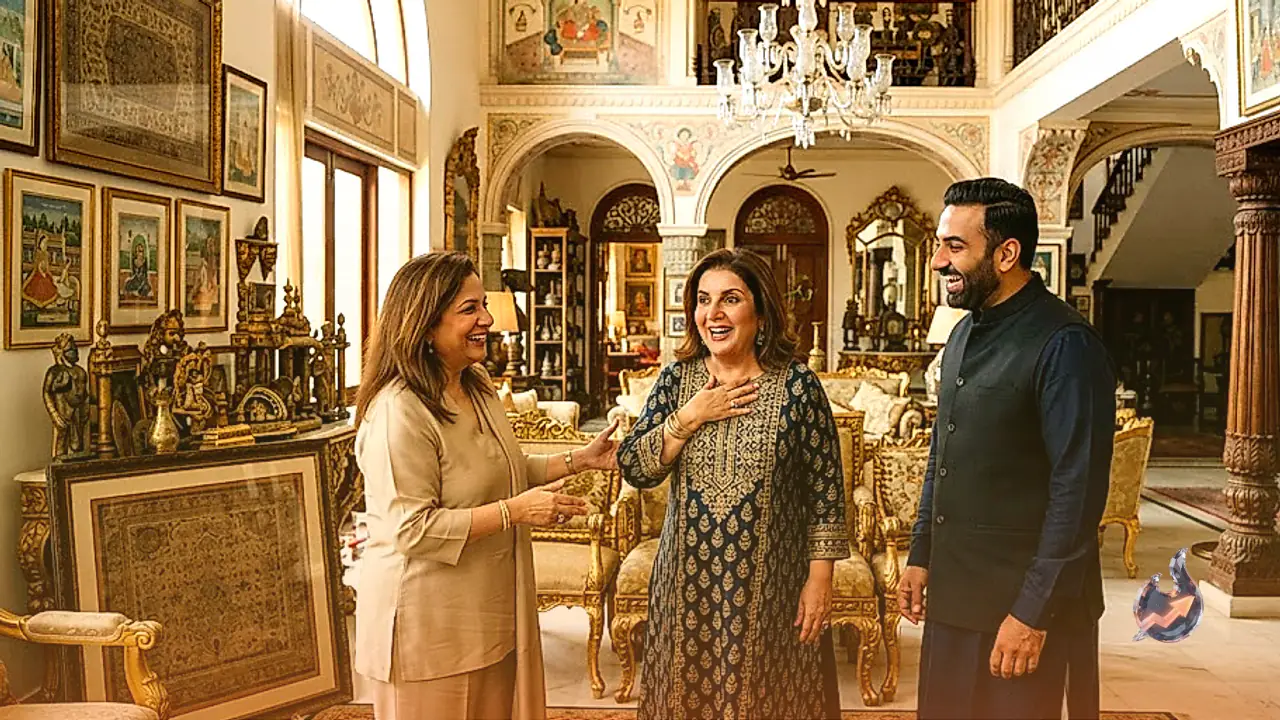

Known across the Indian film fraternity for crafting regal, era-defining period costumes, designer duo Rimple and Harpreet have captured the limelight for their extraordinary private residence. Having previously created the elaborate visual palettes for Sanjay Leela Bhansali's magnum opus film Padmaavat and the period drama series Heeramandi, the celebrated pair recently hosted filmmaker and choreographer Farah Khan at their residence. Rimple and Harpreet are currently entrusted with the monumental wardrobe responsibilities for Namit Malhotra's highly ambitious cinematic spectacle Ramayana, mounted on an estimated budget of ₹4,000 crore. During her walk through their Delhi estate, Farah Khan found herself mesmerized by the sheer density of priceless antiquities, historic art masterpieces, and architectural grandeur woven into the living spaces.
A 10,800 Square Foot Sanctuary in Green Avenue
Located in the Green Avenue enclave of Vasant Kunj in New Delhi, the sprawling bungalow covers roughly 10,800 square feet of meticulously designed interior space. Assembling the historic treasures, bespoke architectural fittings, and rare art objects scattered across the house required a dedicated five-year effort from the designer couple. Far from resembling an ordinary high-end city bungalow, the property functions much like a palatial sanctuary or an expansive private art museum. It boasts towering ceiling heights, an internal lift uniting multiple residential tiers, a secluded private swimming pool, and an array of rare historic artifacts acquired from across the globe. Each wing and corridor of the residence reflects a deliberate commitment to fine design and heritage preservation.
Masterpieces by Modern Legends and Historic Auctions
The moment she stepped through the primary foyer, Farah Khan was greeted by an array of celebrated modernist paintings lining the walls. Standing out among the prominent display is an iconic piece by the legendary pioneer of modern Indian art, FN Souza. Taking in the canvas, Khan spontaneously remarked that an artwork of this caliber truly belonged within the walls of a national museum. FN Souza remains one of the most revered figures in contemporary Indian art history, with his premier works frequently commanding record-breaking valuations on global auction blocks. An untitled painting by FN Souza preserved inside the home of Rimple and Harpreet had commanded an impressive price of ₹1.08 crore during a notable auction held in 2023.
The creative collection displayed across the estate extends well beyond a single marquee acquisition. Adorning the surrounding walls are substantial creations by modern stalwarts including Thota Vaikuntam and Sakti Burman. Sculpted stone figures, metal craft, and time-honored curios occupying quiet niches deepen the home's historic resonance. After examining the extensive compilation of fine art, Farah remarked that only a fellow creator could truly comprehend and honor the dedication behind another artist's craft. Accompanying her on the walkthrough, Dilip playfully chimed in that entering the estate felt entirely like stepping directly into an authentic royal palace.
Harmonizing Royal Indian Heritage with European Vintage Craft
The interior architecture throughout Rimple and Harpreet's home establishes a measured dialogue between aristocratic Indian heritage and European vintage elegance. Across several rooms, antique hand-knotted Persian carpets lie beneath seasoned wooden furniture, ornate heritage accessories, and glass-surfaced center tables. A cluster of colored glass fruits resting upon a table immediately caught Farah Khan's eye. Intrigued by their clarity, she asked whether the ornamental fruits had been acquired from Venice. Harpreet clarified that the handcrafted pieces were sourced directly from the island of Murano in Italy, a world-famous center renowned for centuries of glassmaking mastery.
A dedicated wall in the house honors traditional Pichwai art, preserving the sacred imagery and cultural heritage of Rajasthan. In contrast, the expansive main living lounge embraces modern spatial concepts. It features towering ceiling heights, exposed timber beams, expansive glass windows inviting ample natural illumination, polished stone flooring, and earthy tonal palettes. By placing centuries-old traditional sculptures and classical canvases alongside streamlined contemporary furniture, the entire lounge appears as though staged for the cover of an international architecture journal.
Custom Jamawar Dining Table and Reconstructed Chandeliers
The dining room commands attention for its custom furniture pieces conceived and detailed entirely by the hosts. Both the monumental dining table and the dramatic chandelier suspended overhead were personally conceptualized by Harpreet. Providing insight into the overhead centerpiece, Harpreet explained that elements salvaged from numerous dismantled antique chandeliers were carefully restructured to form an entirely fresh and cohesive lighting installation.
The concept framing the dining table carried an equally distinct decorative narrative. Harpreet shared that the pattern and structural detailing took direct inspiration from the intricate weaves of heirloom Jamawar shawls. To bring the vision to life, the artisans integrated slabs of natural stone precisely matched to the ambient tones of the surrounding stone floor. Through this intervention, historic textile motifs found a permanent and functional expression within a luxury living environment.
Regal Canopy Guest Suite and a Contemporary Kitchen
Continuing the personal tour into the guest bedroom, Farah Khan humorously laid claim to the room, announcing that she intended to make it her own personal quarters. The suite is dominated by a majestic four-poster canopy bed draped with heavy designer curtains, flanked by heritage accent furniture, decorative screens, and period antiques. The ambiance within the room closely parallels the residential feel of an ultra-luxury heritage palace hotel suite. Adding to the lighthearted banter, Rimple joked that whenever Farah stays at their residence, she gladly attends to her comfort by pressing her feet.
The party subsequently toured the state-of-the-art modular kitchen, which leans heavily into modern functional aesthetics. Outfitted with rich teal blue cabinetry, crisp white countertops, patterned geometric flooring, and a dedicated central prep island, the culinary space stands out for its crisp modernity. Large exterior-facing windows flood the room with fresh breeze and abundant daylight, balancing the rich historic sensibilities found across the rest of the residence.
The Business of Bridal Fashion and Epic Cinematic Projects
Beyond architectural aesthetics and rare decor, the conversation naturally transitioned toward the realities of the Indian fashion economy. Rimple and Harpreet noted candidly that the overwhelming volume of their design enterprise is powered by the seasonal Indian wedding market. Commenting on the structural landscape of home-grown fashion, Harpreet observed that India functions predominantly as a wedding industry rather than a conventional fashion runway economy. Farah Khan concurred with the assessment, acknowledging that the most significant capital and custom fashion revenues in the nation stem from weddings.
Having cemented their status in the film industry through grand cinematic achievements like Padmaavat and the period web series Heeramandi, the duo is now fully invested in crafting period-accurate wardrobes for the upcoming cinematic saga Ramayana, planned on a vast ₹4,000-crore scale. While excitement continues to mount regarding how their creative genius will shape the visual identities of epic cinematic characters, their remarkable 10,800-square-foot Delhi home has already captivated audiences as a testament to historic luxury and artistic preservation.