














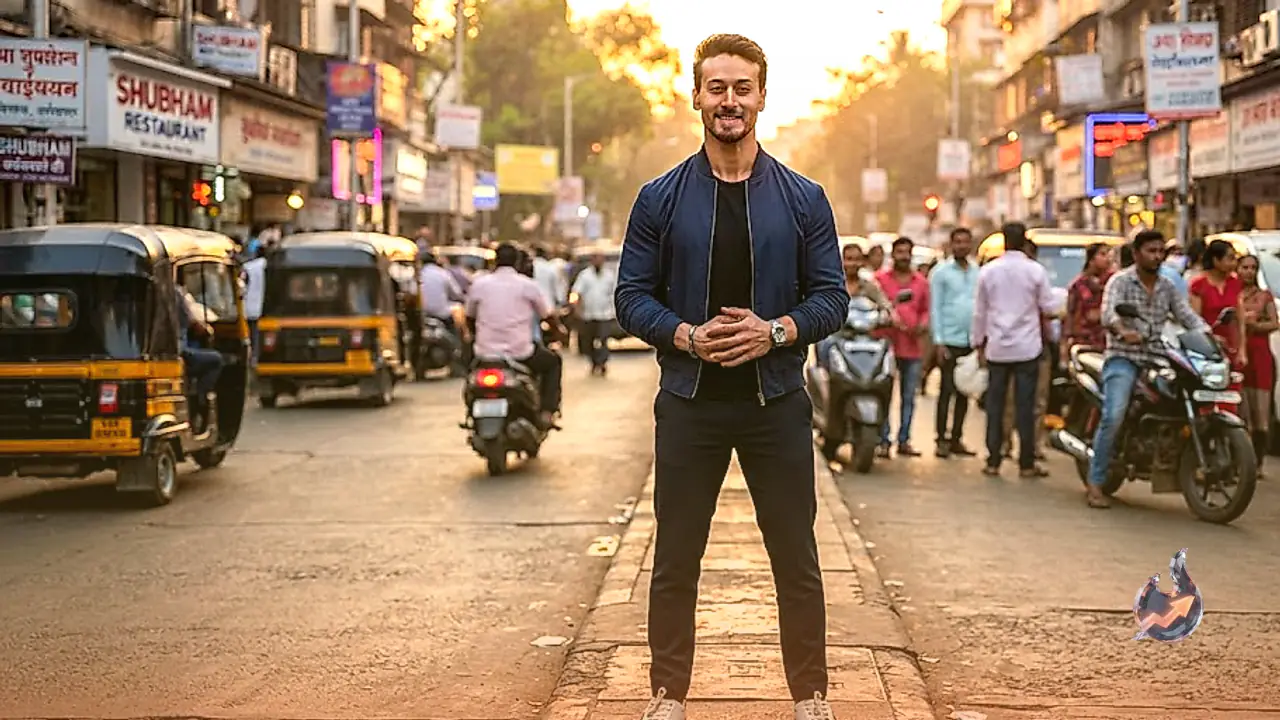

A shocking violent incident in the Juhu locality of Mumbai has recently brought actor Tiger Shroff into national focus. On Sunday evening, 18 October 2026, at approximately 7 PM, three unidentified individuals riding a motorcycle opened fire on his vehicle near Pushpa Park. While the event triggered widespread concern and attention across the film industry, it has also sparked renewed public curiosity regarding his personal life, educational background, martial arts foundation, and how he established himself as one of contemporary Bollywood's foremost action icons.
Early Life and Identity Beyond a Famous Surname
Widely recognized by his screen name, the actor was born on 2 March 1990 in Mumbai, Maharashtra, under the legal name Jai Hemant Shroff. Although his father, Jackie Shroff, remains one of Indian cinema's most revered veterans, the younger Shroff chose to carve out a distinct professional path. Standing roughly 5 feet 8 inches tall, equivalent to 1.73 meters, he did not rely solely on traditional dramatic roles. Instead, he channeled his energy into extreme physical fitness, difficult stunts, and rhythmically complex choreography, gradually defining a signature brand of high-octane entertainment.
Schooling Years in Juhu and Focus on Physical Training
His academic journey commenced at the Besant Montessori School in the Juhu neighborhood of Mumbai. Later, he transferred to the American School of Bombay, a prominent international institution where he eventually finished his secondary education. Even as a school student, his primary passion lay well outside conventional textbooks. Fitness conditioning, competitive sports, and combat arts occupied much of his free time. By balancing standard classroom lessons with rigorous daily physical training, he laid the physiological groundwork that would subsequently define his acting profession.
The Decision to Bypass a College Degree
Upon completing his twelfth-grade schooling at the American School of Bombay, Shroff took steps toward pursuing higher education by enrolling in a reputable national university. However, his tenure as a collegiate student was cut short almost immediately. Prominent Bollywood producers were already taking notice of his physical capabilities and visual screen presence, leading to a direct offer to headline an upcoming feature project. Realizing that preparing for a demanding cinematic launch required total dedication, he opted to withdraw from his university program. Consequently, while he holds a completed high school diploma, he never pursued or received a formal university degree.
A Commercial Breakthrough with Heropanti
Choosing cinema over formal academics enabled Shroff to commit himself fully to intensive acting rehearsals, physique sculpting, and acrobatic agility. That focused preparation culminated in his 2014 theatrical debut with the romantic action release Heropanti. Helmed by director Sabbir Khan and backed by producer Sajid Nadiadwala, the production also served as the debut vehicle for actress Kriti Sanon. Portraying the central protagonist named Bablu, Shroff immediately captured public attention through clean acrobatic execution and striking screen charisma.
Heropanti achieved considerable commercial success, accumulating more than Rs 77.9 crore in worldwide box office receipts. His performance quickly earned him significant industry honors, including the Filmfare Award for Best Debut Male. He was additionally recognized with the Most Promising Newcomer - Male trophy at the Screen Awards, alongside the Star Debut of the Year honor presented at the International Indian Film Academy, widely known as the IIFA Awards.
Starting Martial Arts at the Age of Four
A central pillar of Shroff's public image is his genuine background in combat disciplines. Rather than picking up martial arts as a temporary requirement for film roles, he began learning Wushu and Taekwondo at the tender age of four. Drawing deep inspiration from martial arts icon Bruce Lee, he spent years refining traditional techniques, physical discipline, and spatial awareness. That lifelong pursuit ultimately transitioned seamlessly to the big screen, allowing him to perform complex stunt sequences that require years of muscle memory.
Fifth-Degree Black Belt in Taekwondo
His martial arts credentials extended into formal athletic validation when, in 2014, he was awarded an honorary fifth-degree black belt in Taekwondo. This rank reflects a high degree of technical mastery and physical dedication. It also explains why he consistently undertakes high-risk stunts and complex choreographies personally rather than relying heavily on body doubles. Spectators witnessed the practical results of this rigorous combat upbringing across blockbusters such as Baaghi, War, and Munna Michael, where his hand-to-hand fight sequences demonstrated authentic technique.
Consolidating Star Power Through the Baaghi Franchise
In 2016, Shroff reunited with director Sabbir Khan and producer Sajid Nadiadwala for the raw action film Baaghi. The project pushed his athletic limits further and resonated strongly with domestic and overseas audiences. Generating roughly Rs 127.05 crore globally, Baaghi confirmed his standing as a dependable box office draw and laid the foundation for a lasting action franchise centered on his character.
Expanding Across Action, Superhero, and Dance Genres
That same year, he headlined the superhero action-comedy A Flying Jatt, directed by choreographer-turned-filmmaker Remo D'Souza and co-starring Jacqueline Fernandez. The film showcased his signature dance fluidity alongside comic-book action, earning him the Favourite Dancing Star honor at the Nickelodeon Kids' Choice Awards as well as the Most Entertaining Dancer title at the Big Star Entertainment Awards. In 2017, he followed up with Munna Michael, an energetic homage blending dance routines with high-stakes fight sequences. Through each consecutive cinematic outing, Shroff has continued to lean into his core competencies of athletic combat, intense physical preparation, and dynamic dancing.