














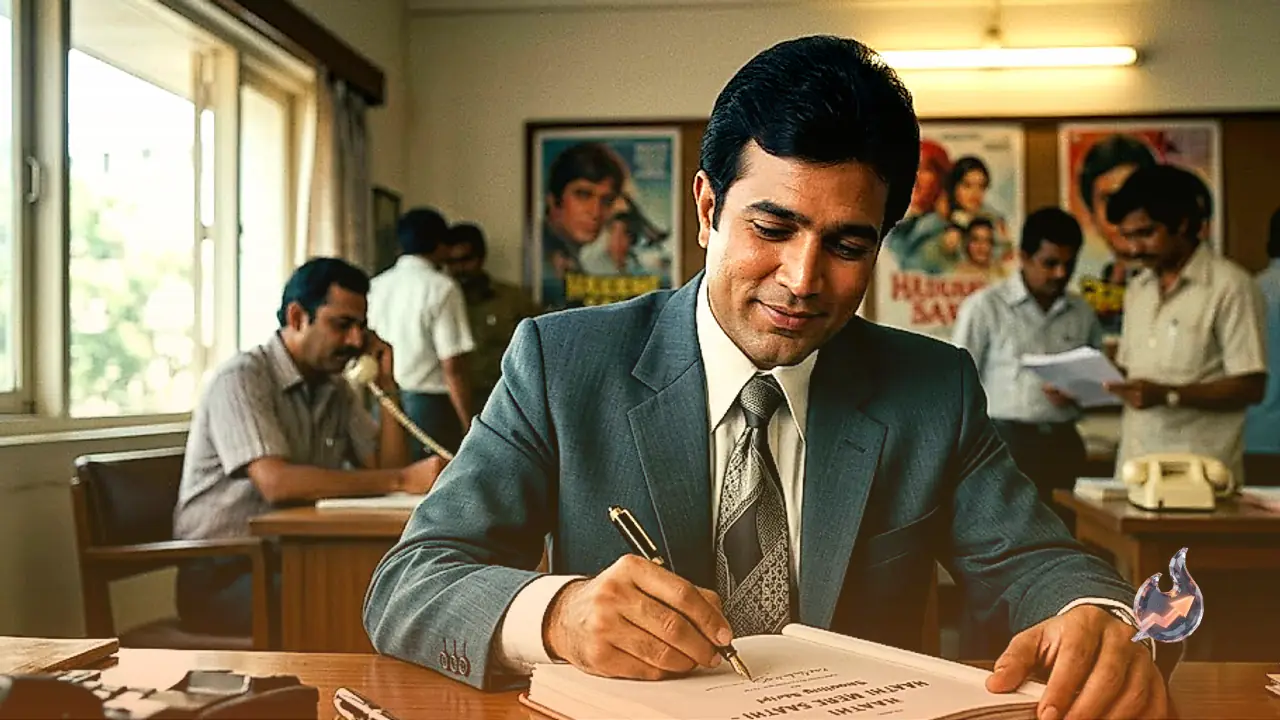

In the chronicle of Indian cinema, Rajesh Khanna holds a legendary stature as the first actor to achieve an unbroken record of 15 consecutive box-office blockbusters. Popularly remembered by fans as Kaka, his box-office dominance during his prime reached a level where commercial triumph became almost routine. The sheer frequency of his success created a unique situation where the superstar found himself longing for a box-office failure just to break the relentless streak. Driven by this wish, he deliberately took up a project he considered narrative-wise weak, only to watch it turn into yet another mega-hit.
The Golden Streak Beginning with Aradhana in 1969
The phenomenal phase of Rajesh Khanna's career commenced in 1969 with the release of 'Aradhana'. Following the massive acclaim of this feature, he delivered an unmatched string of hit films that filled theaters across the country. During this era, his popularity was so immense that four to five of his distinct movies would often run concurrently in cinema halls. Enthusiastic moviegoers would routinely exit one auditorium screen only to walk into another within the same complex to catch another Kaka starrer, ensuring every single venture registered commercial victory.
This legendary run of 15 consecutive hits included monumental titles such as 'Aradhana', 'Doli', 'Bandhan', 'Ittefaq', 'Do Raaste', 'Khamoshi', 'Safar', 'The Train', 'Sachaa Jhutha', 'Aan Milo Sajna', and 'Kati Patang'. Each of these features left an enduring imprint on moviegoers and established his unprecedented status in Hindi mainstream cinema.
Signing Haathi Mere Saathi in 1971 Anticipating a Flop
Amidst this uninterrupted stream of glory, Rajesh Khanna grew increasingly eager to witness a flop that might interrupt his routine box-office winning spree. It was during this phase in 1971 that he was presented with the screenplay for 'Haathi Mere Saathi'. Upon evaluating the script, he felt that the storyline lacked compelling drama and substance, convincing him that the project was bound to fail at the box office.
Expecting it to be a commercial disaster, he agreed to do the film specifically in the hope that it would end his streak. However, when 'Haathi Mere Saathi' released in theaters in 1971, his predictions proved completely inaccurate. The movie resonated deeply with audiences of all age groups, turning into one of the biggest blockbusters of that year and further extending his winning record.
Unprecedented Stardom, On-Set Delays, and Professional Friction
The immense surge of continuous stardom eventually impacted Rajesh Khanna's daily routine and professional relationships. The wave of success fostered a sense of arrogance and indifference, leading to repeated late arrivals on film sets and disregard for scheduling constraints. Numerous film producers and co-stars expressed dissatisfaction over these habits, finding it difficult to manage production timelines.
Nevertheless, Kaka remained untroubled by the rising criticism and refused to alter his routine. Media accounts from that time noted his stance that regardless of how a film fared or what happened to his acting career, he had no intention of modifying his personal lifestyle or compromised convenience.
Career Shift in the 1980s, the Rise of Amitabh Bachchan, and Final Release
By the arrival of the 1980s, the dynamics of Indian cinema underwent a significant transformation, marking a period of decline in Rajesh Khanna's career as several of his projects failed to perform. This decade saw the meteoric rise of Amitabh Bachchan, whose 'Angry Young Man' persona captivated a new generation of moviegoers. As Bachchan's intense screen image dominated the box office, Kaka's romantic stardom began to fade from its peak position.
Rajesh Khanna passed away in 2012 at the age of 69. His final film project, titled 'Riyasat', had been filmed prior to his death. The movie could not be released during his lifetime and eventually arrived in theaters on 18 July 2014, exactly two years after his passing.