























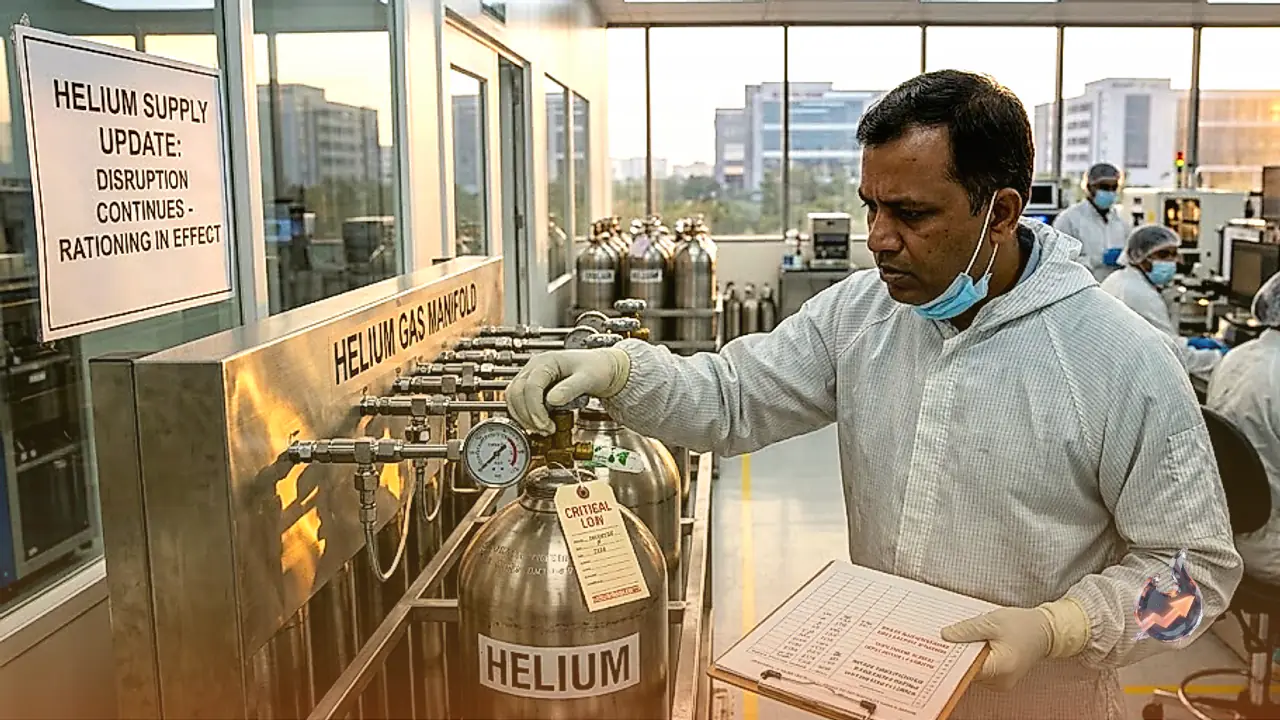

A little-noticed gas that quietly powers hospitals, factories and rockets has suddenly become a flashpoint. China has abruptly stopped exporting helium, and for India that decision lands like a headache. The reason is simple: India imports 100 percent of the helium it needs, with no large domestic source of its own. Of that, roughly 50 percent comes from Qatar alone, a country now badly entangled in tensions linked to Iran. From hospitals to space, and now the semiconductor mission, this gas is needed almost everywhere. Here is the full picture, explained in plain terms.
What helium is and why it matters so much
After hydrogen, helium is the second lightest element in the universe. It is a colourless, odourless and tasteless gas that does not catch fire. Its biggest strength is that it can stay liquid even at extremely cold temperatures. Even when mixed with another chemical, it does not react quickly, which makes it very stable. The catch is that helium exists in very limited quantities on Earth, and once it is used up, it cannot be manufactured again. That is exactly why it is treated as such a precious resource.
Why China suddenly shut the tap
China has taken this step to protect the needs of its own industries. Helium supply is shrinking fast across the world, and China itself imports about 85 percent of the helium it uses. Once supply from countries like Qatar began to falter, China turned cautious and decided its own demand would come first. It does not want work in high-tech sectors like AI chip manufacturing and quantum computing to stall for even a moment. So it chose to halt exports and keep its stock for itself.
Where the world gets its helium
The United States, Qatar and Russia are the largest and most important producers of this gas. Beyond them, Canada and Algeria also supply some helium to the world. What stands out is that China accounts for just 1.6 percent of the world's total helium production. Because output is limited to only a handful of countries, the global supply chain is extremely fragile. Sanctions on Russia and disruptions in supply from Qatar have together triggered a severe helium shortage in the market.
How big a blow this is for India
India is entirely dependent on other countries. More than 50 percent of its helium comes from Qatar alone. The situation worsened in March 2026, when a bomb fell on Qatar's Ras Laffan plant and hit production there. On top of that, the closure of the Strait of Hormuz brought maritime trade almost to a standstill. The result of all this is that helium prices have already climbed 35 to 50 percent, and that burden is now set to spill over onto several sectors.
A direct hit on healthcare, MRI could get costlier
Helium is used most heavily in the medical sector, especially in MRI scanner machines. These machines contain powerful magnets, and liquid helium is used to keep them cold enough to work, at a temperature of minus 269 degrees Celsius. If helium supply is choked or the gas becomes very expensive, getting an MRI scan at a hospital could move out of an ordinary person's reach. In other words, this crisis will reach patients directly.
The strain on the chip and space missions
The government is pushing hard to make semiconductors within the country, and helium could become a major obstacle right there. Making a chip requires this gas to cool silicon wafers very quickly and evenly. On top of that, while chips are being made at very high temperatures, helium creates a safe environment that stops the chip from getting damaged. If the shortage persists, plans to set up chip factories in India could slow down. Helium is also essential for ISRO's rocket launches, where it is used to clean the fuel pipes and clear out dangerous vapours.
The internet and mobile networks are in the line of fire too
Today's high-speed internet and mobile networks rest entirely on optical fibre cables laid underground. When these cables are made, molten glass is drawn into thin threads, and helium is used to cool them rapidly. The gas ensures that no bubbles of oxygen or nitrogen form inside the fibre, so that internet speed never weakens. Clearly, if helium runs short, connectivity will feel the impact as well.
Does India have no reserves of its own
India does have a few sources of helium, but they are far too small against its demand. The natural gases escaping from the hot springs at Bakreshwar in West Bengal contain about 1.4 percent helium. Beyond that, the monazite sands of Kerala in South India also hold some helium. This helium forms naturally from the breakdown of radioactive elements like thorium and uranium, but extracting it is a very long and expensive process.
Why large-scale extraction is so hard here
Around the world, helium is mostly pulled out from underground along with natural gas. To extract it commercially, natural gas must contain at least 0.3 percent helium. The natural gas in the United States and Qatar carries a fairly good share of helium, which makes separation easy there. In contrast, the gas found in India's oil and natural gas basins holds a very small amount of helium, which makes extraction here anything but profitable.
Even moving it around is a tough task
Transporting helium from one place to another is extremely costly in itself. To ship it across the seas from one country to another, it has to be stored either as a highly pressurised gas or as a cryogenic liquid. That calls for specially built vacuum-jacketed stainless steel vessels. And the most startling part is that these special containers, too, are largely made by China, which means China's grip runs through nearly every part of this game.