





















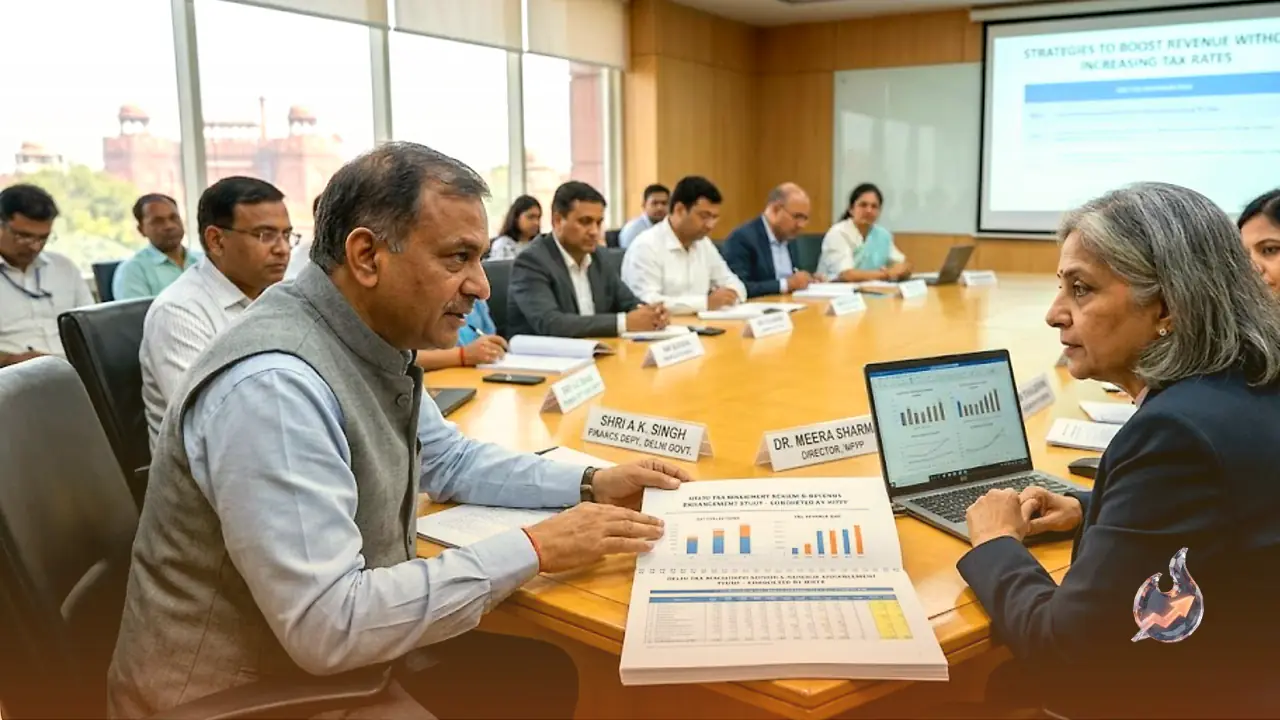

Worried about a possible leak in its revenue and determined to find out exactly why the money isn't coming in as expected, the Delhi government has taken a major step. It has decided to have its entire tax structure examined in detail, handing the job to the National Institute of Public Finance and Policy (NIPFP). This wide-ranging study will look into where the weak spots lie across GST, VAT, excise, stamp duty, vehicle tax and other key revenue streams, and pin down the reasons the government is falling short of what it should be collecting.
The government firmly believes that revenue can rise sharply without touching tax rates at all, provided the tax administration, data monitoring and enforcement machinery are made far tighter and sharper. It is with this thinking that NIPFP has been asked to assess the existing system and then come back with concrete recommendations for reform.
GST Collection Fell Behind the Target
The whole exercise began after GST collection failed to reach its target. For the financial year 2025-26, the Delhi government had set a goal of raising 40 thousand crore rupees from GST, but the actual figure came in lower. According to the economic data, GST and VAT together brought in a total of 36,629.54 crore rupees. It was this gap that pushed the government to understand whether the shortfall was rooted in economic conditions, administrative hurdles, or whether tax was simply leaking away somewhere.
During the study, the trade and taxes department, the excise department, the transport department and the revenue department will be reviewed, along with the entire setup tied to stamp duty and property registration. Experts will also probe how effectively digital technology is being used, at what level data analytics is being carried out, and how well the current measures against tax evasion are actually working.
Big Targets for 2026-27
For the current financial year 2026-27, the government has fixed ambitious tax collection targets. It believes that reaching these higher goals will require making the tax system more transparent and more technology-driven, so that collection becomes stronger and steadier.
Focus on the Tax-to-GDP Ratio
Another major aim of the Delhi government is to lift its tax-to-GDP ratio. In 2024-25 this ratio stood at 4.9 percent, and it is estimated to climb to 5.16 percent in 2025-26. The healthier a state's tax-to-GDP ratio is, the stronger its ability to raise resources for development schemes is considered to be, which is precisely why the government is paying close attention to it.
Learning From Other States' Models
NIPFP will not confine itself to Delhi's tax framework alone. The institute will also study the successful tax collection systems being followed in other states and Union Territories. Its report will spell out which technologies, which monitoring systems and which administrative reforms can be adopted to curb tax leakage and push revenue higher. The government is confident that once this exercise is complete, its tax administration will be stronger than ever, and revenue can be increased without imposing any new tax. The direct benefit of this will be that the government has more funds on hand for development projects, infrastructure and public welfare schemes.