


















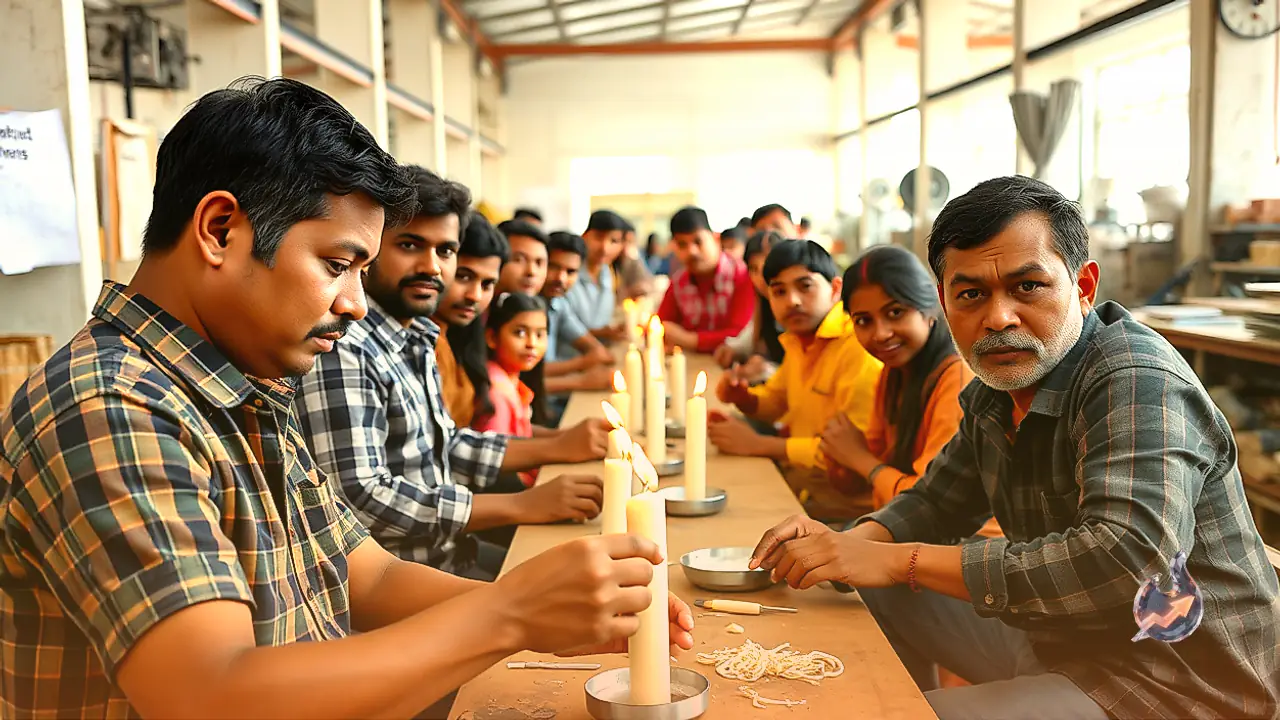

Efforts to expand rural livelihoods and financial independence are gaining momentum through accessible micro enterprise initiatives. In Amethi, women from local self help groups alongside unemployed youth are receiving hands on training in candle manufacturing. Organized by the RSETI institute, this skill development programme is delivered completely free of charge. It offers an accessible pathway for aspiring rural entrepreneurs looking to establish home based production units with very modest capital investment.
Production Steps and Raw Material Dynamics
The manufacturing process involved in candle making is straightforward and requires no complicated machinery. Explaining the workflow, self help group member Pinki shared that the primary requirement is raw wax. The solid wax is placed in a melting container and heated until liquefied. Simultaneously, production moulds are thoroughly cleaned and inspected to ensure a flawless final finish. Once wicks are positioned within the mould, the molten wax is poured in carefully. After an interval of 10 to 15 minutes, the wax solidifies completely, allowing the finished candles to be demoulded and set aside for packaging.
For standard utility candles, paraffin wax serves as the basic raw material. The primary supplies required comprise wax, cotton wicks, suitable moulds, and auxiliary tools. All necessary raw materials can be conveniently sourced in bulk from Kanpur. Looking at the unit economics, one kilogram of wax costs roughly 180 rupees and yields about 100 standard candles. By blending specialized pigments into the heated wax, makers can also produce vibrant, decorative candles suited to premium retail markets. Fellow group member Archana Kumari highlighted that mastering this craft equips village women with the capability to start earning independently while working from their residences.
Investment Needs and Enrollment Process
Highlighting the economic relevance of the craft, Mahima, a master trainer and faculty member at the institute, pointed out that skill modules are scheduled with market opportunities in view. Festive occasions such as Deepawali generate massive seasonal demand for decorative and utilitarian candles, providing local makers with a lucrative commercial window. She outlined that an aspiring entrepreneur can launch this business with an estimated seed capital of 8 to 10 thousand rupees.
Those wishing to enroll in this complimentary training must register their mobile phone number alongside submitting a copy of their Aadhar card and photographs. The facility operates near Vikas Bhavan in Amethi. Beyond on campus instruction, training teams also travel directly into surrounding villages to deliver outreach sessions, ensuring rural women gain direct access to practical commercial skills without encountering travel hurdles.