





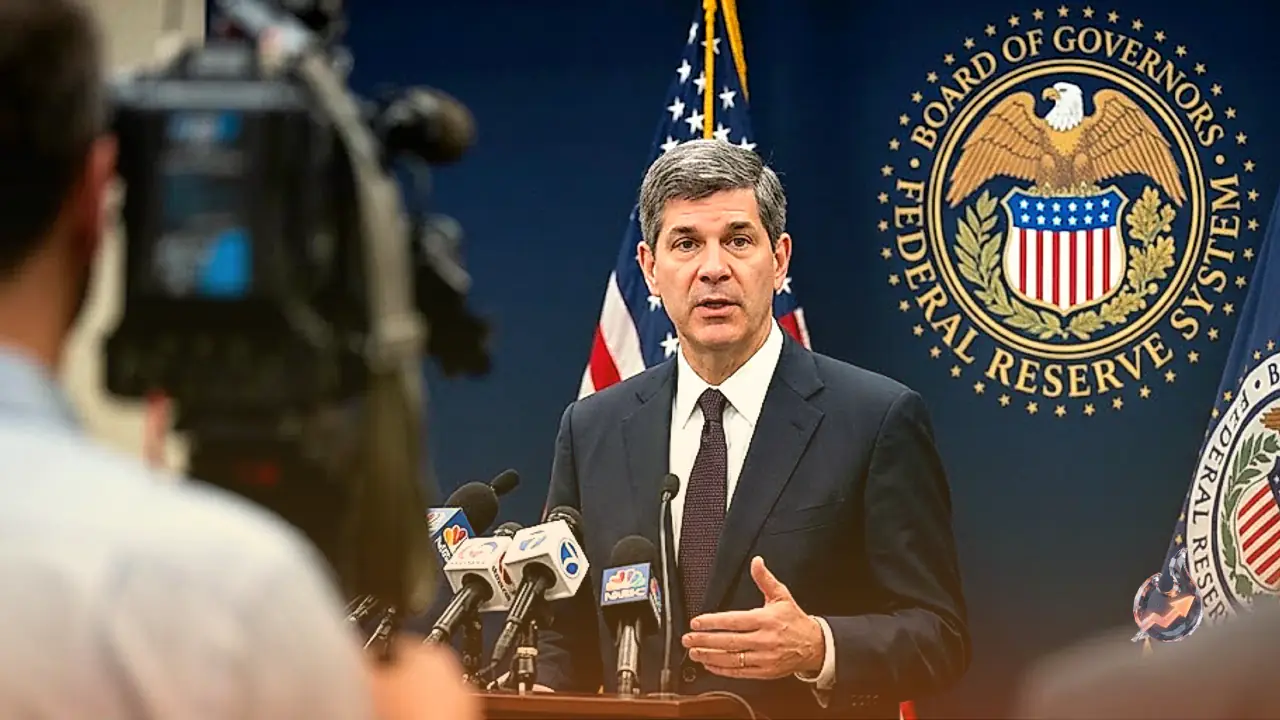
















Selling pressure resurfaced across global currency trading on Friday as the head of the United States central bank refrained from offering forward guidance ahead of upcoming monetary policy meetings. Speaking at an event in Bangkok, Federal Reserve Chair Warsh emphasized that decisions for the scheduled October and December gatherings will be weighed strictly as those dates arrive. He underscored that the monetary authority is purposefully shifting away from previewing its choices in advance, leaving market participants without the explicit roadmap they sought. Following these neutral remarks, the US Dollar Index tumbled to its lowest benchmark recorded since October 1, completely unwinding the risk premium built over the week.
October Policy Tightening Odds Retreat Sharply
Prior to the Bangkok appearance, traders had been steadily pricing in a tighter liquidity stance for the upcoming autumn session. Market probabilities pointing toward a rate increase at the October 27-28 meeting had climbed close to 28 percent on Thursday. However, as Warsh reiterated an open-ended approach to economic conditions, those tightening wagers swiftly collapsed to approximately 16 percent. That reduced probability matches the exact pricing seen prior to Wednesday's release of the Consumer Price Index. While macroeconomic observers had widely presumed aggressive action following the inflation figures, the central bank’s refusal to confirm those bets forced an immediate downward repricing of the dollar.
The window for official monetary communication is now closing, as Fed officials enter their customary pre-meeting blackout period starting Saturday and running through the conclusion of the October 27-28 summit. With central bankers prohibited from addressing policy stances publicly over the next fortnight, upcoming incoming economic data releases will carry sole responsibility for steering investor expectations. While October tightening odds have diminished, market positioning continues to reflect near 90 percent expectations for a rate hike in December. Traders are keeping close tabs on the final scheduled US release for the week, the monthly budget statement due at 18:00 GMT.
Technical Overview and Chart Thresholds
During the session, the Dollar Index briefly breached the key 101.75 support mark, which had served as an intraday floor since October 5 before Wednesday's sharp spike, though prices subsequently managed to hover just around that threshold. Based on live market quotes, the US Dollar Index stands at 101.79, reflecting a 0.20 percent retreat from the previous closing price of 102.00. Across the broader fifty-two-week frame, trading has ranged from a base of 95.55 to an upper ceiling of 102.95, with current volume matching its twenty-day average.
The broader chart suggests the index is on track to register its initial weekly setback since the onset of September. Crucial moving averages show the 50-day Exponential Moving Average located around 100.88, positioned roughly a point beneath current levels, while the 20-day EMA sits at 101.63 and the 200-day EMA resides at 99.69. The structural long-term posture retains an upward tilt supported by an active golden cross formation between the 50-day and 200-day moving averages. Momentum metrics display a 14-day RSI of 56 and a MACD standing at 0.55 against a signal of 0.59, creating a slight bearish divergence. Bollinger Bands frame price movement between 100.50 and 102.92, while the ADX registers 44. Key pivots identify central support at 101.55 followed by 101.31, alongside overhead resistance barriers at 102.06 and 102.33.
The Dollar's Structural Position in Global Finance
Beyond momentary policy headlines, the US Dollar commands an unmatched footprint across global commerce. It functions as the sovereign medium of exchange for the United States while circulating de facto across several foreign territories alongside domestic currencies. According to data published in 2022, the greenback features in more than 88 percent of daily global foreign exchange turnover, representing an average transaction scale of $6.6 trillion every single day. The currency assumed world reserve status following the conclusion of World War II, taking the mantle once held by the British Pound. For decades the currency's value was anchored directly to gold reserves until the dissolution of the Bretton Woods structure in 1971 eliminated the gold standard.
The fundamental driver governing the dollar’s relative strength remains the policy trajectory set by the Federal Reserve. Tasked with the dual legal mandates of maintaining stable prices by suppressing inflation and fostering sustainable maximum employment, the institution utilizes the benchmark federal funds rate as its primary lever. Whenever inflationary pressures exceed the statutory 2 percent objective, officials typically raise interest rates, an action that elevates sovereign bond yields and enhances the currency’s attractiveness. Conversely, when economic growth wanes, inflation drops under the 2 percent target, or unemployment surges, policymakers enact rate cuts, which tends to reduce foreign capital inflow and depress the greenback's value.
Liquidity Facilities: Balance Sheet Expansion Versus Contraction
When interest rate adjustments prove insufficient during severe banking crises, the central bank maintains the capability to conduct quantitative easing. Under this extraordinary framework, the institution injects liquidity directly into a frozen credit ecosystem when commercial lenders freeze interbank lending due to counterparty insolvency fears. This tool served as the main defense mechanism during the Great Financial Crisis in 2008, where the central bank generated new reserves to purchase substantial volumes of government bonds and related paper from private institutions. Such extensive balance sheet expansion typically dilutes the dollar's value over extended horizons.
In contrast, quantitative tightening represents the systemic reversal of balance sheet expansion. During this process, the Federal Reserve ceases secondary market asset acquisitions and declines to reinvest principal distributions originating from maturing debt holdings. By allowing bonds to expire without replacement, the central bank systematically withdraws excess cash balances from the broader financial system, a mechanism that generally bolsters the dollar's purchasing power.
Cross-Asset Reaction Across Currencies, Bullion and Crypto
The pullback in the dollar unleashed crosswinds across multiple foreign exchange pairs and risk assets. In Asian hours on Friday, the Australian Dollar found renewed buying interest against the greenback, driving the AUD/USD pair higher toward the 0.6950 region. The absence of hawkish forward guidance from Warsh dampened dollar sentiment, enabling the pair to build upside traction despite his explicit reiteration of price stability goals.
Simultaneously, the Japanese Yen registered gains as USD/JPY faced renewed downward momentum, falling beneath the key 158.00 psychological threshold. In the metals sector, gold exhibited choppy trade just under the $4,200 per troy ounce line on Friday, caught between the softer dollar tone and an underlying stabilization across sovereign Treasury yields. Digital assets experienced persistent headwinds, with Bitcoin recovering toward $82,000 on Friday after briefly dropping under $80,000 earlier in the week, as macroeconomic ambiguity and tempered speculative interest kept broader crypto valuations under ongoing scrutiny.