






















Recent natural disasters in Nepal have reopened intense debate regarding whether unbridled infrastructure expansion and rapid human activity are placing excessive strain on fragile Himalayan ecology. Amid these environmental concerns, questions are emerging over which external actor is driving development projects in the landlocked nation. Nepal's geographic reality makes it fundamentally impossible for its economy to function smoothly without India's support. However, India has historically focused on sustainable partnerships rather than reckless over-development. While New Delhi has been Kathmandu's steadfast neighbor for decades, Beijing has significantly expanded its economic footprint across Nepal in recent years. Official statistics reveal that China's capital outflow into Nepal is surging rapidly, positioning it to become the leading foreign investor in terms of committed FDI flow. This situation warrants a comprehensive analysis comparing India and China's total investment figures and commercial trade volumes with Nepal.
Nepal's Geographic Reality and Trade Balance Between Two Asian Giants
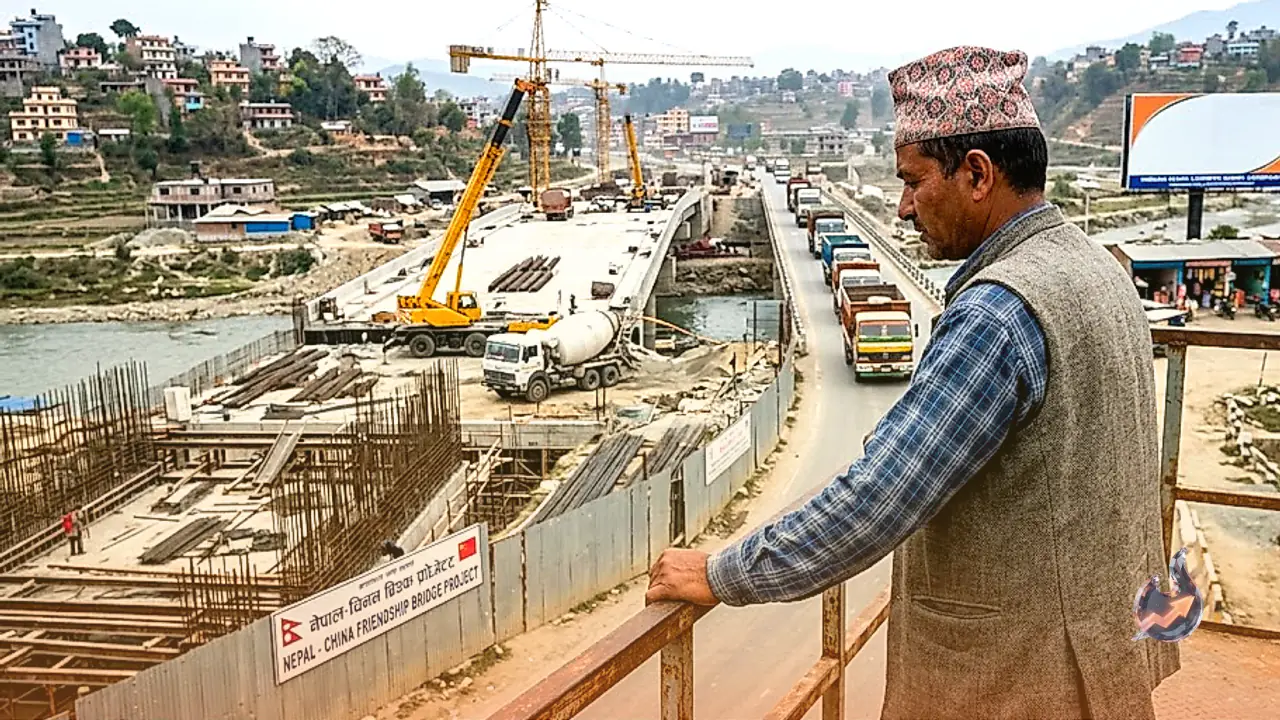
To grasp the underlying mechanics of Nepal's commerce, one must first consider its unique topography. Bordered by the high peaks of Mount Everest and the Himalayas to the north, Nepal shares land boundaries exclusively with India and China. Because it lacks direct access to the sea, Nepal must rely on transit corridors through either India or China to engage with global markets. India has traditionally served as Nepal's primary economic partner, constructing vital border roads, trade checkpoints, and transit routes over several decades. Conversely, China's aggressive entry into Nepal is a relatively recent phenomenon spanning the past decade. Beijing is now swiftly building highways and transit networks connecting Tibet to Nepalese border crossings. Recent figures demonstrate record levels of foreign direct investment originating from China, aimed at controlling major infrastructure projects and expanding geopolitical leverage along India's northern frontier.
Nepal's Lifeline Connection: Commercial Dependencies and Trade with India
A closer look at bilateral trade statistics confirms that India remains the irreplaceable financial lifeline for Nepal. Data for fiscal year 2025-26 indicates that total bilateral trade between India and Nepal reached approximately 10 billion dollars, equivalent to nearly 96,000 crore rupees. India supplies more than 60 percent of Nepal's total global imports, proving that the vast majority of essential goods consumed in Nepal originate in Indian markets. On the export front, Nepal's reliance on its southern neighbor is even more pronounced, with around 80 percent of Nepal's total exports destined for India. Whether procuring essential supplies or selling domestic goods, Nepal's economic stability depends entirely on its open and integrated border with India.
One-Sided Trade Deficit: Nepal's Skewed Commercial Dynamic with China
In sharp contrast, trade figures between Nepal and China highlight a severe commercial imbalance that leaves Kathmandu at a heavy economic disadvantage. During fiscal year 2025-26, total trade between Nepal and China stood at approximately 34,373 crore rupees. However, a breakdown of this trade volume shows that Nepal imported goods valued at 34,110 crore rupees from China, while exporting a mere 263 crore rupees worth of products in return. As a direct consequence, Nepal incurred a staggering trade deficit of approximately 33,847 crore rupees with China. These numbers illustrate how Chinese manufacturers use Nepal primarily as a destination for dumping goods, while offering minimal market access for Nepalese products.
Detailed Commodity Breakdown: Supplies from India and China
The nature of goods exchanged between Nepal and its two large neighbors reflects fundamentally different economic relationships. Imports from China consist mostly of heavy machinery, electronics, construction materials, apparel, footwear, chemical fertilizers, and pharmaceuticals. In exchange, Nepal exports modest quantities of agricultural produce, tea, coffee, yarsagumba herbs, and small handcrafted items to China. Conversely, India supplies Nepal with essential daily commodities and strategic resources. These include petrol, diesel, and all types of refined fuels, food grains, motor vehicles, industrial machinery, structural steel, electricity, cross-border banking, and insurance services, alongside generating employment for Nepalese workers. Furthermore, India provides Nepal with sea route access through its ports for third-country trade and has maintained a 750 million dollar Line of Credit facility over the past 20 years to fund infrastructure development.
FDI and Infrastructure Investments: China's Footprint vs India's Deep Roots
While trade and daily commodity supplies confirm India's deep-rooted economic presence in Nepal, Beijing is attempting to secure structural influence by targeting major capital projects. China has injected approximately 224 billion Nepalese rupees in foreign direct investment into Nepal, representing roughly 45 percent of the country's total incoming FDI commitments. Meanwhile, India remains the largest historical cumulative investor with 800 million dollars in committed capital, supporting around 150 Indian companies currently operating within Nepal. The core strategic dynamic reveals that India forms the backbone of Nepal's daily real economy, whereas China is concentrating capital in hydropower generation, highways, tourism infrastructure, manufacturing, and northern border facilities. Analysts view Beijing's aggressive investments in Nepal as part of its broader regional strategy to surround India, mimicking approaches previously deployed in Pakistan, Bangladesh, and Sri Lanka.