
























The collapse of Theranos remains one of the most cautionary tales in modern Silicon Valley lore, yet its underlying ambition continues to echo through a new venture. Billy Evans, the husband of Elizabeth Holmes, is currently spearheading a health technology enterprise named Haemanthus out of Austin, Texas. On public forums and social platforms, Evans has been emphatic that the firm is unequivocally distinct from Theranos. Yet, behind closed doors and in unreleased documentary footage, he appears far more receptive to the comparison, discussing functional prototypes and theoretical product iterations conceived alongside Holmes during her incarceration. While Holmes holds no formal corporate standing in the official incorporation filings, the enterprise has inevitably attracted intense scrutiny regarding its true origins and technological validity.
Heritage of Wealth: From Mission Bay to Silicon Valley
Billy Evans did not emerge from obscurity; his roots run deep into the established wealth of Southern California. In 1953, his grandparents, William and Anne Evans, saw commercial potential in the tidal mudflats of Mission Bay and opened an ambitious resort hotel. That single property laid the foundation for Evans Hotels, a hospitality empire that later expanded across the bay and into the affluent coastal enclave of La Jolla. The generational enterprise was eventually entrusted to the stewardship of Billy's father, William Evans, embedding the family firmly among San Diego's social and financial aristocracy.
Young Billy was educated at the Francis Parker School, an elite private academy in San Diego. Acquaintances from his youth recall him as a privileged individual often prone to theatrics and interpersonal conflicts, exhibiting traits frequently associated with unchecked affluence. Following preparatory school, Evans enrolled at the Massachusetts Institute of Technology, earning a bachelor of science degree in economics. His early post-collegiate career included an unsuccessful venture into medical concierge services, followed by positions within established corporate environments such as LinkedIn and Luminar Technologies, a developer of autonomous driving sensors. In 2017, while attending a Fleet Week charity gala in the San Francisco Bay Area, the 25-year-old Evans crossed paths with Elizabeth Holmes, initiating a relationship that would soon become intertwined with one of the most publicized corporate fraud trials in history.
Courtroom Loyalty and the Prison Years
Although early accounts suggested that the Evans family harbored reservations about the union, those concerns were publicly set aside as Holmes faced federal indictment. During jury selection at her trial, Billy's father appeared in the gallery incognito, introducing himself to observers as an ordinary mechanic named Hanson. The elder Evans, who commands an extensive personal collection of vintage automobiles, drew significant attention inside the courtroom when the crackling wrapper of an oversized Rice Krispies treat disrupted the proceedings on day one of jury selection. Through the birth of their two children, son William and daughter Invicta, and throughout Holmes' eventual sentencing, Evans maintained unwavering support, writing emotional character references describing a profound transformation in his own life following a monthslong camping excursion.
Raman Spectroscopy: A Century-Old Physics Principle
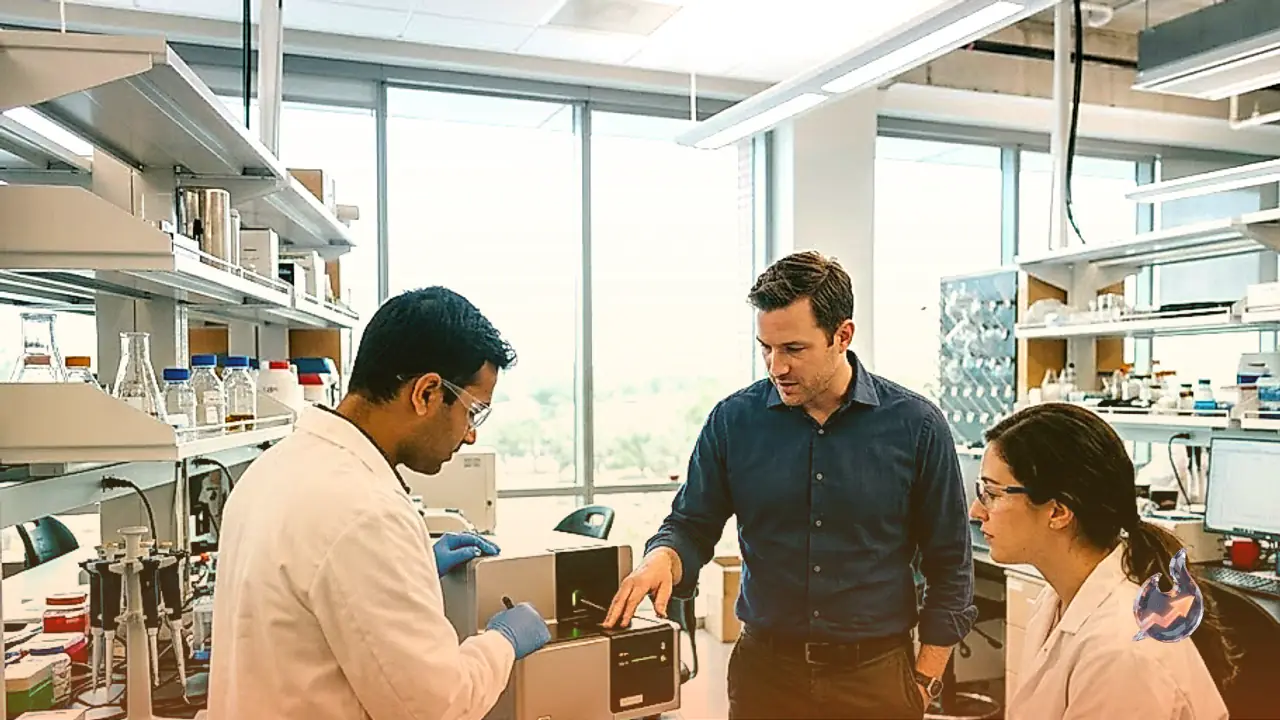
Formally incorporated in 2022, Haemanthus aims to deliver a compact countertop device capable of analyzing blood, urine, and saliva samples within home environments. While the objective mirrors the promise that once propelled Theranos, the technological mechanics are fundamentally divergent. Theranos attempted to miniaturize conventional, wet-chemistry diagnostic machinery into an automated microfluidic desktop box. Haemanthus, by contrast, relies entirely on optical physics, specifically employing laser illumination to examine biological samples.
The foundation of this approach rests on Raman spectroscopy, a phenomenon first observed in 1928 by Indian physicist C. V. Raman. When an intense, concentrated beam of light strikes a molecular structure, roughly one out of every one million scattered photons experiences an inelastic shift in frequency. This wavelength shift corresponds precisely to the specific vibrational energy of the targeted chemical bonds, creating an optical fingerprint of the specimen. On January 21, 2025, Haemanthus was granted a patent for its proprietary Raman Spectroscopy System, designed to direct high-energy light into biological fluids and register molecular signals with high fidelity.
Scientific Potential Versus Engineering Constraints
Unlike previous diagnostic failures that relied on undisclosed science, the core mechanism behind Raman spectroscopy is widely recognized and documented within academic and clinical literature. Eric Potma, a chemistry professor at the University of California, Irvine, who serves as an external consultant to Haemanthus, confirmed that the company's technical foundation is legitimate. Potma noted that the startup's engineering team possesses valid technical credentials and is actively pursuing legitimate applications of Raman detection rather than fabricating claims out of thin air. In his view, the enterprise cannot simply be dismissed as an automatic replay of earlier scandals solely because of Evans' marital connection.
Nevertheless, translating sensitive optical instrumentation from a heavily calibrated university laboratory into a consumer-grade countertop appliance presents staggering technical hurdles. To deliver medical-grade diagnostic results in a matter of seconds, an optical system must overcome background noise, sample turbidity, and laser stability limitations, all while satisfying strict health accuracy benchmarks. Furthermore, regulatory strategy has raised industry eyebrows. Promotional literature distributed to potential backers suggested the company might bypass standard oversight by initially deploying the hardware exclusively for veterinary diagnostics. However, federal authorities, including the United States Department of Agriculture, maintain rigorous regulatory oversight over animal diagnostic products, contradicting assumptions of an unregulated market entry.
Stealth Operations, Multi-Million Dollar Capital, and Wearable Ambitions
Haemanthus operates under strict institutional discretion. The company maintains virtually no digital footprint, lacking an active commercial website and holding only an unpopulated profile on LinkedIn. Public registry records trace its operational nodes to private residential properties in Austin's desirable Barton Springs district. Individuals associated with the firm maintain strict silence when approached, consistently declining to discuss operational roles or system progress. Evans has explicitly affirmed this stealth posture, indicating that external parties will find minimal public breadcrumbs concerning the entity.
This low profile has not hindered significant capital acquisition. What began as a $3.5 million funding round drawn from friends and family has expanded into approximately $20 million in backing. The capital is aimed at an even more radical long-term trajectory: corporate documents reveal plans to condense the entire optical diagnostic engine into a stamp-sized wearable monitor. Haemanthus has informed prospective investors that developing this miniaturized wearable will require approximately $70 million and three years of continuous development. With Elizabeth Holmes scheduled to transition from federal prison to a halfway house next summer, the ongoing evolution of Haemanthus will unfold under an unrelenting public and scientific spotlight.