























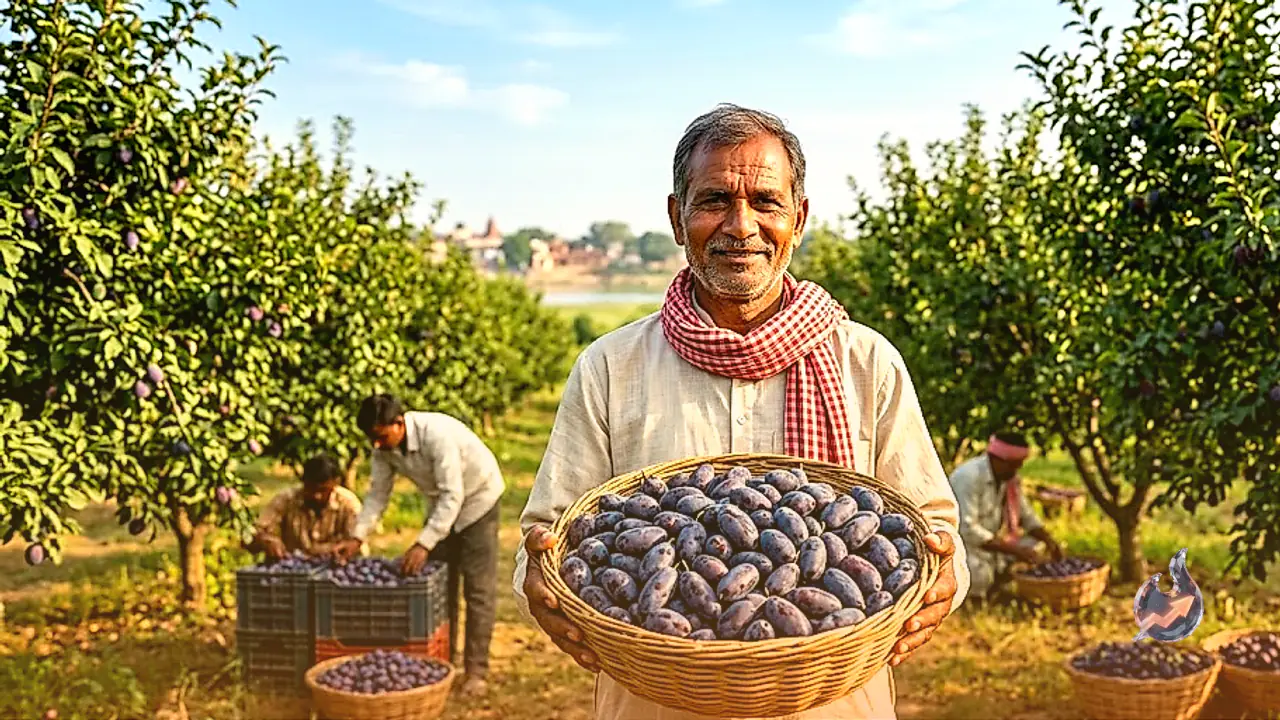

The agricultural landscape on the banks of the river Ganges is experiencing a remarkable economic transformation. The historic town of Bithoor, situated near Kanpur in Uttar Pradesh, has moved beyond its traditional roots to become a major hub for black plum cultivation. The juicy, organic fruits grown in these local orchards are no longer restricted to state boundaries or domestic consumption. Instead, they are crossing international borders in massive numbers, making their way onto supermarket shelves in London and several other European countries. A combination of exceptional taste, chemical-free farming, and an impressive shelf life has fueled a massive surge in global demand. This lucrative shift has completely altered the region's financial dynamics, with an estimated 10,000 to 15,000 farmers from Bithoor and its neighboring villages now relying on this specific crop as a primary source of household income and long-term economic stability.
Scaling Production for International Markets
During the peak summer harvesting season, which stretches roughly from May to the end of July, the entire agricultural belt operates at maximum capacity. The sheer volume of the harvest is staggering, with orchards collectively producing anywhere between 1.5 lakh to 2 lakh crates in a single season. To streamline the logistics, each carefully packed crate contains exactly 25 kilograms of the premium fruit. The daily outward movement is equally massive, seeing regular dispatches of 5,000 to 10,000 crates via massive transport networks. While domestic commercial hubs like Mumbai, Delhi, Hyderabad, Bihar, and Punjab receive a large chunk of this inventory, the international supply chain remains the most fascinating aspect of the trade. Exporters heavily rely on highly specialized packing materials and advanced logistical techniques. The sole purpose of this meticulous packaging process is to definitively guarantee that the delicate cargo survives the exhausting, multi-day transit to London and Europe without experiencing any loss in its natural quality or original freshness.
The Dominance of the Capsule Variety
Growers in the region primarily focus their extensive efforts on cultivating two distinct commercial varieties. The first is the traditional, round-shaped variant widely known as Desi, which generally weighs in at 10 to 15 grams per piece. However, the true star of the orchards is the elongated version, popularly referred to as the Capsule or Pantra variety. Ravi Nishad, a veteran farmer from the village of Baniyapurwa who has spent 20 years tending to these trees, points out that the elongated fruit is significantly sweeter than its competitors. Weighing between 25 and 30 grams, the Capsule variant is heavily favored by international buyers because it naturally resists spoilage for three to four days at room temperature. Most importantly, both of these prized fruit varieties are cultivated entirely using strict organic farming practices. By deliberately avoiding synthetic fertilizers, the farmers ensure that their produce meets the stringent health standards required globally.
Overcoming Weather Shocks and Price Volatility
Despite the booming demand, the agricultural sector remains highly vulnerable to unpredictable weather patterns. Recent fierce storms and high-speed winds uprooted numerous mature trees across the belt, leading to a noticeable drop in overall seasonal production. This sudden supply shortage immediately rippled through the local retail markets, creating an unprecedented price hike. For the very first time, consumers in local areas found themselves paying exorbitant retail rates ranging from Rs 200 to Rs 250 per kilogram. Under normal market conditions, the standard retail price generally stabilizes around Rs 150 per kilogram. Meanwhile, in the wholesale export sector, cultivators are currently securing a steady rate of Rs 120 per kilogram for their highest-quality batches. Nishad recalls that back in 2005-06, only a handful of individuals experimented with this crop, but the sheer promise of high financial returns eventually prompted thousands to establish large-scale orchards.
Botanical Innovations and Expanding Horizons
The agricultural triumph of Kanpur has sent ripples across other farming states in India, inspiring widespread innovation. Utilizing specialized saplings originally transported from Bithoor, cultivators in South India have successfully engineered a completely new commercial variant named KG-10. This impressive new botanical breed produces massive individual fruits that weigh approximately 50 grams each. Similarly, agricultural communities in Punjab are actively conducting new cultivation experiments based on these superior genetics. Vikas Jaiswal, a prominent exporter who has been handling nationwide distribution for the past five years, notes that he regularly ships huge consignments to West Bengal, Chhattisgarh, Punjab, and major metropolitan centers. The unwavering dedication to organic purity and premium taste has firmly established a strong international brand identity for Bithoor's produce, ensuring that export demands will likely continue to climb with each passing year.