





















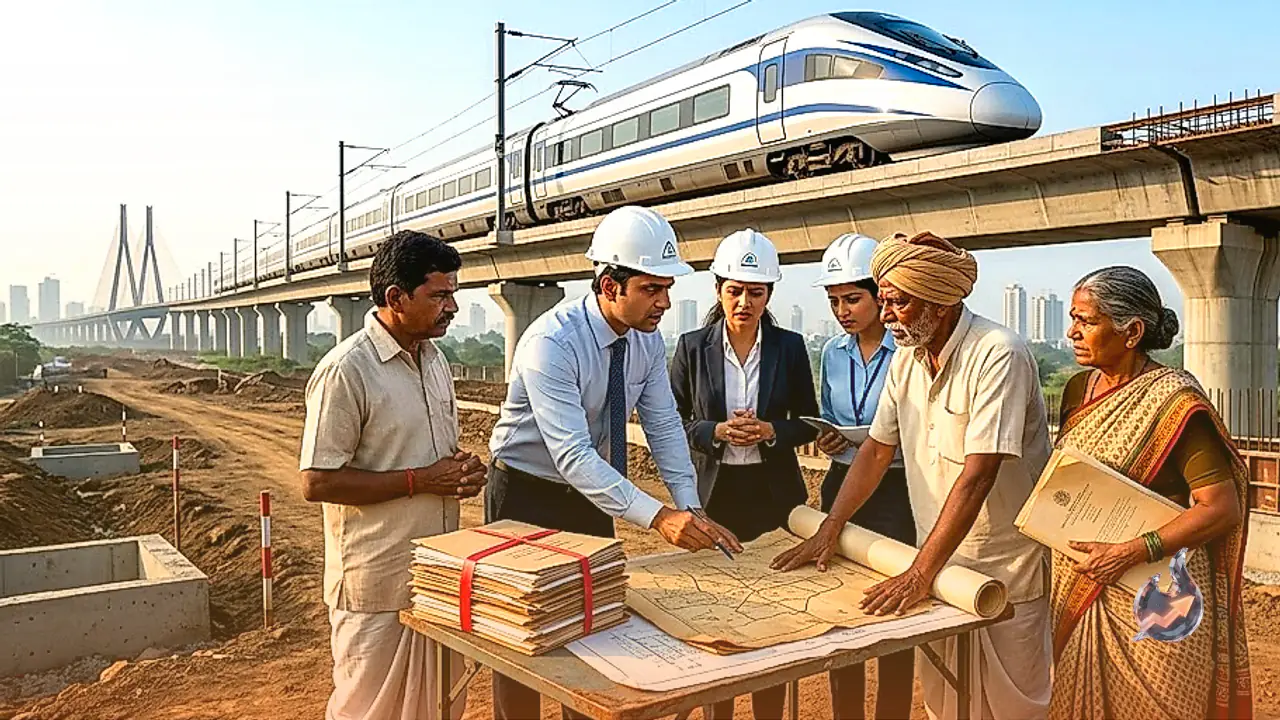

The Mumbai-Ahmedabad bullet train project, widely considered a landmark endeavor for Indian infrastructure, is currently grappling with a severe crisis that could jeopardize its future. With an original estimated cost of 1.10 lakh crore rupees, the high-speed rail initiative is now under immense pressure due to a dispute over land acquisition compensation. The main management authority for the project has officially approached the Gujarat High Court, expressing grave concerns. According to their petition, if the compensation amounts recently revised by the Land Acquisition, Rehabilitation, and Resettlement Authority (LARRA) are enforced, the project could face an additional financial burden of approximately 40,000 crore rupees, which could render the entire project unfeasible.
Legal Battles and Financial Exposure
During the proceedings at the Gujarat High Court, Advocate General Kamal Trivedi presented a stark picture of the potential fallout. He highlighted that the revised compensation orders issued by LARRA in January and February have caused an exponential surge in projected costs. He explicitly warned the court that imposing such a massive financial load on the project would pose a serious threat to its continued progress, noting that the situation is grave and could force a halt to construction. The core argument is that the project's economic viability would be fundamentally compromised if these revised, significantly higher payouts are upheld by the judiciary.
The Root Cause: Disputes in Ochhan Village
The controversy is centered on a specific land parcel in Ochhan village within the Amod taluka of Bharuch district. When the acquisition process commenced in 2018, the official acquisition authority had initially set the compensation at 50 rupees per square meter. Consequently, one landowner received approximately 85.8 lakh rupees based on this valuation. However, the landowner sought higher compensation, leading to an intervention by LARRA. The authority subsequently revised the compensation rate to 660 rupees per square meter, ballooning the payout for that specific plot to roughly 8.4 crore rupees. This drastic escalation triggered the management's decision to seek legal redress.
Management’s Stance and Future Outlook
The project management argues that LARRA erred significantly during the valuation process. They claim that the authority ignored prevailing land prices in neighboring villages and instead relied on rates from Simartha village, located 14 kilometers away, which they describe as an invalid benchmark. The management maintains that compensation should be strictly based on the average market price of similarly situated land in the immediate vicinity. The Gujarat High Court has accepted the project management's appeal in three cases involving Surat and Bharuch districts. The next hearing is scheduled for August 5, during which the court may decide on whether to place an interim stay on the LARRA orders. The court has also directed the project authority to state the specific amount they are prepared to deposit as compensation.