























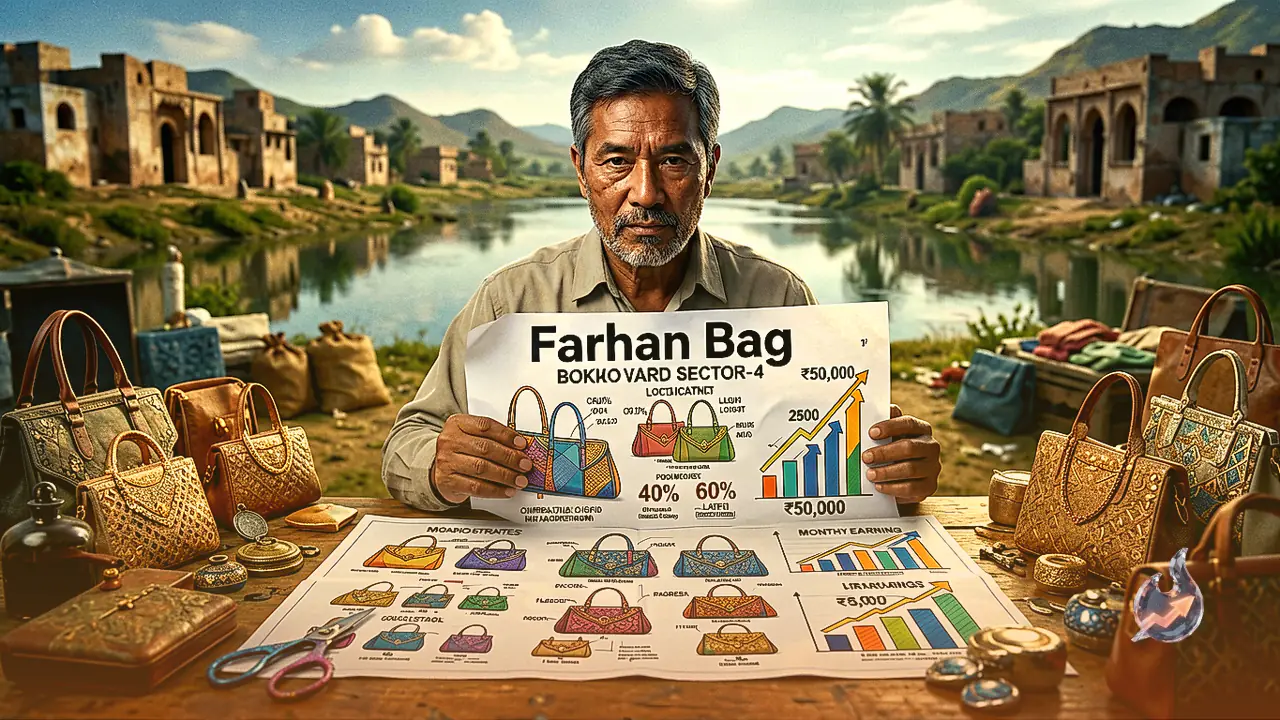

In modern times, ladies' handbags have evolved beyond mere daily utility items to become an essential component of women's style and fashion. Driven by changing trends, customer preferences, and evolving designs, the price ranges and structural varieties of handbags continue to undergo frequent updates. Consequently, retail markets maintain a consistently strong demand for diverse styles of purses and bags. For aspiring entrepreneurs seeking a low-capital business venture, starting a ladies' handbag enterprise offers a highly lucrative opportunity. Drawing from 21 years of industry experience, Arshad, the proprietor of 'Farhan Bag' located in Bokaro Sector-4, Jharkhand, has outlined a comprehensive operational roadmap for establishing a successful handbag retail business on a modest budget.
Selecting the Right Location and Starting with a ₹50,000 Capital
Sharing insights gained from over two decades in the trade, Arshad highlights that launching a handbag shop does not require massive financial capital. An individual can successfully set up a small-scale retail unit with an initial budget of approximately ₹50,000. However, the most critical prerequisite before investing is selecting an optimal business location. The retail outlet should ideally be situated in high-footfall commercial zones where women frequently shop. Securing a spot near bustling markets, ladies' cosmetic hubs, or popular shopping complexes significantly enhances foot traffic, thereby maximizing sales potential from day one.
Rent, Interior Setup, and Initial Stock Investment Breakdown
During the foundational phase of the business, Arshad advises against acquiring expensive, large retail properties. Instead, renting a compact room or small shop for a monthly rent of around ₹5,000 is completely sufficient. Regarding store setup, an investment of approximately ₹10,000 should be allocated toward store interiors, display racks, and effective lighting arrangements. The remaining capital of around ₹35,000 can then be deployed to purchase the primary inventory. A stock budget of ₹35,000 easily accommodates between 200 and 250 handbags across varied designs and price tiers. Retailers should avoid stocking large quantities of a single design and instead maintain a diverse selection to cater to customers across different budget brackets.
Wholesale Sourcing from Kanpur, Delhi, and Kolkata with Trending Designs
To procure high-quality inventory at competitive rates, shop owners should leverage major wholesale hubs across India. According to Arshad, cities like Kanpur, Delhi, and Kolkata serve as premier wholesale destinations for purchasing handbags and purses. These markets offer an extensive selection of patterns, materials, and price segments, allowing retailers to curate inventory according to their specific budget and customer demand. Currently, designs such as Bridal, Decorative, Mirror work, and Coba pattern handbags command strong market demand. Because handbag fashion trends shift rapidly, store owners must continuously refresh their inventory with new arrivals to keep returning shoppers engaged.
40% to 60% Profit Margins and Monthly Earning Potential of up to ₹50,000
Explaining the financial dynamics of the trade, Arshad notes that earnings in the handbag retail business depend directly on the spread between wholesale purchase cost and retail selling price. Shop owners can comfortably maintain profit margins ranging between 40% and 60%. However, during the initial launch phase, adopting a strategy of lower profit margins to drive higher sales volume is far more effective. Offering competitive prices accelerates inventory turnover, attracts first-time buyers, and helps build a loyal customer base. Once the store gains local recognition and steady footfall, monthly earnings can reliably reach between ₹40,000 and ₹50,000.
Expanding Reach via WhatsApp, Instagram, and Facebook
In today's digitally connected market, a retail handbag business should not remain confined to physical storefront sales alone. Leveraging online channels can dramatically amplify customer outreach and revenue. Arshad suggests that retailers regularly record high-quality photos and videos of new handbag collections and showcase them on platforms like WhatsApp, Instagram, and Facebook. This digital cataloging allows local walk-in customers as well as prospective online buyers to browse available designs, inspect features, and check prices from the comfort of their homes, ultimately driving higher conversion rates and sales volume.