























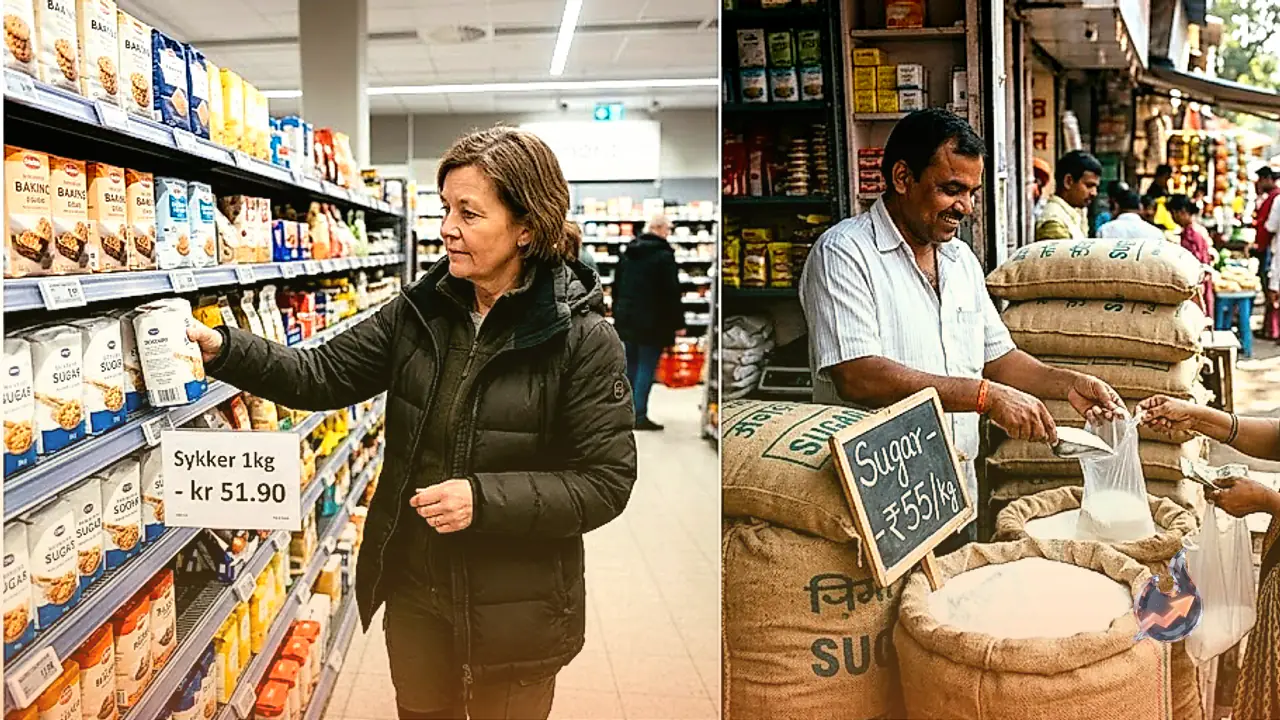

Everyday kitchen staples often exhibit massive price disparities across international borders, and sugar is no exception to this economic reality. An examination of global market data covering 79 countries reveals that factors such as geographical constraints, domestic agricultural yield, and reliance on foreign trade create a wide spectrum of retail sugar prices worldwide. While consumers in India and select neighboring countries benefit from relatively affordable rates, residents in several affluent or import-dependent European and Asian nations face substantially higher expenses for the exact same commodity.
European Nations and Developed Economies Top the Price Charts
When categorizing countries by highest retail sugar costs, the European nation of Norway secures the topmost position globally. Consumers in this wealthy country pay an average of 4.22 Dollars per kilogram, which translates to approximately 400 Indian Rupees per kg. Compared to high-producing agricultural economies, this represents an exceptionally steep rate. Interestingly, elevated prices are not exclusive to high-income nations; Ghana, an economically developing nation, also ranks prominently on this list. In Ghana, sugar retails at 3.37 Dollars per kilogram, equivalent to roughly 323 Indian Rupees.
Similarly, the Asian commercial hub of Hong Kong records elevated figures, with sugar priced at 3.19 Dollars per kilogram, amounting to around 306 Indian Rupees. Ireland occupies the 4th spot among the most expensive markets for sugar, with an average rate of 2.80 Dollars per kg, or about 268 Indian Rupees.
Japan also sees high consumer costs for sugar, taking the 6th position in global rankings. In Japanese markets, sugar commands a price of 2.68 Dollars per kilogram, which works out to about 257 Indian Rupees. In Switzerland, buyers spend 2.37 Dollars per kg, equaling approximately 227 Indian Rupees. Meanwhile, in Russia, the average price stands at around 1.99 Dollars per kilogram, translating to nearly 191 Indian Rupees.
Pricing Dynamics in the Americas and Singapore
In the United States, sugar trades at 1.80 Dollars per kilogram, which corresponds to approximately 172 Indian Rupees. The country places 20th in global price rankings. Although sugarcane is cultivated domestically within the United States, limited crop yields require the nation to import a major share of its overall sugar supply to meet consumer demand. To fulfill these requirements, the United States primarily sources sugar shipments from India and Brazil.
Brazil holds the distinction of being the world's second-largest sugar producer after India. Despite its massive production output, the average price of sugar in Brazil stands at 1.12 Dollars per kilogram, or roughly 107 Indian Rupees, placing the country in the 59th spot on the expense index. Meanwhile, Singapore sits in the 21st position, where consumers pay 1.89 Dollars per kg, equivalent to around 181 Indian Rupees.
Import Reliance across Middle Eastern Gulf States
The geography of the Gulf region presents severe water scarcity, making sugarcane farming unfeasible locally. Consequently, countries in the Gulf must import nearly all the sugar needed for domestic consumption. Kuwait records the highest sugar prices within the Gulf region, occupying the 30th rank globally. The retail price in Kuwait reaches 1.62 Dollars per kilogram, amounting to 155 Indian Rupees.
Saudi Arabia, another key nation in the Gulf, holds the 47th position internationally. The average cost of sugar in Saudi Arabia is recorded at 1.25 Dollars per kilogram, which converts to approximately 120 Indian Rupees.
Price Comparison Across India and Neighboring Asian Nations
At the opposite end of the global spectrum, India and Pakistan feature near the bottom of the 79-country dataset, reflecting some of the lowest consumer prices for sugar worldwide. In India, retail sugar sells for approximately 55 Indian Rupees per kilogram. In Pakistan, local prices range between 175 and 200 Pakistani Rupees per kg, which converts to about 53 to 60 Indian Rupees. Pakistan operates roughly 8 sugar mills, allowing domestic manufacturing to satisfy most of its internal demand.
Looking at other nearby countries, sugar in China costs 5.28 Yuan per kilogram, coming to around 72 to 75 Indian Rupees. Bangladesh sits at the 69th spot with a price of 0.86 Dollars per kg (roughly 82 Indian Rupees), while Sri Lanka places 68th with a rate of 0.88 Dollars per kg (approximately 84 Indian Rupees). Both Bangladesh and Sri Lanka rely heavily on international imports to satisfy their national sugar consumption requirements.