























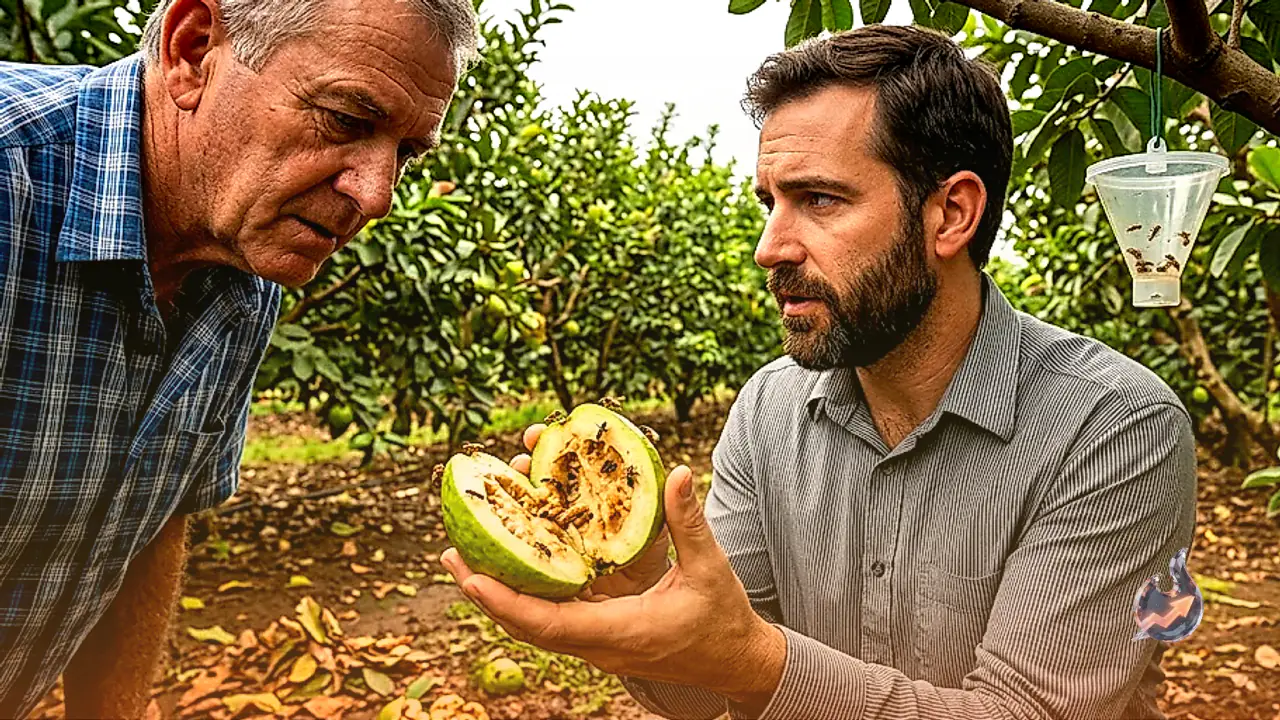

Guava growers across the monsoon belt run into the same costly problem every year, fruit that looks perfectly ripe on the outside turns hollow, sticky and rotten inside almost overnight. According to Dr. Hadi Hussain Khan, a crop protection scientist in Shahjahanpur, two insects are behind most of this damage, the fruit fly and the fruit borer, and both strike hardest once the rains begin. The trouble is that the early damage is hard to spot, and by the time a grower notices anything wrong, a large part of the harvest is often already ruined.
How the fruit fly hollows out guava from the inside
Dr. Khan explains that the female fruit fly punctures a thin layer on the back portion of the guava and lays her eggs just beneath the surface, a puncture so fine that it is barely visible from outside. Within days, these eggs hatch into larvae that begin feeding on the fruit's pulp from the inside. As the larvae grow, the fruit is slowly eaten away until it turns completely hollow, even as the outside still looks fairly normal for a while. By the time the fruit starts to soften and give off a rotten smell, the pulp inside is usually beyond saving, the guava turns sticky and rotten, and its market price crashes almost instantly.
Falling prices and rejected export consignments
The damage does not stop at the local market. When infested fruit ends up in an export consignment, international quarantine rules require the entire batch to be rejected on the spot. For a farmer whose produce was picked for export, that hits especially hard, because a flagged consignment cannot simply be sorted and resold, and the loss of the entire shipment lands all at once. In effect, the fruit fly does not just ruin individual guavas, it strikes directly at a farmer's earnings for the whole season.
Fruit borer riddles the fruit with holes and sawdust
Alongside the fruit fly, Dr. Khan flags the fruit borer as another serious threat to guava orchards during the rainy season. This pest bores directly into the fruit, and because the entry hole is also small, most growers first notice the problem from the sawdust-like material scattered around the fruit rather than the hole itself. Like the fruit fly, it badly damages both the internal and external quality of the fruit, making it unfit for sale. Left untreated, the infestation does not stay confined to a few plants, it can spread and engulf an entire orchard, turning a season that should have been profitable into a season of losses.
Traps and sprays that can save the orchard
To keep fruit flies under control, Dr. Khan advises farmers to install Methyl Eugenol Traps or lure-based pheromone traps in their orchards, which draw the flies away before they get a chance to lay eggs. For the fruit borer, he recommends spraying Emamectin Benzoate on affected areas to stop the infestation before it spreads further. He notes that acting early in the monsoon, before either pest gets established, gives the best results. Adopting both scientific measures together, he says, can keep the two pests in check, protect the crop through the monsoon, and help guava farmers hold on to the profits that are otherwise lost every year to rotten fruit, rejected export orders and falling market prices.