























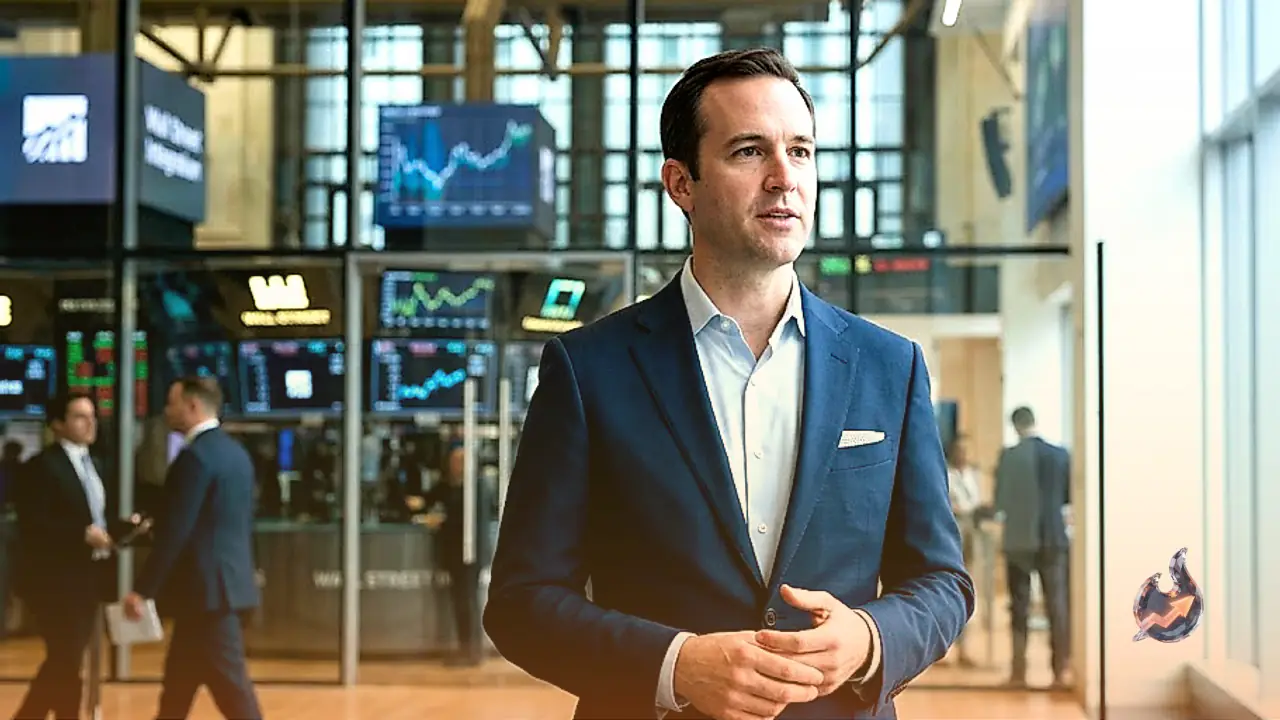

Institutional money and real on-chain revenue are quietly laying the foundation for a fundamentally different kind of cryptocurrency bull market, one driven by utility rather than pure speculation. Even as traditional equities face headwinds from disappointing tech earnings and macroeconomic pressures, the digital asset ecosystem is showing unexpected resilience, buoyed by consistent ETF inflows and major structural shifts in decentralized finance.
Wall Street's Transition to On-Chain Mechanics
The next major expansion in the cryptocurrency space will not resemble the frenzy of past cycles. According to Bitwise Chief Investment Officer Matt Hougan, the upcoming bull market will be fueled by the profound integration of traditional finance with blockchain infrastructure. In a detailed market memo, Hougan highlighted that the convergence of stablecoins, asset tokenization, round-the-clock trading, instant settlement, and institutional-grade decentralized finance (DeFi) is shifting the industry's focus. Instead of relying on speculative retail demand, this new phase is being constructed on a foundation of tangible financial activity and real revenue streams. Because of this structural maturity, the incoming market cycle is expected to be substantially larger than previous rallies, even if the growth curve appears slower and the price action exhibits significantly less volatility.
To explain this evolution, Hougan categorized the market opportunity into two distinct pathways: the "Hyperliquid Lane" and the "Robinhood Lane." The former represents crypto-native protocols that have evolved beyond merely accumulating user fees. Instead, these platforms are generating massive, verifiable revenue and strategically routing that capital back into their own ecosystems. Hyperliquid, a decentralized exchange, serves as the prime example of this model. The protocol surpassed the $1 billion mark in cumulative revenue in June and is currently on track to generate roughly $800 million for the current calendar year. Notably, the protocol directs 99% of this revenue toward purchasing HYPE tokens on the open market, creating consistent structural demand. This mechanism addresses a chronic flaw in older decentralized applications, which often saw high trading volumes but failed to accrue value for their native tokens. Other major protocols, including Uniswap, Aave, and Morpho, are pivoting in a similar direction, alongside popular on-chain platforms like Pump.fun.
The "Robinhood Lane," conversely, represents established traditional financial entities that are moving past the experimental phase and building fully operational financial services on blockchain rails. Robinhood Chain, which officially launched on July 1, has already processed over $3 billion in trading volume. This transition is echoed across the legacy financial sector, with Citadel's integration into Crypto.com, Morgan Stanley's moves involving E*TRADE, and the Depository Trust & Clearing Corporation (DTCC) executing live asset tokenization. The overarching consensus is shifting from anticipating the arrival of institutional players to acknowledging that they are already fully operational within the ecosystem and preparing to drive the next wave of capital expansion.
Crypto Markets Hold Steady Amid Macro Volatility
Despite significant turbulence in traditional financial markets, major cryptocurrencies are demonstrating remarkable stability. The digital asset sector remained largely flat even as stock futures flashed red following disappointing corporate earnings reports from industry giants Tesla and Google. The broader equities market felt the pressure, with the DOW dipping 0.4% and the Nasdaq sliding 0.5%. Simultaneously, commodity markets experienced sharp movements, as oil prices surged 4.5% to reach $90 per barrel, while gold prices retreated 1.5% to settle at $4,090.
Against this macroeconomic backdrop, Bitcoin (BTC) experienced a negligible dip of 0.3%, maintaining its position around the $65,500 mark. Ethereum (ETH) remained perfectly flat at $1,925, and Solana (SOL) held steady at $78. The HYPE token also showed no movement, sitting at $59.30. Among the top-performing altcoins, Stable posted impressive gains of 16%, followed by WLFI with a 13% increase and ENA rising by 4%.
ETF Momentum and Regulatory Warnings
Institutional appetite for digital asset exchange-traded funds remains robust. The spot Bitcoin ETFs recorded their seventh consecutive day of positive inflows, capturing $69 million in net fresh capital on Wednesday alone. The newly launched spot Ethereum ETFs also saw strong demand, pulling in $73 million in net inflows. The global ETF landscape is also preparing for future expansion, with reports suggesting that Japan is currently revising its cryptocurrency investment regulations and may launch its very first domestic Bitcoin ETF as early as 2028.
On the Ethereum network, staking dynamics are shifting dramatically. The validator exit queue has plummeted from its historical peak of 2.6 million ETH down to absolute zero, indicating that the wave of major unstaking has concluded. Conversely, the demand to secure the network is surging, with the active staking queue now holding 2.48 million ETH and requiring a massive 43-day waiting period for new validators to come online.
In the regulatory sphere, Washington continues to grapple with digital asset oversight. Senate Republicans have published a new draft of the CLARITY Act, which includes provisions that would impose strict limitations on Donald Trump's cryptocurrency ventures, alongside several other legislative updates. However, the proposal immediately faced severe pushback, with seven key Senate Democrats formally stating that the current draft falls significantly short on issues of government ethics, consumer protection, illicit finance prevention, and overall market integrity.
Meanwhile, the Securities and Exchange Commission (SEC) is signaling increased scrutiny over decentralized finance. SEC Commissioner Hester Peirce issued a stark warning that certain DeFi vaults and on-chain lending products may inevitably fall under existing federal securities laws. This statement carries particular weight coming from Peirce, who is widely regarded as the regulatory agency's most crypto-friendly commissioner.
The Future of Machine Payments and Platform Closures
Looking toward the intersection of blockchain and artificial intelligence, Franklin Templeton executive Sandy Kaul has positioned blockchain technology as the definitive "next AI trade." Kaul argues that as autonomous AI agents increasingly conduct micro-transactions—often exchanging fractions of a single cent for data or compute power—traditional credit card networks will become entirely uneconomical. Instead, highly efficient blockchain networks are poised to completely dominate the machine-to-machine payment layer.
In a surprising development for the crypto exchange sector, BitMEX, the pioneering derivatives platform co-founded by Arthur Hayes, has officially announced that it will permanently shut down its operations on September 23, 2026. In preparation for this complete winding down, the exchange has already halted the onboarding of all new users.
In the political betting arena, Kalshi has expanded its prediction market offerings by launching a comprehensive US Midterms Hub. The platform now features live betting odds for both Senate and House of Representatives races, integrating real-time polling numbers and official Federal Election Commission (FEC) data directly into its interface.
Bridge Exploits Expose Network Vulnerabilities
Security vulnerabilities in cross-chain infrastructure continue to plague the decentralized ecosystem, resulting in millions of dollars in catastrophic losses. An Arbitrum-based USDC bridge was successfully compromised, leading to the theft of approximately $24.15 million. The sophisticated attackers managed to compromise the protocol's hot-validator signing path, which allowed them to clear the required security quorum and authorize a massive withdrawal that the smart contract erroneously treated as completely legitimate.
In a separate incident, the Verus-Ethereum network bridge suffered a major exploit, marking the second time the protocol has been drained in just two months. Attackers systematically abused a critical vulnerability in the bridge's import path, successfully siphoning $7.54 million in digital assets before the breach could be contained.
Meme Tokens and High-Stakes NFT Speculation
The more speculative corners of the market saw mixed results. Leading meme tokens were largely stagnant or slightly negative, with DOGE slipping 1%, SHIB dropping 1%, PEPE remaining flat, and PENGU declining 1%. The TRUMP token managed a 3% gain, while BONK retreated by 3%.
Activity on the newly launched Robinhood chain presented a much more volatile picture. The GME token exploded with a staggering 425x increase, while AI surged 80% and SWOGE climbed 190%. However, previous heavy hitters suffered severe sell-offs, with Cashcat plummeting 25% to a $48 million market capitalization, and PONS plunging 18% down to $26 million. The Solana blockchain saw its own distinct winners, as Jimothy gained 5%, KET rocketed 110%, and BOP exploded by 170%, even as ANSEM dropped 10% to settle at a $175 million valuation.
In the non-fungible token (NFT) sector, blue-chip collections remained mostly static in their pricing. CryptoPunks held steady at a 32 ETH floor price, Bored Ape Yacht Club (BAYC) stayed at 8.65 ETH, Pudgy Penguins hovered at 4.18 ETH, and Hypurr's remained at 185 HYPE. However, mid-tier collections experienced significant upward momentum, acting as the day's top movers. Cyberkongz surged 53%, Memeland MVPs climbed 29%, TTT rose 38%, and Creepz jumped an impressive 77%, while both mfers and CrypToadz secured 16% gains. Robinhood's native NFTs also saw action, led by Hood Mundo's 39% pump and Pepe Hood Town's 9% rise.
A new speculative protocol from Rhynotic, the Fake World Assets (FWA) NFT gacha platform, captured the market's attention as its native token skyrocketed to an $11 million valuation overnight before experiencing a sharp retrace. Highlighting the extreme risk and reward nature of the platform, one extraordinarily lucky FWA user managed to win a highly coveted CryptoPunk NFT off a simple 0.06 ETH gacha spin—representing a monumental 550x return on investment—before immediately selling the asset back to the protocol in exchange for FWA tokens.