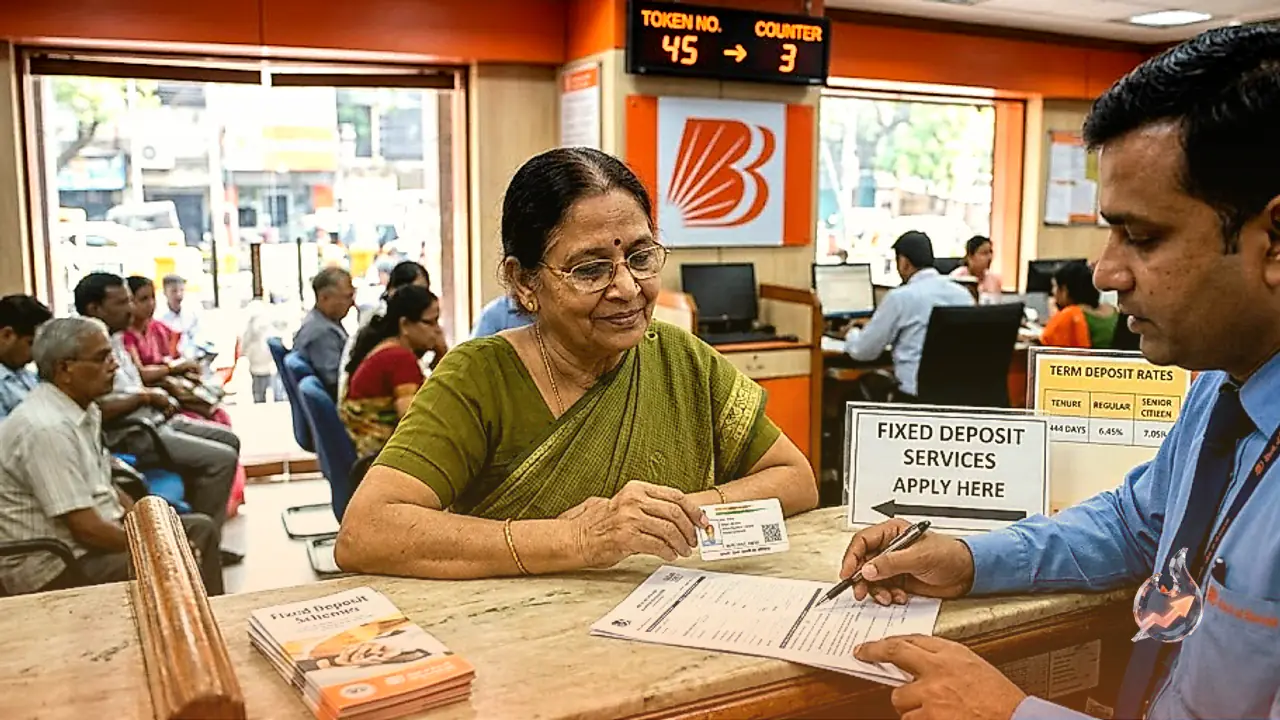
























Punjab National Bank continues to offer attractive returns to depositors across its fixed deposit (FD) schemes. India's major government-owned lender is currently paying interest ranging from 3.00 percent to 7.40 percent across various tenures, with accounts open for a minimum period of just 7 days and a maximum period of up to 10 years. Among these, the bank's 444-day FD scheme is drawing attention because the rate offered varies depending on the depositor's age.
How much interest PNB pays on its 444-day FD
On its 444-day fixed deposit scheme, Punjab National Bank (PNB) is offering interest rates ranging from 6.60 percent to 7.40 percent, with the exact rate depending entirely on the customer's age bracket. All regular customers up to the age of 59 years earn 6.60 percent interest under this scheme. For senior citizens aged 60 years and above, the rate rises to 7.10 percent. Customers in the highest age bracket, that is super senior citizens aged 80 years and above, are offered the highest rate of 7.40 percent on the same 444-day scheme. These rates apply only to deposits below Rs 3 crore; larger deposits may fall under separate slabs and conditions set by the bank.
The extra benefit for senior and super senior citizens
Punjab National Bank builds in extra benefits for older depositors across its FD schemes. Senior citizens are paid 0.50 percent more interest than regular customers, meaning this premium is added on top of the base rate applicable to their tenure. Super senior citizens go a step further, earning 0.30 percent more than senior citizens, which gives them the best overall returns among all customer categories. It is worth noting, however, that the additional benefit offered to super senior citizens is not uniform across banks, as each lender sets its own policy for this age group, so the premium can vary from one bank to another.
PNB ranks as the country's second-largest government bank
Going by customer numbers, Punjab National Bank is the second-largest government-owned bank in the country after the State Bank of India. The bank last revised the interest rates on its FD schemes on June 1, 2026, and the current rates have been in effect since then. It is also worth understanding that the interest rates offered by other banks on their FD accounts are closely tied to the repo rate set by the Reserve Bank of India, so any change in the repo rate typically has a knock-on effect on FD rates across the banking sector.