























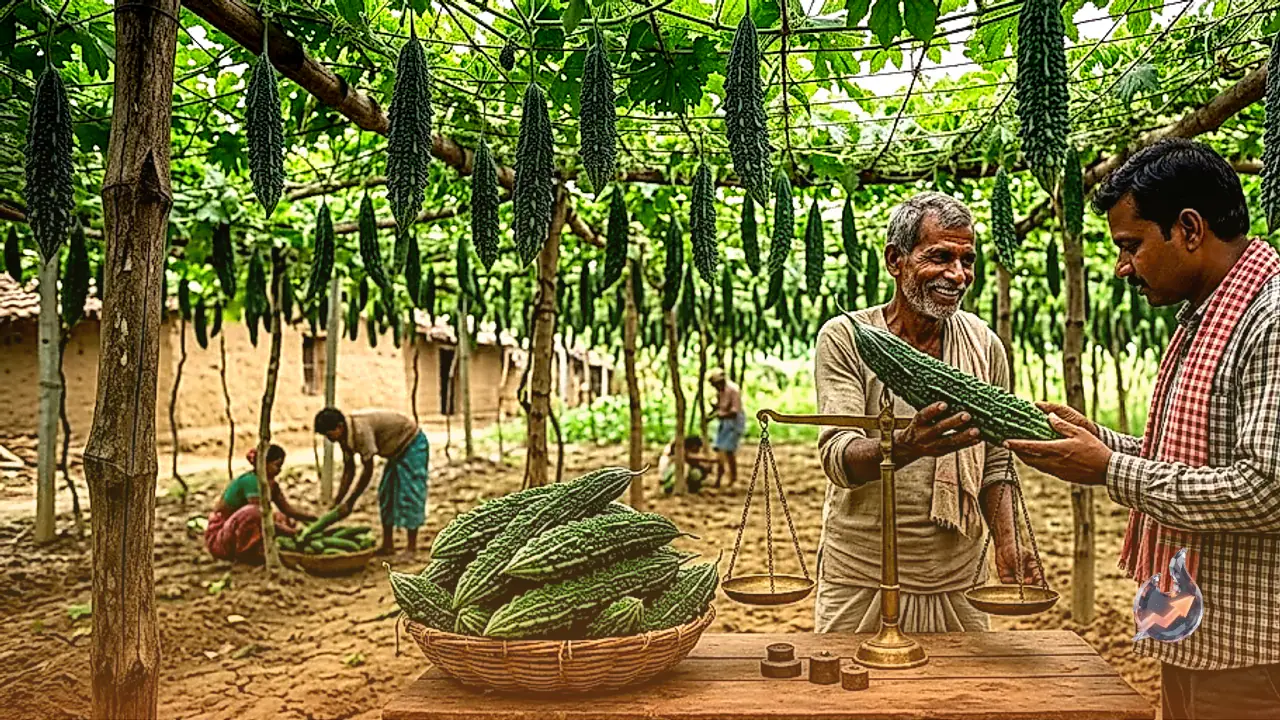

In Manjhi block of Bihar's Chapra district, bitter gourd farming has turned into a small local success story. The karela grown here is noticeably large and flavourful, good enough that traders travel in from Gopalganj, Siwan, Chapra town and even Uttar Pradesh to buy directly from the fields. Thousands of farming families in the area depend on green vegetable cultivation for their livelihood, and bitter gourd has emerged as one of the most profitable crops among them.
A growing method built for bigger profits
Farmers here grow green vegetables largely through organic methods, and fields carpeted with sprawling bitter gourd vines stretch as far as the eye can see. Around 90 percent of farmers in the region use the machaan method, training the creeper vines onto raised platforms instead of letting them spread across the ground. The logic is straightforward, during the monsoon the soil harbours far more pests, and fruit resting directly on wet earth is much more likely to rot or get damaged. By training the vines onto an elevated platform, the fruit hangs above ground and stays fully protected, and there is no risk of the vines rotting from standing rainwater either. Only the plant's roots remain in the soil, which is mounded up slightly to keep them anchored. This is precisely why farmers in the area have come to prefer this technique over conventional ground farming.
The Nandita variety and its taste
The dominant variety grown here is called Nandita, known for its bumper yields. Locals say a bharuwa, the stuffed bitter gourd dish prepared from this local produce, turns out especially tasty. Years of farming experience have also taught growers exactly how to harvest and store the vegetable so that it stays fresh without spoiling for a long stretch, which is one reason the produce commands strong demand and traders are willing to travel long distances and pay a good price for it.
Farmer Mahant Yadav's experience
Farmer Mahant Yadav said he has planted the Nandita variety of bitter gourd on eight kattha of land, and the plants have now started fruiting. "I have been farming bitter gourd for the past 15 years," he said. Once fruiting begins, the vegetable has to be picked and sold every single day, since leaving ripe fruit on the vine for too long causes losses. According to Yadav, farmers pluck and sell anywhere between 80 kilograms and over a quintal of bitter gourd daily, and this cycle continues uninterrupted for 2 to 3 months, giving growers a steady, regular income through the season.
Disease risk and where the produce is sold
Yadav also pointed out that the crop needs constant monitoring, since bitter gourd is prone to several kinds of disease. If the right pesticide and treatment are not applied in time, the crop can deteriorate very quickly, leaving farmers with heavy losses. That is why staying alert through the growing cycle is considered essential. Once harvested, Yadav sells his produce in the nearby local market itself, where traders from distant towns arrive to buy it. He added that when the Nandita variety is grown using the machaan method, the yield turns out to be tremendous, which is what makes the crop such a profitable venture for farmers in the region.