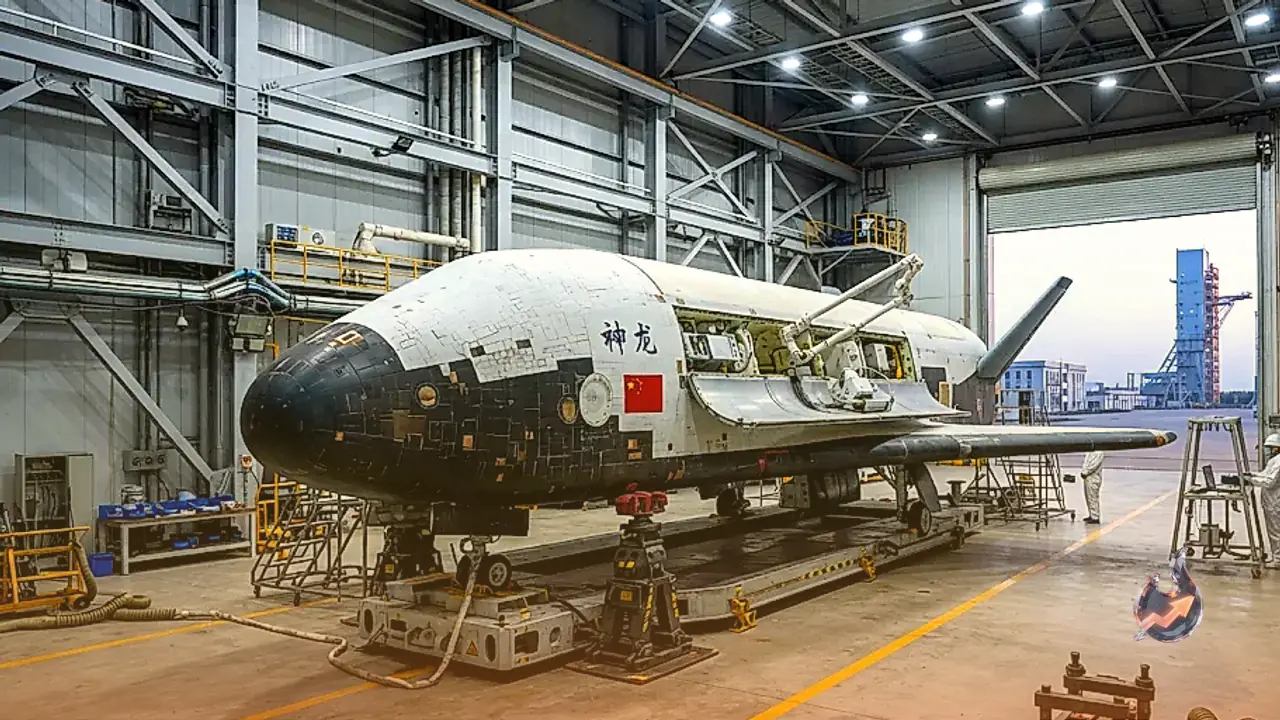

Intensifying the race for dominance beyond the atmosphere, China has once again drawn global attention with its mysterious Shenlong spaceplane. The uncrewed orbital vehicle was captured in detail by a US intelligence agency report, utilizing a photograph taken by Maxar Technologies WorldView-3 satellite on May 28, 2024, from a distance of less than 90 kilometers.
Design Features And Past Missions
The captured imagery reveals a delta-wing design equipped with open payload bay doors and specialized equipment mounted near the rear section. Observers have noted distinct structural similarities between this vehicle and the American X-37B spaceplane. Built as an uncrewed craft capable of extended orbital stays and conventional runway landings, Shenlong has completed four missions since 2020, with the most recent launch occurring in February. Despite these milestones, Beijing has kept the exact technical specifications, design details, and true military capabilities of the spacecraft strictly confidential.
Fleet Projections And Orbital Descent Timelines
A recent study conducted by Chinese researchers outlines a scenario where a fleet of 40 reusable orbital vehicles could grant the nation the capacity to reach nearly any location across the globe on short notice. Computer simulations featured in the research suggest that the maximum waiting time to catch the correct orbital window for a descent toward a target would be approximately 2.5 minutes. For a majority of major global cities, this calculated waiting window is estimated to be one minute or even less. Experts clarify that this duration does not mean the craft physically arrives at the target within sixty seconds, but rather represents the initiation phase of the deorbiting sequence, with actual travel time extending significantly beyond that initial window.
Implications For Global Defense Systems
The advanced orbital capabilities demonstrated by the craft present unique strategic puzzles for defense analysts and rivals like the US. Unlike traditional ballistic missiles, these spaceplanes can remain parked in orbit indefinitely before being commanded to return, and they possess the capability to perform orbital maneuvers to alter their trajectory. Such in-flight adjustments would make them exceedingly difficult for standard air defense networks to intercept or target effectively. While official Chinese academic and research documentation frames the project around routine transportation, emergency rescue operations, and general space utilization, military analysts continue to monitor its strategic dual-use potential.
The Shifting Landscape Of Space Warfare
The continuous development of the Shenlong program underscores a broader transition toward militarized space exploration, where low Earth orbit increasingly functions as a theater of strategic competition. While it remains premature to conclude that Beijing has fully operationalized the craft as an active weapon system, the advancement signals a potential paradigm shift in future defense planning. As orbital technologies mature, governments worldwide are forced to reevaluate their security frameworks to account for rapid deployment capabilities originating from space.