





















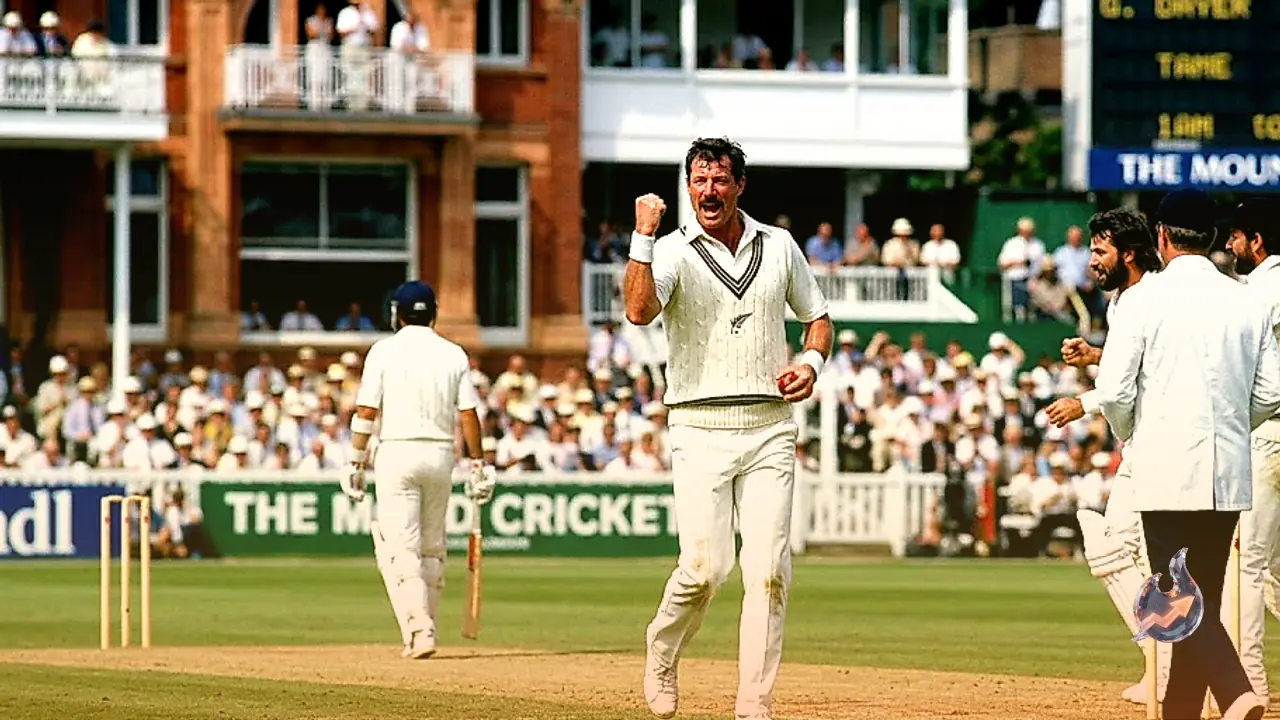

In the longest and most demanding format of cricket, relying purely on raw bowling speed is rarely enough to guarantee sustained success. A bowler's true legacy is forged through the discipline, control, and relentless swing they maintain across all five days of a Test match. Looking back through the rich history of the sport, certain elite fast bowlers single-handedly dismantled opposition batting lineups by taking 10 or more wickets in a single match, etching their names permanently into the record books.
Sir Richard Hadlee and His Unmatched Dominance
When discussing the ability to claim 10 wickets in a single match, the name of legendary New Zealand all-rounder Sir Richard Hadlee immediately stands out at the very peak. Spanning a brilliant career from 1973 to 1990 across 86 Test matches, he baffled batsmen worldwide with his metronomic swing and immaculate line and length. He finished his career with a total of 431 scalps, but his true greatness is reflected in the fact that he claimed 10 or more wickets in a single match on 9 separate occasions. His best match figures of 15/123 proved that when he was in full rhythm, survival for the opposition became practically impossible. With 36 five-wicket hauls in an innings during his career, Sir Richard Hadlee remains one of the most influential bowlers in Test history.
Sydney Burns and His Rare Efficiency
When evaluating statistical impact, the name of English bowler Sydney Burns still astonishes cricket experts to this day. Over a brief period from 1901 to 1914, Sydney Burns played just 27 Test matches, yet left an impact that would endure for generations. In those 27 matches alone, he achieved the remarkable feat of taking 10 wickets in a match 7 different times. His bowling was so economical and lethal that he finished with a career bowling average of just 16.43. He claimed 189 total wickets in his career, recording 24 five-wicket hauls in an innings along the way. His career-best match figures of 17 wickets for 159 runs remain a statistic that feels virtually impossible to replicate in modern cricket.
Dennis Lillee and Aggressive Australian Pace
Australia's Dennis Lillee was the kind of fast bowler whose very presence on the run-up struck fear into opposing batsmen. Playing 70 Test matches between 1971 and 1984, Dennis Lillee captured 355 total wickets throughout his career. Much like Sydney Burns, he also recorded the milestone of taking 10 wickets in a match 7 times during his Test career. He was far more than just a wicket-taker; he was a master at turning the course of a match entirely. Recording 23 five-wicket hauls in an innings, his best match performance stood at 11/123. His fierce competitive mindset and refusal to accept defeat delivered numerous historic victories for Australia.
Among the greatest icons of Pakistan cricket, Imran Khan dominated the global stage between 1971 and 1992 through his devastating reverse swing. Capturing 362 wickets across 88 Test matches, he not only shouldered the responsibility of team captaincy but also turned matches around single-handedly. Imran Khan claimed 10 or more wickets in a single match 6 times during his career. With 23 five-wicket hauls in an innings, his best match figures were 14/116. His impressive bowling average of 22.81 is enough to confirm that he was among the most consistent and terrifying bowlers of his era.
Alec Bedser and Reliable English Swing
Another major name on this elite list is England's Alec Bedser, who established his mastery of swing during the post-Second World War era. Playing 51 Test matches between 1946 and 1955, Alec Bedser claimed 236 wickets over the course of his career. He achieved the milestone of taking 10 wickets in a Test match on 5 occasions. Operating at an exceptional economy rate of just 2.21, he was an expert at tying down batsmen and restricting scoring options. His best match figures reached 14/99, alongside 15 five-wicket hauls in an innings.