























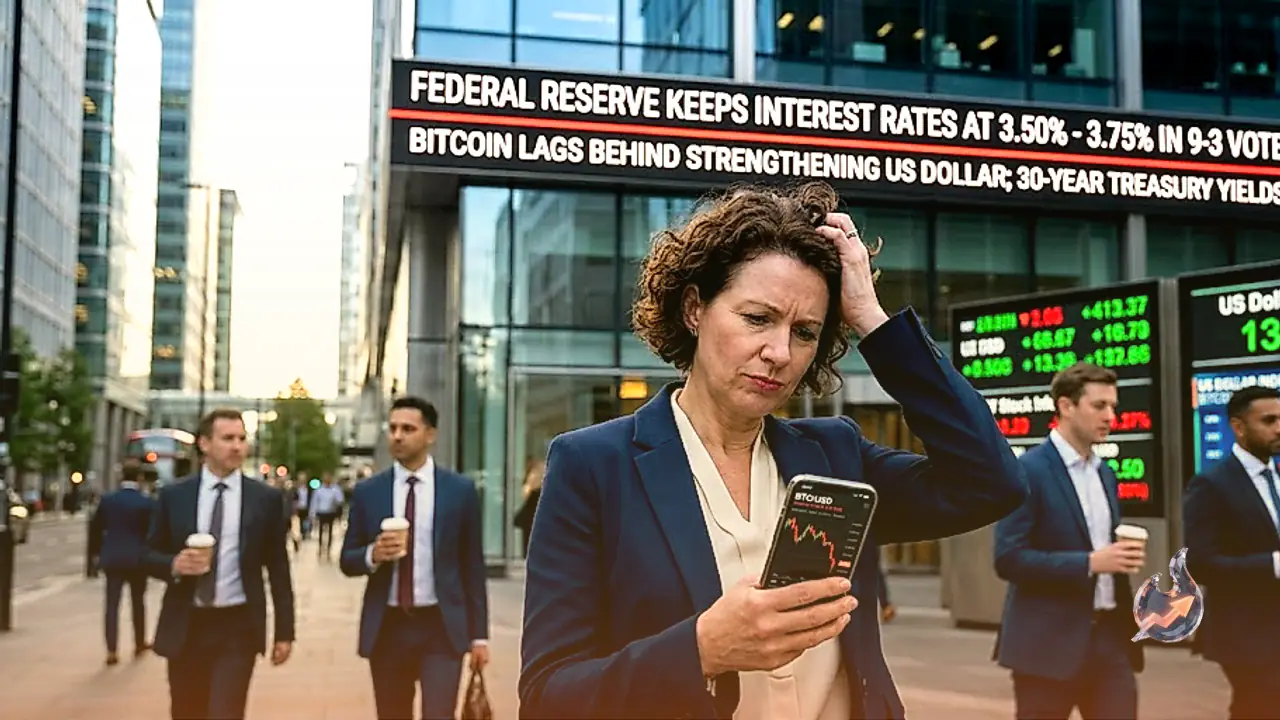

Digital asset markets witnessed swift volatility after the Federal Reserve opted to leave its benchmark interest rate unchanged in the 3.50% to 3.75% range during its scheduled policy meeting. Major cryptocurrencies initially posted rapid gains following the policy announcement, but the rally quickly lost momentum as broader macroeconomic factors reasserted control. Bitcoin rose briefly above the $64,000 mark before retreating to trade around $63,900, down 0.2% over the trailing 24-hour period. Analytics indicate that the flagship digital currency is currently recording one of its weakest performances on record relative to an ongoing rally in the US dollar.
Federal Reserve Policy Vote Breakdown and Dissent
The decision to hold borrowing costs steady was finalized by a 9-3 majority vote among Fed officials. The split highlighted internal disagreements over monetary policy, with the Federal Reserve Presidents of Cleveland, Minneapolis, and Dallas dissenting in favor of a 25-basis-point (0.25%) rate increase. Meeting minutes indicated that economic expansion has continued at a solid pace despite high levels of global uncertainty, with employment gains maintaining stride with overall workforce growth. Following the policy stance, the yield on the 30-year US Treasury bond climbed above 5.20%, heightening competitive pressure on non-yielding digital assets.
Historical Underperformance Against the US Dollar Rally
Market analytics firm Glassnode revealed that Bitcoin's relative trajectory against the US dollar has lagged significantly since the greenback began its upward trend in May. Historical comparisons spanning back to 2015 show that in 20 previous instances of sustained dollar rallies, Bitcoin produced a weaker performance at a comparable timeline in only 3 cases. Analysts caution that persistent strength in Treasury yields alongside dollar appreciation creates an environment where digital asset underperformance could extend further.
Futures Basis Anomalies and Treasury Yield Spreads
Glassnode also drew attention to metric compression within the three-month Bitcoin futures basis, which calculates the structural yield available via cash-and-carry trades. This futures basis metric has continuously traded below the yield of the two-year US Treasury bond since February. Historical records show this is only the second time that the spread between Bitcoin futures yield and two-year Treasuries has remained negative for such a prolonged duration. The only prior occurrence took place between August 2022 and January 2023, a timeframe that ultimately marked the lower boundary of the previous market cycle.
Cost Basis Clusters and Holder Dynamics
Bitcoin is currently consolidating inside its largest historical cost-basis concentration zone, located approximately between $62,000 and $68,000, where more tokens changed hands than in any other price band. On-chain distribution displays an almost equal division between short-term holders and long-term holders. While long-term holders often provide structural support due to higher holding conviction, short-term holders currently sit at a loss and may introduce selling pressure during price bounces. Glassnode pinpointed $69,000 as the critical short-term holder cost basis, above which a heavy supply overhead held by long-term investors rests between $83,000 and $86,000. Evaluating the market cycle, analysts noted that current drawdowns require strategic patience rather than premature attempts to call a definitive price bottom.