





















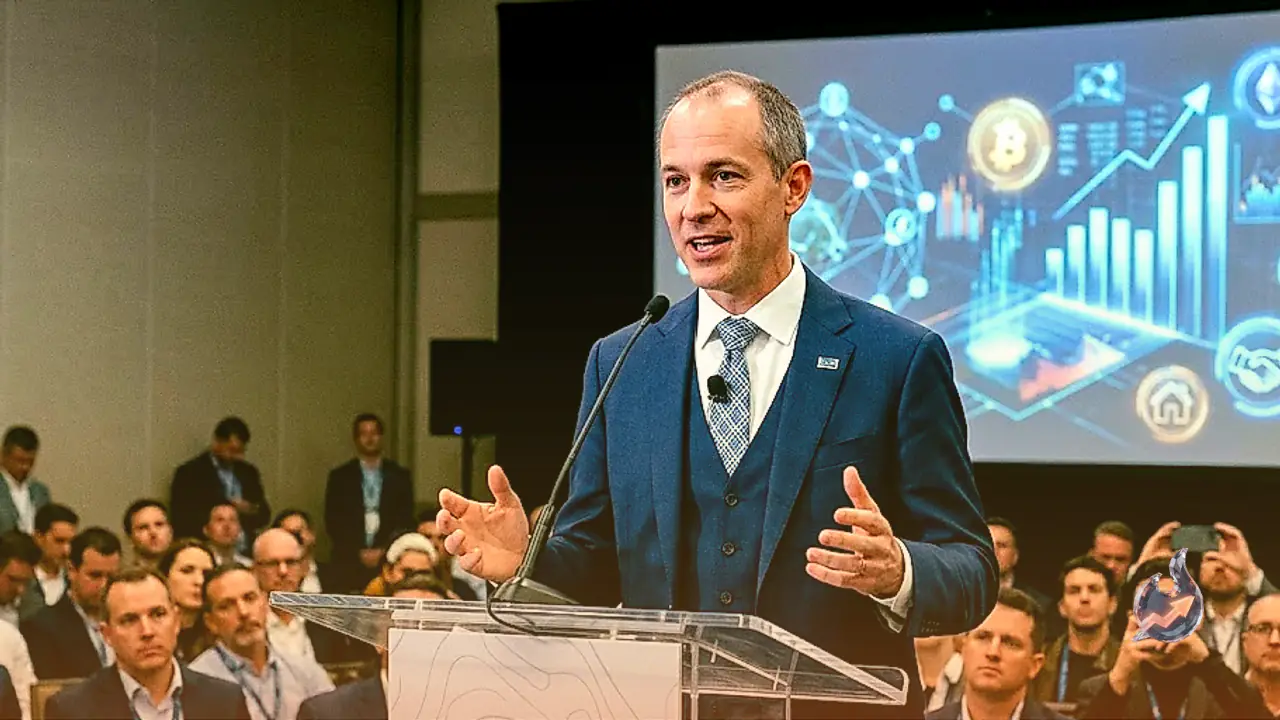

Amid ongoing consolidation across digital asset markets, the long-term potential of cryptocurrency extends far beyond current price action. Bitwise Chief Investment Officer Matt Hougan emphasized that investors are fundamentally underestimating the scale and scope of the industry's next growth phase. By anchoring expectations to present market conditions and short-term volatility, market participants risk overlooking a massive structural shift driven by the tokenization of traditional financial assets.
Tokenization of Traditional Assets and the Amazon Analogy
Matt Hougan pointed out that market participants consistently underestimate the total addressable markets that decentralized applications are designed to serve. Citing decentralized exchange Uniswap as a primary example, he explained that while the protocol was originally engineered to facilitate trading strictly between native crypto tokens, its potential addressable market expands exponentially as equities, bonds, and real-world assets undergo tokenization.
Drawing a direct parallel to the early evolution of the internet economy, Matt Hougan noted that people view these protocols as mere crypto applications in much the same way early observers dismissed Amazon as simply an online bookstore. It is now becoming widely recognized that tokenization will eventually absorb virtually every traditional asset class imaginable.
Crypto-Native Resilience vs Traditional Financial Entrants
A common consensus among mainstream analysts is that established Traditional Financial (TradFi) institutions will inevitably dominate the cryptocurrency landscape due to their scale. However, Matt Hougan argued that investors routinely overestimate the ability of legacy financial giants to capture crypto-native market share. He cited PayPal's launch of its proprietary stablecoin in 2023 to illustrate the point.
Despite PayPal possessing a globally recognized brand and hundreds of millions of active users, its stablecoin accounts for only approximately 1% of the total stablecoin market. In contrast, crypto-native issuers Tether (USDT) and Circle (USDC) maintain a combined dominance of roughly 88%. Within the digital asset ecosystem, users demonstrate greater familiarity and trust toward Tether than established legacy payment providers.
A similar dynamic has played out in institutional custody. While Fidelity entered the crypto custody market in 2019, crypto-native exchange Coinbase successfully emerged as the largest digital asset custodian in the United States. Nonetheless, traditional institutions retain an edge in areas where their structural distribution models excel, as demonstrated by BlackRock's dominant position in the US spot Bitcoin Exchange-Traded Fund (ETF) market.
24/7 Continuous Trading and the Impact of AI Agents
Another structural shift underestimating market capacity involves trading availability and automated execution. Traditional US equity markets operate for roughly 33 hours per week. In contrast, tokenized markets running on blockchain infrastructure operate continuously for 168 hours every week.
As financial assets transition to continuous 24/7 settlement and artificial intelligence (AI) agents increasingly assume portfolio management and trade execution responsibilities, total transaction volume is projected to surge dramatically. Estimating future blockchain market sizing based solely on today's transaction metrics creates a major blind spot. The gap between how fast the technology moves and how slowly market perceptions catch up represents the primary opportunity for forward-looking investors.
Bitcoin Technicals and Market Consolidation
In broader market action, Bitcoin (BTC) continues to demonstrate resilient structural support despite range-bound conditions. On Wednesday, Bitcoin traded firmly above the $64,000 threshold, consolidating near its 50-day Exponential Moving Average (EMA) of $64,370 after securing a 2.9% gain over the preceding two trading sessions.
Live market data shows Bitcoin surging to $69,551, representing a 7.53% increase from its previous close of $64,681, within a 52-week range of $57,748 to $97,861. Technical indicators display strong momentum, with the 14-day RSI at 74 (overbought territory) and the MACD histogram printing a bullish 389.17. The 20-day EMA stands at $64,428 while the 50-day EMA rests at $64,524. On shorter horizons, Bitcoin maintains key technical support near the $63,000 region.
Altcoin Performance: Ethereum, Ripple, and Pump.fun
Altcoins are similarly displaying tight consolidation patterns across major trading pairs. Ethereum (ETH) remains steady above the $1,900 level, while Ripple (XRP) reclaimed crucial technical support at $1.00 on Wednesday following minor headwinds earlier in the week.
Rebound interest around the $0.99 support level encouraged fresh spot buying in XRP, reinforced by renewed capital inflows into spot Exchange-Traded Funds (ETFs). Meanwhile, derivative token Pump.fun (PUMP) eased by 3% on Wednesday after a powerful 13% rally the previous day. Despite the minor pullback, Open Interest for PUMP derivatives reached a seven-month high of $258.62 million, indicating sustained leverage-backed trader interest.