


















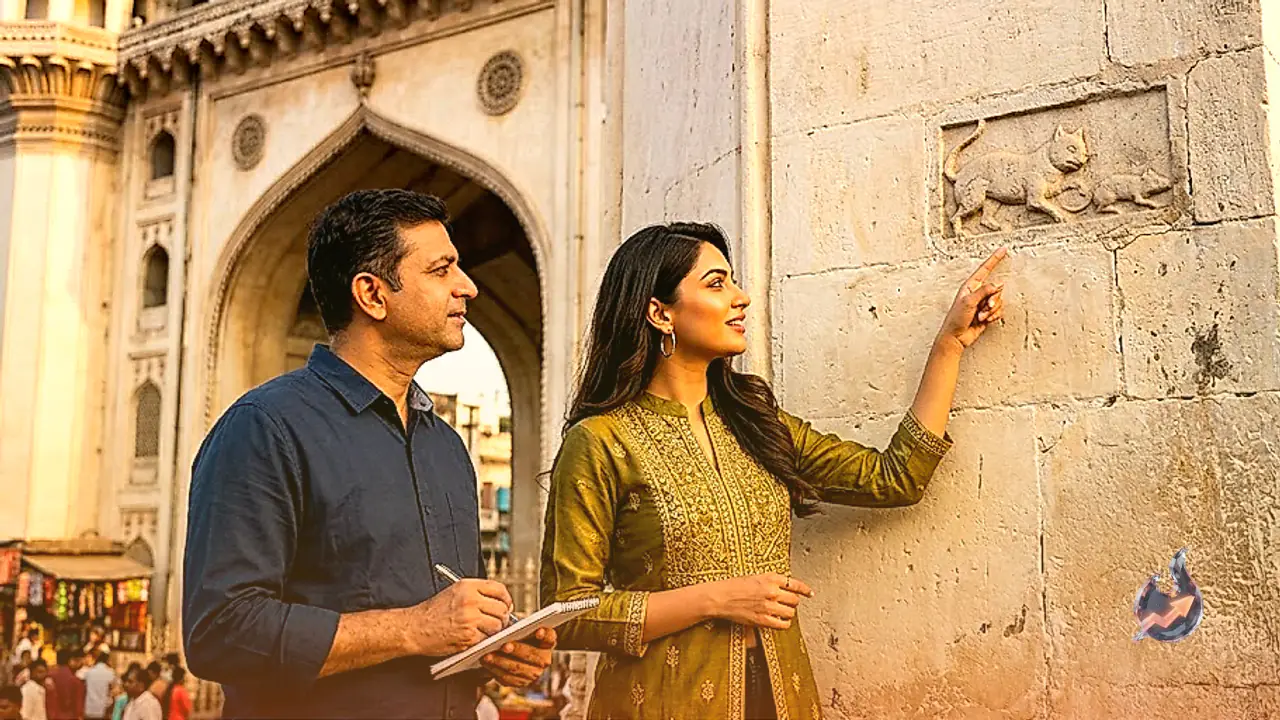

Standing tall at the heart of historic Hyderabad, the Charminar is globally celebrated for its imposing arches, intricate masonry, and soaring towers. Erected more than 430 years ago using a blend of granite blocks, lime, and mortar, this architectural treasure carries centuries of urban memory within its walls. Yet beyond its familiar silhouette, the structure preserves an obscure artistic detail that eludes most casual visitors. High along the ornate masonry, artisans carefully chiseled the figures of a cat and a rat into the stonework of the vast arches, an astonishing presence inside an edifice dominated by Indo-Persian aesthetic traditions.
An Unusual Animal Relief on the Eastern Arch
Those who carefully inspect the junction where the ceiling meets the eastern archway can still distinguish the faint silhouette of a cat etched directly into the stone. History enthusiast Shahid Omer explains that medieval Islamic architecture almost universally favored geometric forms, intricate Arabesque foliage, and Arabic calligraphy. Incorporating an animal depiction into such a prestigious public building was an extraordinary deviation from contemporary artistic norms. Local elder Shameeq Khan affirms that this rare motif holds an immediate, unbroken connection to the very founding of Hyderabad and the solemn purpose behind raising the landmark.
The Deadly Plague Outbreak of 1591
The genesis of this stonework dates back to 1591, when the fifth Sultan of Golconda's Qutb Shahi dynasty, Muhammad Quli Qutb Shah, reigned over the kingdom. During this juncture, a catastrophic epidemic of plague, carried by rodent populations and their fleas, ravaged the settlement and claimed thousands of lives across the region. Distressed by the immense suffering of his subjects, the ruler offered an impassioned prayer, vowing to erect a majestic monument on the very spot if his populace was spared from the affliction. When the pestilence finally subsided and the territory returned to health, the Sultan fulfilled his sacred vow by initiating the construction of the Charminar as a public monument of thanksgiving.
A Tribute to the Natural Hunters of Rodents
Because the deadly infection spread primarily through rats and fleas, felines served as nature's most effective front-line defense against the carriers of the plague. The master masons of the Qutb Shahi court elected to memorialize this critical turning point by embedding the feline form into the monument's enduring masonry. Far from being a superstitious charm or arbitrary ornament, the carved cat stands as an intentional historical emblem commemorating the eradication of the rodents and the relief of an entire metropolis. Today, after more than four centuries, this subtle carving quietly preserves the memory of Hyderabad's darkest trial and its historic survival.