



















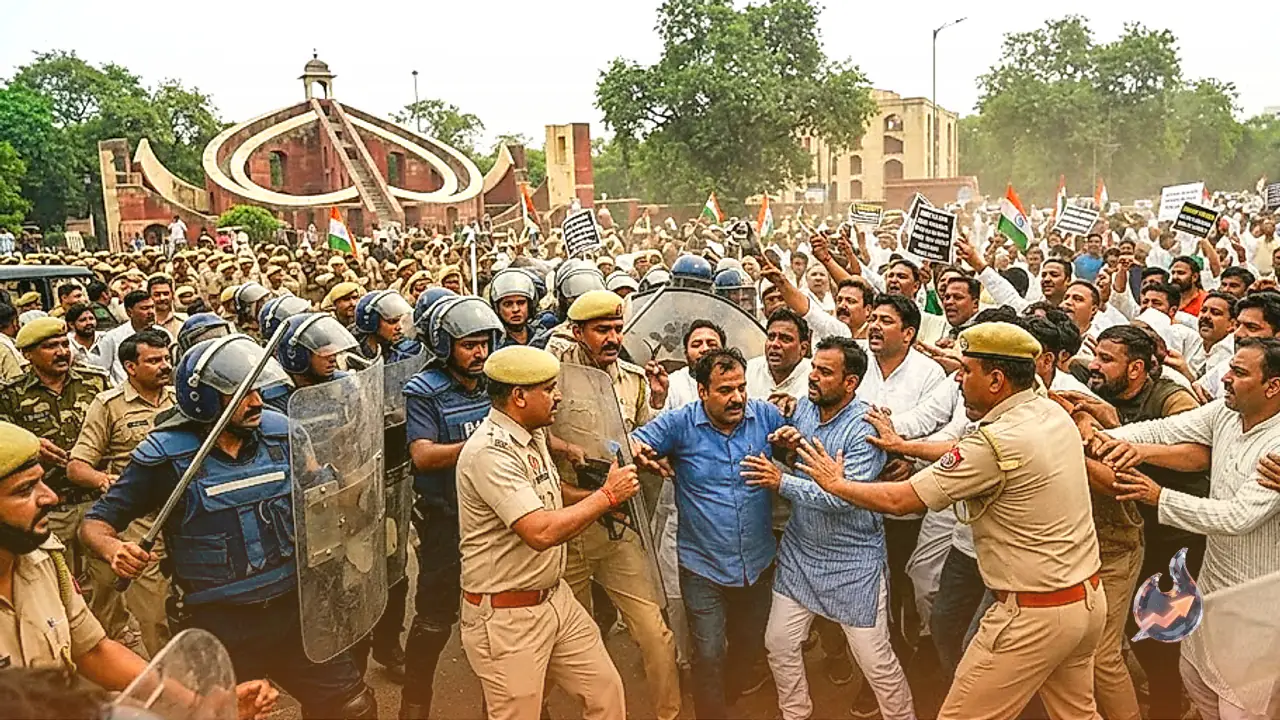

Security personnel clashed with a crowd of demonstrators attempting to march from Jantar Mantar towards India's Parliament in Delhi on Sunday morning, as organisers under the banner of CJP pushed ahead with the march despite the Delhi Police refusing permission for it.
Clashes break out as the march begins
The march began early on Sunday at Jantar Mantar, a traditional protest site in central Delhi. Police had already made clear in an official statement that no permission had been granted for this particular march towards Parliament. Even so, organisers went ahead, prompting the Delhi Police to station a massive contingent of security forces at the site. During the standoff, members of the Rapid Action Force (RAF) and protesters were seen clashing at the spot.
Delhi Police calls the operation "professional"
As visuals of the clash spread, the Delhi Police moved to counter reports emerging in sections of the media about alleged violence or people being detained at Jantar Mantar. In a statement posted on X, the force said, "It is informed that no such incident has occurred and the protest is being handled professionally." The police appealed to the public not to pay heed to rumours or misunderstandings and to cooperate in maintaining peace and law and order in and around the protest site.
More than 10,000 security personnel deployed
The scale of the security build-up around Jantar Mantar has been unusually large. Three layers of security barricading have been put up along the route connecting Jantar Mantar to Parliament. At the time of the clash, an estimated 5,000 to 6,000 protesters were present at Jantar Mantar, while more than 10,000 security personnel were deployed at the spot to manage the crowd. Tear gas, batons and 'Vajra' vehicles have also been stationed along the route between Jantar Mantar and Parliament in case the situation escalates further.
Section 163 of the BNSS in force across Delhi
Alongside the security deployment, prohibitory orders under Section 163 of the Bharatiya Nagarik Suraksha Sanhita (BNSS) have been imposed across Delhi. Under this order, the gathering of five or more people at any single location is banned everywhere in the city except at Jantar Mantar. The Delhi Police has appealed to the public to maintain law and order and not take the law into their own hands.
Deputy Commissioner of Police (DCP) Sachin Sharma had already issued a public advisory on X on Sunday, well before the clash. In it, he said, "Delhi Police clarifies that neither permission has been sought nor granted for any such protest march or procession." The advisory added that under the prohibitory order, protest marches, processions, demonstrations and the gathering of five or more people are strictly banned everywhere except at the designated protest site at Jantar Mantar, and that too only with prior permission.
Sonam Wangchuk's three conditions to end his fast
Amid the standoff, Sonam Wangchuk has laid down conditions for ending his hunger strike. He posted a letter on social media spelling out three demands. His first condition is that the government take responsibility for recent failures in the education system, including paper leaks. His second condition is that he and the leadership of CJP be allowed to reach Parliament. His third condition is that members of Parliament and leaders from different parties present at the spot give an assurance that they will raise the issue in Parliament, and if that is not possible for reasons of health or otherwise, that MPs and leaders from various parties visit the hospital to give the same assurance in person.