















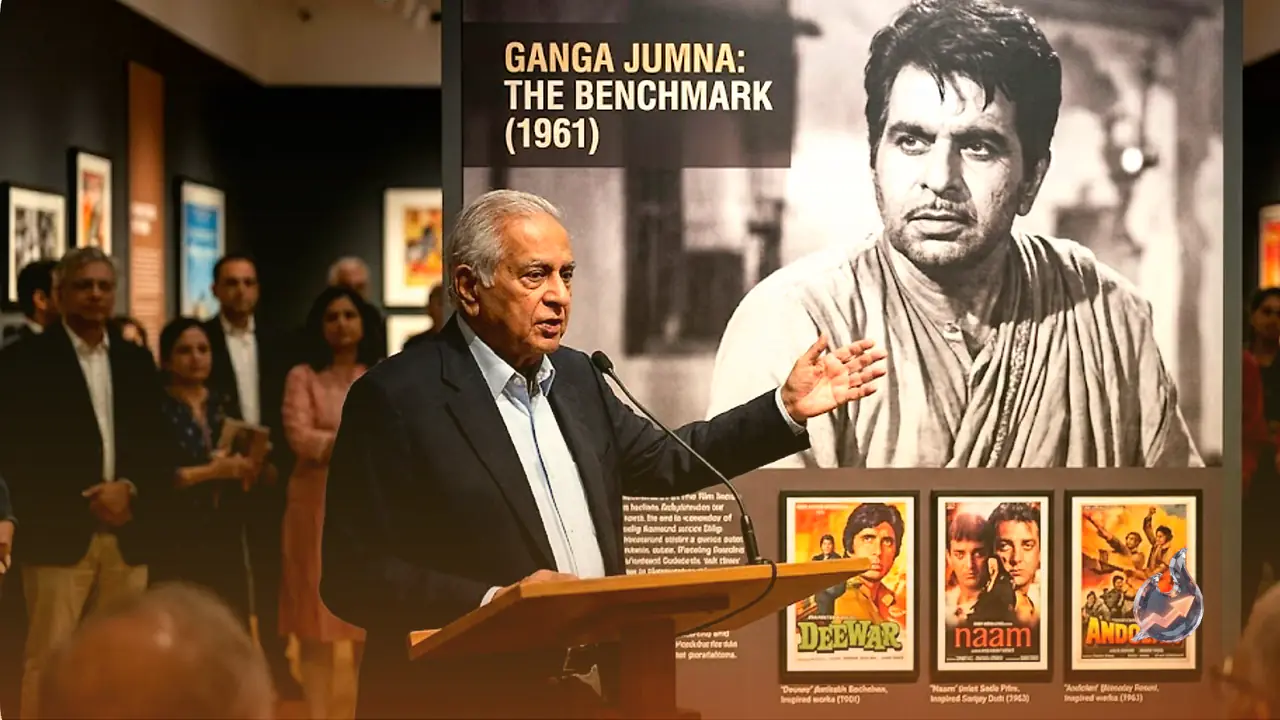

Dilip Kumar is often referred to as an institution of acting, a legend whom the likes of Amitabh Bachchan and Raj Kapoor regarded as their ultimate inspiration. Released in 1961, the film 'Ganga Jumna' remains a monumental achievement in Bollywood history. While Nitin Bose is credited as the director, Dilip Kumar was the true force behind the camera; he produced the film, wrote the screenplay, and largely took over the directorial responsibilities. His vision for 'Ganga Jumna' created a blueprint for dramatic storytelling that resonated through decades of Indian filmmaking.
Language, Craft, and Censorship Challenges
The film stood out primarily for its authentic use of the Awadhi language, a bold choice that defied the standard dialogue styles of the time. Vyjayanthimala, an actress from the South, delivered a stellar performance; she perfected her Awadhi lines after Dilip Kumar sent her recorded audio tapes to help her grasp the nuances. Her dedication earned her a Filmfare award for Best Actress. The cast included Kanhaiya Lal, Anwar Khan, Leela Chitnis, and notably, Dilip Kumar’s real-life younger brother, Nasir Hussain. The siblings appeared together once more in the 1976 film 'Bairag', though Nasir Hussain passed away before its release. With music by Naushad and lyrics by Shakeel Badayuni, the soundtrack—featuring classics like 'Insaaf Ki Dagar Pe'—became legendary. The film's net collection of 3.5 crore rupees in 1961 would be equivalent to nearly 1000 crore rupees today. Before it could reach theaters, it faced severe hurdles with the Censor Board, which demanded 200 cuts. Dilip Kumar famously sought the assistance of the then-Prime Minister Jawaharlal Nehru to clear the path for its release.
The Inspiration Behind Deewar
The core narrative of 'Ganga Jumna' famously inspired the writing duo Salim-Javed to pen 'Deewar'. Directed by Yash Chopra and produced by Gulshan Rai, the film arrived on January 24, 1975. It featured Amitabh Bachchan as the criminal-minded Vijay and Shashi Kapoor as the upright police inspector Ravi Verma. The emotional conflict between the two brothers cemented the film's status as an iconic piece of Hindi cinema. It ran for 100 weeks, collected 4.25 crore rupees, and stood as the fourth highest-grossing film of 1975.
The Success of Naam
Another film drawing from the 'Ganga Jumna' template was the 1986 blockbuster 'Naam', directed by Mahesh Bhatt. Starring Sanjay Dutt and Kumar गौरव (who is also Dutt’s real-life brother-in-law), the film focused on one brother’s path into drug trafficking while the other remained truthful. Made on a budget of approximately 2 crore rupees, it earned 4 crore rupees in India and 7 crore rupees globally. With iconic music by Laxmikant-Pyarelal, including the immortal ghazal 'Chitthi Aayi Hai', it ranked as the fourth highest-grossing film of 1986.
Andolan: The Final Iteration
The narrative trope of the 'Ganga Jumna' and 'Deewar' style brother conflict made a final appearance in the 90s with the 1995 film 'Andolan'. Directed by Aziz Sejwal, the film starred Sanjay Dutt and Govinda. Written by Anees Bazmee with music by Nadeem-Shravan, it portrayed a contrast between a criminal brother and an honest engineer. Produced on a budget of 3.75 crore rupees, the film collected 10 crore rupees, ultimately performing as an average box-office venture.