



















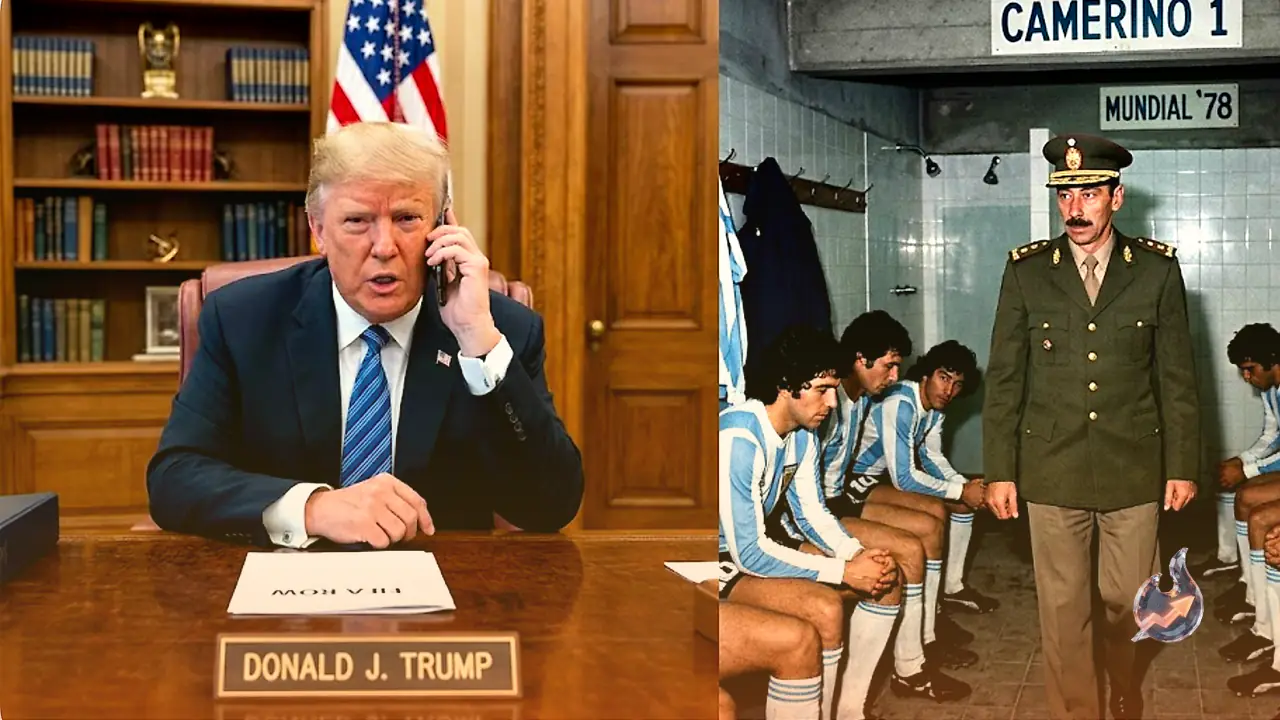

US President Donald Trump is facing accusations of pressuring FIFA after American striker Folarin Balogun's red card during a World Cup match was withdrawn. Under football's rules, a red card automatically bans a player from the next match, a rule that normally leaves no room for reversal. But in this case the decision was overturned, and the reason being floated is a threat Trump is said to have made to FIFA. The controversy is still unfolding, but it has also revived an old and far darker World Cup story, one where a dictator personally walked into a team's dressing room to threaten the players before a match.
Balogun's red card, and its sudden reversal
The row began when American striker Folarin Balogun was shown a red card during a World Cup fixture. Under football's laid down rules, a red card triggers an automatic one match ban, a rule that is usually applied without exceptions. This time, however, the decision was reversed and Balogun's red card was withdrawn. That reversal is what triggered the accusation that Trump had threatened FIFA into changing course, and it is now the most talked about controversy in football circles.
Argentina's desperate position at the 1978 World Cup
21 June 1978 remains one of the most disputed dates in football history. Argentina was hosting the World Cup that year, yet found itself on the verge of elimination in its own tournament. It had already beaten strong sides like Italy, France and Hungary, but was trailing arch rival Brazil in the second group stage. The format back then looked nothing like today's. There were no knockout rounds, and a win carried no bonus of 3 points. The rule was simple, whichever team topped its group would go straight into the final against the Netherlands.
The goal difference math that raised the stakes
Before the match, the picture was stark. Brazil sat on top with 5 points and a +5 goal difference, while Argentina was second with 3 points and a +2 goal difference. To book a final spot, Argentina had exactly one path left, win its last group match by a margin of at least 4 goals. That was no small ask, it was immense pressure on the host nation.
A scheduling call that raised eyebrows
Normally, final round group matches are played simultaneously to prevent any manipulation. In 1978, FIFA chose the opposite. The organisation feared that if both matches kicked off at the same time, fans would rather watch on television at home than turn up at the stadium. So Argentina's match was scheduled after Brazil's had already finished. The result was that Argentina's players knew, before they even stepped onto the pitch, exactly how many goals they needed to advance.
A 6-0 win and a first World Cup title
What followed on the pitch was something almost nobody expected. Argentina thrashed Peru 6-0, overtaking Brazil on goal difference and securing its place in the final. It then went on to beat the Netherlands 3-1 in the final to win its first ever World Cup title. But as spectacular as the win looked, it has remained wrapped in controversy ever since, with questions that persist to this day.
A dictator's direct entry into the dressing room
According to the claims, just before kickoff Argentina's dictator Jorge Rafael Videla walked straight into Peru's dressing room. He was accompanied by then US Secretary of State Henry Kissinger. There, Videla read out a message sent by Peru's own dictator, one that invoked the long standing friendship between the two nations. On the surface it looked like an ordinary goodwill message, but for the players the hidden meaning was unmistakable, it was a signal to lose the match.
A loan and a grain shipment that raised questions
Exactly 10 days after the match, the Argentine government extended Peru a substantial loan, structured as non refundable credit, meaning it was never meant to be repaid. Even before that, right before the match, Argentina had sent Peru 35,000 tonnes of grain free of cost, the kind of assistance usually reserved for major natural disasters. It is the timing of these two gestures, tied so closely to the match, that has kept the result under a cloud of suspicion for decades.
Denials at the time, confessions years later
Argentina's government and its players always flatly denied the allegations. They instead claimed that Brazil had tried to bribe Peru's players to beat Argentina. Some Peruvian players also attributed the defeat to fatigue and internal disagreements within the squad. But years later, a different side of the story emerged. Peru's star players Juan Carlos Oblitas, Jose Velasquez and German Leguia openly admitted that they had received both bribes and threats from the Argentine government. Velasquez went a step further and named the players who had allegedly taken the money, a list that included his own captain, Hector Chumpitaz. Those named players, however, have consistently denied the accusations.