


















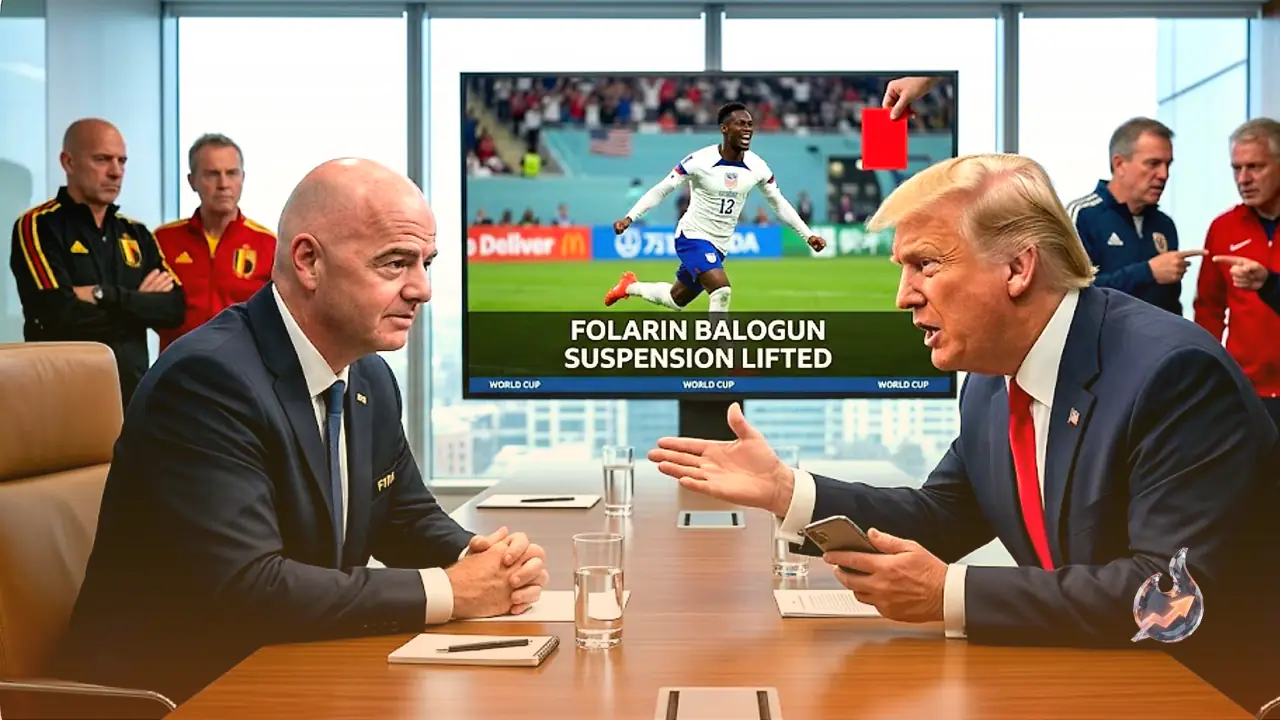

A single phone call from the White House has thrown the FIFA World Cup's knockout stage into turmoil, after Belgium accused football's governing body of caving to pressure and clearing American forward Folarin Balogun to play despite a red card that should have kept him out of Monday's round of 16 clash in Seattle.
How a red card turned into a diplomatic incident
The trouble began during last Wednesday's round of 32 fixture, when a referee sent Balogun off for what officials ruled was a reckless tackle on a Bosnia-Herzegovina player. Under FIFA's standard disciplinary rules, a straight red card in a knockout match should trigger an automatic one match suspension, which would have ruled the striker out of the United States' next fixture against Belgium. Instead, FIFA opted not to enforce that ban, clearing Balogun to line up on Monday, and the decision instantly became the flashpoint of the tournament.
Trump defends his call to Infantino
President Donald Trump chose not to distance himself from the episode. Speaking to reporters at the White House on Monday, he confirmed he had personally raised the matter with FIFA president Gianni Infantino, though he insisted he had not pushed for any particular outcome. 'I just asked for a review. I didn't think it was a foul,' Trump said, describing the referee's call as a genuinely 'terrible' decision that deserved a second look. He framed his intervention as a simple request to revisit what he saw as a bad piece of officiating, not an attempt to dictate the outcome, but the optics of a sitting American president lobbying a football body hours before a knockout match were impossible to ignore.
Belgium and UEFA say FIFA crossed a line
Belgium's football federation reacted with alarm, issuing a statement describing itself as 'very concerned' and voicing clear frustration with FIFA for failing to show good faith in following the legal steps needed to appeal the Balogun ruling. UEFA had already weighed in before that, blasting what it called an 'incomprehensible and unfair decision' and arguing that FIFA had overstepped by not applying the mandatory one match ban that the red card should have carried. Both bodies effectively accused FIFA of bending its own rulebook at the exact moment it mattered most, just hours before the United States and Belgium were due to meet in Seattle with a quarterfinal spot on the line.
Norway's coach says the decision 'will hurt the World Cup'
The backlash was not confined to the two federations directly involved. Norway coach Ståle Solbakken, speaking on Sunday after his team knocked Brazil out of the tournament to reach the quarterfinals, did not hold back. 'This is a very, very, very, very, very bad decision that will hurt the World Cup,' he said. UEFA echoed that concern in blunter institutional language, warning that 'when those who enforce the rules do not guarantee their own certainty, the integrity of the game is at risk and the competition's credibility diminishes.' Coming from two separate voices within the sport, the criticism painted the episode as the most serious credibility crisis the tournament has faced in its 96 year history.
Infantino says judges, not politics, will settle it
FIFA president Gianni Infantino pushed back on the idea that politics had decided the matter. He confirmed that he had indeed discussed Balogun's suspension with Trump, but said he used the conversation to explain that the final call rested with FIFA's independent judicial bodies, not with him or any government. In a statement posted on X, Infantino said, 'During our conversation I explained that there is a legal process underway involving FIFA's independent judicial bodies, and the competent body will decide on this matter at the right time.' He added, 'This is how FIFA's system works, and it is a principle I will always follow,' effectively arguing that Trump's call changed nothing about how the case would ultimately be resolved.
What happens next
For now, the practical outcome favours the Americans. With FIFA lifting the automatic one match suspension, Balogun was cleared to take the field for the United States in Monday's round of 16 match against Belgium in Seattle, with the winner advancing to the quarterfinals. Belgium, however, has made clear it is not letting the matter drop, confirming that it is formally challenging FIFA's decision even as the match goes ahead. That leaves the World Cup with an unusual situation, a knockout game being played under a disciplinary ruling that multiple federations, a head coach, and continental body UEFA have all publicly branded unfair, with the final word on Balogun's case still pending from FIFA's judicial process.