
























Game development is a notoriously unforgiving business. While some creators struggle to ever make a lasting mark, others achieve such colossal and monumental success that virtually everything else they produce gets completely sidelined or forgotten. Take Game Freak as a prime example. You have likely never played titles such as HarmoKnight, Drill Dozer, or Tembo the Badass Elephant, but you are undoubtedly familiar with Pokémon. How could anyone escape it? It remains an absolute cultural juggernaut, and it serves as an impossibly high standard against which Beast of Reincarnation is inevitably measured.
Stepping Outside Traditional Boundaries
That is not to suggest that Game Freak's latest release is a bad game—far from it, in fact. This open-field action game presents a delightful blend of diverse ideas, mechanics, and conceptual frameworks, proving that the developer is operating far beyond its comfort zone of decades past. However, the experience also carries the distinct impression that the studio was so intensely eager to establish its capability of producing something entirely detached from its signature monster-catching megahit that it drew inspiration from nearly every available source in a bid to avoid being permanently typecast.
Post-Apocalyptic Mythology and Protagonists
The narrative follows Emma, designated as a Sealer living in a harsh post-apocalyptic world roughly two thousand years removed from our contemporary era. Following a mysterious blight that materialized in the distant past, the landscape was profoundly corrupted, mutating local wildlife into aggressive plant-animal hybrids known as malefacts. Consequently, the vast majority of humanity abandoned their fragile biological forms in favor of robotic golems, holding out hope for a future day when they could cleanse the Earth and reclaim their mortal bodies. Emma remains one of the rare individuals who still retains an organic physique, albeit one infected with a unique strain of the blight. This infection grants her the ability to extend her hair into plant-like vines to combat malefacts. Furthermore, she shares an enigmatic connection with Koo, a wolf-like malefact exhibiting a degree of sentience who assists her in combat and serves as an endearing companion that players can pet between missions.
Royal Summons and Colossal Threats
Summoned to the Capital to investigate widespread reports regarding the awakening of the titular beast from a century-long slumber—an event carrying catastrophic implications for the remaining pockets of humanity—Emma and Koo traverse the ruined world. Along their journey, they confront the colossal Nushi, overgrown malefacts that rule over individual regions, while simultaneously unearthing long-buried secrets regarding their respective pasts. This constitutes the central path of the game, and it is precisely here that its plethora of prominent influences becomes glaringly obvious.
This open field action game is a delightful blend of ideas.
A Patchwork of Influences and Combat Mechanics
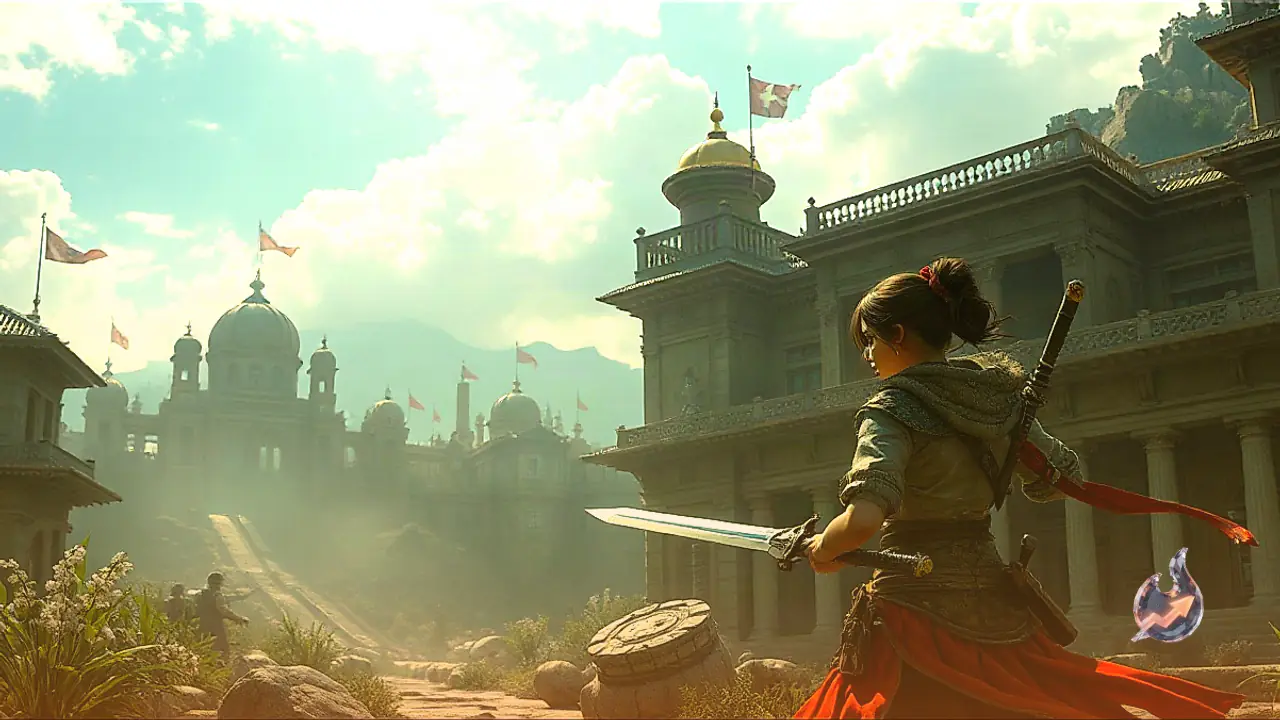
The game world itself is undeniably striking, yet it clearly stems from transplanting the wild, rural, and feudal aesthetic of Princess Mononoke into a timeline set well after Judgement Day, right down to an opening boss encounter lifted straight from the climax of Miyazaki’s masterpiece. Combat liberally borrows from Soulsbornes, unfolding as a rhythmic dance of weapon strikes, deflections, parries, and evasive rolls, while enemies respawn whenever the player rests at a campsite—the exact locations where earned leveling points are spent to upgrade the attributes of both Emma and Koo. Yet, the experience also incorporates elements reminiscent of Monster Hunter and even Shadow of the Colossus, pitting players against gargantuan adversaries that leave them questioning the wisdom of their actions long after the dust has settled.
Exploration and Follicular Abilities
Exploration draws heavy inspiration from Horizon: Zero Dawn, offering abundant crafting components alongside ranged weaponry and stealth takedowns designed to bypass direct skirmishes, though it also features a touch of Death Stranding that requires careful thought when navigating impassable terrain. This traversal frequently relies on Emma’s unique hair, which functions as a propulsion mechanism to launch her into the air, form functional bridges, or grapple onto anchor points in a manner reminiscent of Batman or Spider-Man swinging across skyscrapers. These same follicular powers subsequently integrate back into active combat to achieve an effect increasingly comparable to Bayonetta.
Verdict and Final Impressions
To Game Freak's credit, the studio executes a surprisingly competent job of balancing all these disparate elements. Everything manages to gel together reasonably well even when individual components appear an awkward fit, and it remains evident that the team genuinely enjoys developing for hardware significantly more powerful than Nintendo's typical hardware offerings. Players who become thoroughly immersed in its eccentric mythology or invest the necessary effort to master its fast-paced combat encounters and signature boss battles will undoubtedly find plenty to enjoy. Nevertheless, Beast of Reincarnation ultimately lacks any defining element that truly allows it to stand out on its own merits—it remains very much the sum of its constituent parts, nothing less, but regrettably nothing more.