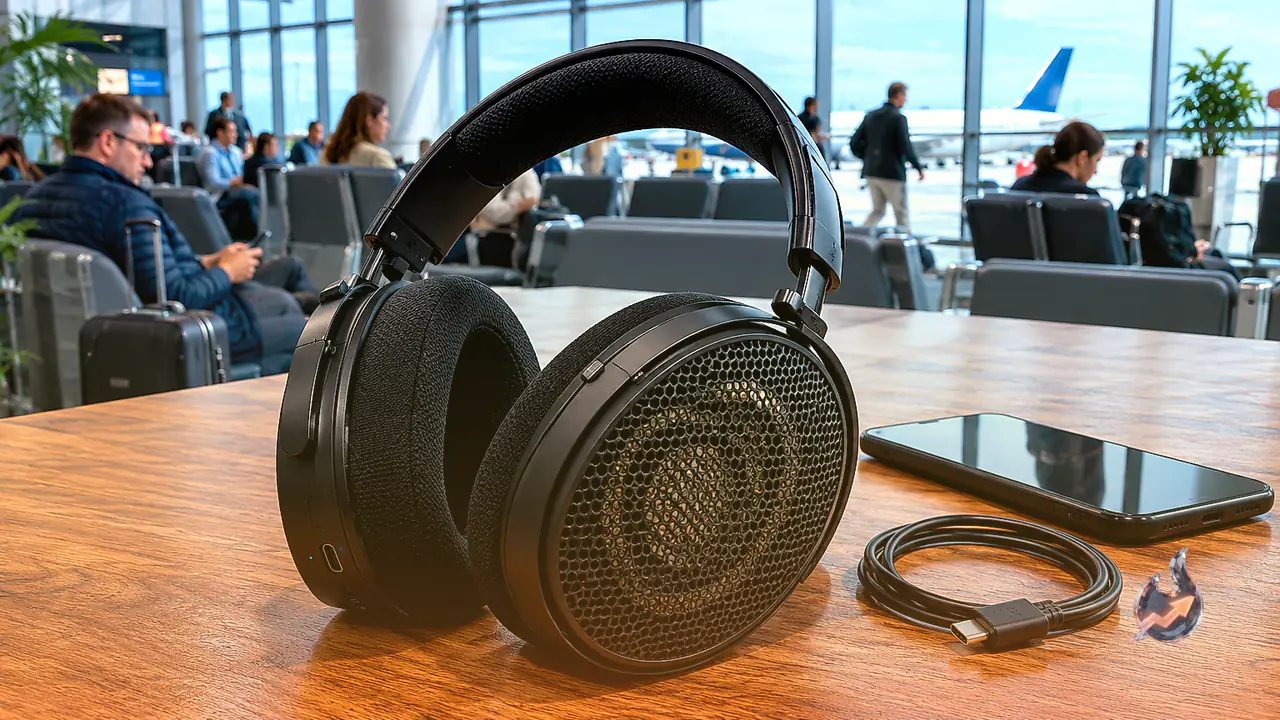

For listeners who want the airy presentation of open-back headphones at home without being tethered to a cable, the Audio-Technica ATH-AL5NC offers an unusual combination. These are wireless open-back headphones, a relatively rare type: even the brand’s Audio-Technica ATH-M50xBT2 Wireless is closed-back. The ATH-AL5NC also includes noise cancelling, but its open construction lets sound pass both ways. That makes it a poor stand-in for closed-back headphones on a commute, despite the feature.
Sound and everyday listening
The headphones are light and reasonably comfortable over longer sessions. Their warm tuning keeps bass and mid-range close to the target, while the stronger noise-cancelling mode extends bass deeper than many open-back designs. That can help recordings where low-end weight matters. Treble is less even: a narrow dip in the low treble takes some presence away from vocals and lead instruments, while peaks higher up can make sibilants and cymbal hits stand out sharply.
Stereo placement remains stable because the left and right drivers in the reviewed unit were well matched. Harmonic distortion stayed very low even at high volume, so playback remains clean when turned up. The frequency response also changes little between wears. Bass and treble sound much the same each time the headphones are put on, and the fit accommodates most head shapes and sizes without needing repeated adjustment. That consistency supports a reliable listening experience, although the loose fit becomes a drawback when movement is involved.
Travel, office and exercise limitations
These headphones are poorly suited to workouts. Their low weight helps, but the large cups and weak clamping force mean they can shift during a jog or a set of burpees. They are bulky to bring to the gym, and the included soft pouch offers little protection inside a bag. There is also no dust- or water-resistance rating. Those limitations make them a questionable choice for exercise or conditions where sweat and exposure are concerns.
For travel, the 54-hour battery can last through a long trip, and the low weight and reasonable comfort make extended wear manageable. The open-back design, however, leaves much of the train or plane environment audible. Noise cancelling can soften some steady hums, such as a refrigerator, but does little against voices and higher-pitched sounds. Audio also leaks enough that people nearby in a quiet train car can hear what is playing. Their large size takes up considerable bag space, so the battery advantage comes with a portability trade-off.
In an office, conversations and keyboard clatter remain audible through the headphones. Sound leakage can also reach nearby coworkers. A leakage-reduction mode is available, but it hollows out the sound and disables the EQ. The integrated microphone is adequate for calls in a quiet room, though it struggles to separate a speaker’s voice from background noise. The headphones are light and reasonably comfortable for a full workday, can remain paired with two devices at once, and have a battery life exceeding 54 hours. Those conveniences do not resolve the lack of isolation or privacy in shared spaces.
Gaming and voice calls
Wireless gaming is a weak use case. There is no low-latency wireless dongle, and Bluetooth delay can put game audio out of sync with on-screen action. The low-latency option in the app does not solve that issue: it made no difference to latency measured on PC. Anyone prioritizing untethered play may find that delay disruptive.
Wired gaming works better. The analog cable has an in-line microphone, allowing one connection to carry game audio and voice chat on PCs and through PS5 and Xbox controllers. Their light weight and reasonable comfort can help during long sessions, although the fit may feel loose. With power on, the warm tuning stays close to target in bass and mid-range, reproducing dialogue and effects such as explosions accurately. Turning the headphones off reduces low bass and dulls the treble. The cable microphone makes a voice sound quieter and bassier than the integrated microphone.
Noise control and microphone quality
Noise isolation is poor, as expected from an open-back construction. The stronger noise-cancelling mode reduces some high-bass sounds, including refrigerator hum, but low-bass engine rumble still gets through and higher-pitched sounds such as voices remain audible. Leakage is also substantial: people nearby in a quiet room can clearly hear the audio. The leakage-reduction mode lowers what escapes, but it also removes much of the mid-range and treble from the listener’s sound.
The integrated microphone records speech clearly enough in a quiet room, but the result lacks brightness and detail. Persistent background noise remains audible throughout a call. A loud passing train can overwhelm the voice entirely. The in-line microphone is available for wired use, though it sounds quieter and bassier than the built-in one. Overall, the ATH-AL5NC’s strongest fit is home listening and wired gaming, while its open design and connection limitations constrain it for commuting, shared offices, workouts and wireless play.